|
|
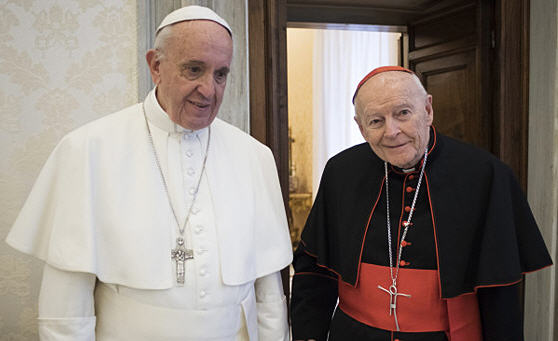
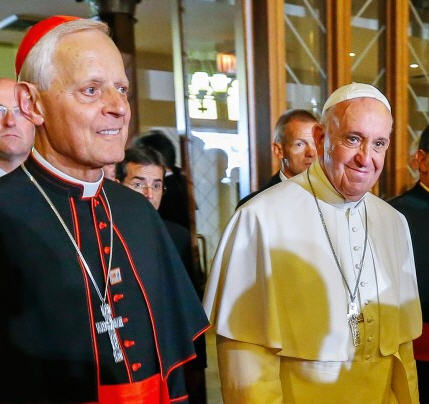
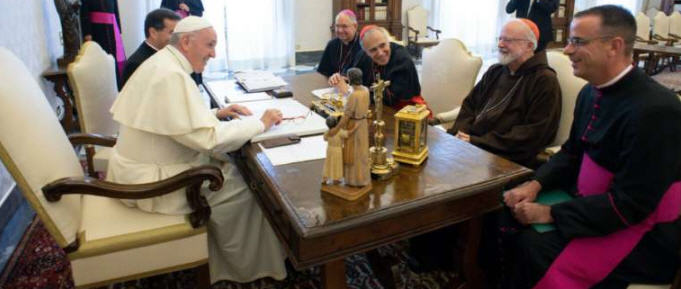
Pope Francis and (formerly CardinalArchbishop) Mr. McCarrick |
See also: Pro Publica Database
OFFICIAL STATEMENTS of the MAGISTERIUM:
Vatican Press Office summarized the Accusations against former-Cardinal McCarrick and announced an investigation to be completed “in due course”. (October 6, 2018)
THERE is something I have understood with great clarity: this drama of abuse, especially when it is widespread and gives great scandal – think of Chile, here in Ireland or in the United States – has behind it a Church that is elitist and clericalist, an inability to be near to the people of God. Elitism, clericalism fosters every form of abuse. And sexual abuse is not the first. The first abuse is of power and conscience.
Pope Francis to the Jesuits of Ireland, August 25, 2018
https://laciviltacattolica.com/it-is-not-enough-to-turn-the-page-life-must-be-given-anew/
|
|
|
|
|
|
|
|
|
|
1.
Msgr.
MAURO
INZOLI |
|
|
|
|
|
|
|
|
|
|
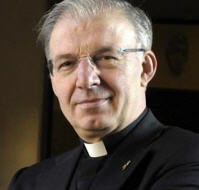
IN 2012 Msgr. Mauro Inzoli of the Diocese of Crema, Italy, was found guilty by an ecclesiastical court of having sexually abused teenagers, and was deprived of his his priestly faculties by Pope Benedict XVI. Pope Francis restored his faculties in 2014, commuting his sentence to “a life of humility and prayer”. In 2017 Inzoli was arrested, tried, and convicted in a civil court of eight offenses: a second ecclesiastical trial was held, and in June, 2017, he was laicized by Pope Francis.
|
|
|
|
|
|
|
|
|
|
2.
MARIE
COLLINS’
Resignation |
|
|
|
|
|
|
|
|
|
|
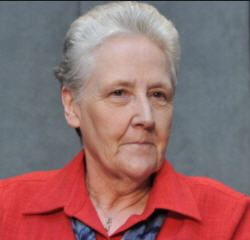
MARIE Collins, an Irish victim of child-abuse by her parish priest, was appointed in 2013 to Pope Francis’ newly-created Pontifical Council for the Protection of Minors. She resigned from the Council on March 1, 2017, explaining on her website:
[...] despite the Holy Father approving all the recommendations made to him by the Commission, there have been constant setbacks. This has been directly due to the resistance by some members of the Vatican Curia to the work of the Commission. The lack of co-operation, particularly by the dicastery most closely involved in dealing with cases of abuse, has been shameful.
Although not specifically mentioned in her statement, the controversial restoration of Fr. Inzoli’s faculties and his subsequent civil arrest have been cited by others as an example of the failures and frustrations she described. More detailed statements concerning her resignation are available.
|
|
|
|
|
|
|
|
|
|
|
|
|
|
3.
Cardinal
BARBARIN
/
Fr.
PREYNAT |
|
|
|
|
|
|
|
|
|
|
|
|
|
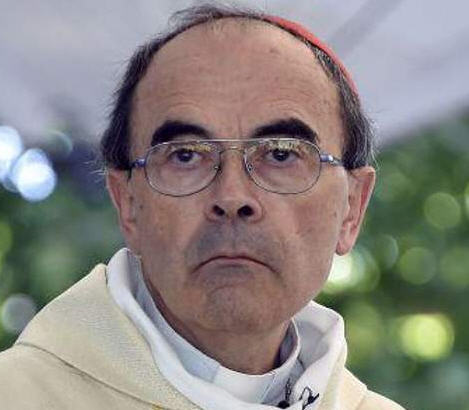
IN 2015 Fr. Bernard Preynat was deprived of his priestly faculties, having admitted to abusing children in the 1980s. His bishop, Cardinal Barbarin, faces a civil trial along with Cardinal Luis Ladaria Ferrer, the Spanish-born Prefect of the Congregation for the Doctrine of the Faith (CDF), two French bishops and a priest for failing to denounce Preynat to the police.
March 7, 2019
FRENCH tribunal president Brigitte Vernay declared Barbarin guilty on March 7 “of non-denunciation of ill-treatment” of a minor, according to AFP. Barbarin was not present in court for the verdict.
Five other archdiocesan officials on trial with Barbarin were acquitted. Barbarin was also expected to be acquitted after even the prosecutor of the case argued there was no proof of the cardinal’s legal wrongdoing and therefore no grounds for conviction, the Associated Press reports.
The cardinal will appeal the verdict
Cardinal Luis Francisco Ladaria Ferrer, prefect of the Congregation for the Doctrine of the Faith, was also ordered to testify in the case. In October [2018], the Vatican invoked diplomatic immunity in refusing to deliver a French court summons to Ladaria, saying that as a minister of Vatican City State, he is protected under international law.
|
|
|
|
|
|
|
|
|
|
4.
Bishop
BARROS
and
CHILE |
|
|
|
|
|
|
|
|
|
|
ON January 10, 2015, Pope Francis named Juan Barros bishop of Osomo, Chile. Barro was a protege of Fr Fernando Karadima, a charismatic priest who was sanctioned by the Vatican in 2011 for sexually abusing minors. Bishop Barros denied allegations by victims that he had witnessed or known of the abuse. On January 15, 2018 Pope Francis stated to a journalist, “The day they bring me proof against Bishop Barros, I’ll speak. There is not one shred of proof against him. It’s all calumny. Is that clear?” Although this statement evoked a rebuke from Cardinal O’Malley, on January 21 Pope Francis reiterated his conviction to reporters, describing the accusations against Bishop Barros as “slander.”.
Multiple victims then came forward and made their accusations public. An Investigation was undertaken that reported back on March 20, and on April 11, 2018 Pope Francis wrote a letter to the bishops of Chile expressing his “pain and shame,” asking their forgiveness, In May the Pope met with 34 Chilean bishops who offered their resignations en masse. On June 11, 2018 Pope Francis accepted Bishop Barros’ resignation.
By September 21 Pope Francis had accepted the resignations of seven of the bishops of Chile (20% of the Chilean episcopate) and appointed administrators of their dioceses.
ON October 12 the Vatican Press Office announced:“The Holy Father has removed from the clerical state Francisco José Cox Huneeus, archbishop emeritus of La Serena, Chile, member of the Institute of Schoenstatt Fathers, and Marco Antonio Órdenes Fernández, bishop emeritus of Iquique, Chile.” This laicization of two bishops without right of appeal has been described as “unprecedented.”
|
|
|
|
|
|
|
|
|
|
5.
Archbishop (former-Cardinal)
|
|
|
|
|
|
|
|
|
|
|
ON June 20, 2018, the Archdiocese of New York announced it had found to be credible an allegation that then-cardinal McCarrick, retired Archbishop of Washington D.C., had sexually abused a teenage boy in the 1970s. The Archdiocese of Newark and the Diocese of Metuchen also acknowledged on June 20 that they had reached legal settlements with alleged victims of McCarrick in 2005 and 2007. Attempts had been made by Richard Sipe in 2008 and 2016 and by Fr. Boniface Ramsey in 2015 to warn church authorities of McCarrick's ongoing abuse of seminarians and young priests, but these warnings had no effect on the then-cardinal's ecclesiastical career. An NCR article in 2014 described the Cardinal's new prominence in the service of Pope Francis
Archbishop McCarrick was Archbishop of Washington from 2000 to 2006. Bishop Bransfield worked at the National Shrine of the Immaculate Conception in Washington D.C. from 1980 and was rector of the shrine from 1990 to 2004, when he was made bishop.
ON August 20, 2018, the Vatican Press Office summarized the accusations against former-Cardinal McCarrick and announced an investigation to be completed "in due course".
ON January 11, 2019 the Congregation for the Doctrine of the Faith announced that ex-Cardinal McCarrick had been dismissed from the clerical state.
|
|
|
|
|
|
|
|
|
|
|
6.
USCCB
STATEMENTS Cardinal DiNardo |
|
|
|
|
|
|
|
|
|
THE United States Conference of Catholic Bishops responded to the evolving abuse crisis in a series of statements, the first four written by USCCB President, Cardinal diNardo, Archbishop of Galveston- Houston, beginning August 1, 2018:
[6.] U.S. Conference of Catholic Bishops’ Administrative Committee Statement on Sex Abuse Scandals; Committee Releases Actions to be Taken Within Its Authority (September 19, 2018)
[7.] President of U.S. Bishops’ Conference Welcomes Steps Holy See is Taking to Ensure Faithful are Protected from the Evil of Sexual Abuse (September 19, 2018)
[8.] U.S. Justice Department Demands that documents be preserved (October 9, 2018)
[9]
“At the
insistence of the Holy See we will not be voting on the two action items in
our documentation regarding the abuse crisis:, that is, the standards for
the accountability of bishops and the special commission for receiving
complaints against bishops. The Holy See has asked that we delay
voting on these so that our deliberations can inform and be informed by the
global meeting of the conference presidents that the Holy Father has called
for February, 2019.”
(Opening
Address, Cardinal DiNardo)
Bishop Cupich then suggested: Instead of taking a
binding vote as an action item, we
[should]
take a
resolution ballot
(and meet in
March rather than June)
(November 12, 2018)
Commentators have noted:
[1] Referring all “credible ”accusation to the Nuncio may not be either workable or canonical
[2] The French (Nov. 3-7) and Italian (Nov. 12-14) National Conferences of Bishops are discussing the abuse crisis at this moment and have not been similarly silenced. [N.B.: but they are not principally focused, as is the U.S., on bishop-accountability]
[3] In his address, the Nuncio, Archbishop Christophe Pierre (who had an audience with the pope 24 hours before the beginning of the meeting) hinted at opposition to involving laity in the process of assessing accusations: “We [bishops] must show that we can solve problems rather than simply delegating them to others.”
George Weigel offered the following comment/explanation:
I recently spent almost five weeks in Rome, during which I found an anti-American atmosphere worse than anything I’d experienced in 30 years of work in and around the Vatican. A false picture of the Church’s life in the United States, in which wealthy Catholics in league with extreme right-wing bishops have hijacked the Church and are leading an embittered resistance to the present pontificate, has been successfully sold. And in another offense against collegiality, this grossly distorted depiction of American Catholicism has not been effectively challenged or corrected by American bishops enjoying Roman favor these days.
Honest disagreements — about, say, Amoris Laetitia and its implications for doctrine and pastoral practice — are one thing. A systematic distortion of reality, which tramples on the presumption of an opponent’s good will that should guide any internal Catholic debate, is quite another. Those involved in this anti-American-bishops calumny might also reflect on its disturbing genealogy. For one of those who injected this toxin into the Roman bloodstream was a serial sexual predator specializing in the abuse of seminarians under his authority — Theodore McCarrick, former archbishop of Washington.
VATICAN AUTOCRACY AND THE U.S. BISHOPS by George Weigel. First Things,Nov.21, 2018. https://www.firstthings.com/web-exclusives/2018/11/vatican-autocracy-and-the-us-bishops
|
|
|
|
|
|
|
|
|
|
7.
PENNSYLVANIA
GRAND
JURY |
|
|
|
|
|
|
|
|
|
|
On August 14, 2018 a “Redacted Interim Report” from the Pennsylvania Grand jury documented sexual abuse of more than 1000 victims by 301 Catholic priests over a 70-year period, (=approx. 8% of 5000 priests who served during this period) in six of the state’s eight Catholic dioceses.
74 percent of the predator priests mentioned in the Grand Jury Report abused male victims, and 23 percent abused female victims. Of the male victims, 11 percent involved a pre-pubescent child (pedophilia) 60 percent involved a teenage boy; and 2 percent involved an adult. In total, 189 priests abused male victims and 58 priests abused female victims.
|
|
|
|
|
|
|
|
|
|
|
Cardinal O'Malley |
|
|
|
|
|
|
|
|
|
ON August 10, 2018 on his personal blog Cardinal Seán O’Malley placed a statement he had released concerning St. John's Seminary in Boston. It included the following:
Earlier this week I was informed that two former seminarians of St. John’s Seminary in the Archdiocese of Boston had posted allegations on social media sites including the Archdiocese’s Facebook page that during their time at the seminary they witnessed and experienced activities which are directly contrary to the moral standards and requirements of formation for the Catholic priesthood.
The statement also explained that the rector of the seminary has been placed on sabbatical leave and the cardinal has named a Board of Inquiry to investigate the allegations.
2019
(Sept. 21)
CARA
SURVEY
SEXUAL
HARASSMENT
of SEMINARIANS
A study released by CARA reports that six percent of U.S. seminarians have experienced some form of sexual harassment, abuse or misconduct; another four percent said they might have experienced misconduct but were not sure; while 89% report none.
Of those surveyed, 84% of seminarians believe their administration and faculty take reports of such misconduct very seriously, according to the announcement accompanying the report.
Respondents were enrolled at 72 seminaries and houses of formation across the U.S. The study included responses from about two-thirds of the 2,375 seminarians invited to participate.
Sixty-eight percent of respondents are studying to serve as diocesan priests and 28% studying to serve as religious priests or brothers, according to the study. Just two percent of those surveyed live off-site.
Of those who said they have or may have experienced sexual harassment, 80% pointed to a fellow seminary student or religious in formation as the alleged perpetrator.
Three in four seminarians reported that sexual harassment, abuse, or misconduct are “not at all a problem” at their current seminary or house of formation. Nearly nine in ten said there is none or little talk or rumors of sexual promiscuity at their seminary.
Fifty-nine percent said they are “very aware” of the policies and procedures of their seminary or house of formation concerning sexual harassment, abuse, and misconduct, with 29% saying they are “somewhat aware.”
|
|
|
|
|
|
|
|
|
|
9.
ARCHBISHOP
VIGANÒ |
|
|
|
|
|
|
|
|
|
|
ON Sunday, August 26, 2018, Archbishop Viganò, former Papal Nuncio to the United States, released an eleven-page Testimony, constituting his response to the evolving sexual-abuse crisis, including especially the controversy surrounding Archbishop (former-cardinal) McCarrick.
POPE Francis responded to Archbishop Viganò’s Testimony during the press conference aboard the papal plane from Dublin to Rome on August 26:
“I read the statement this morning, and I must tell you sincerely that, I must say this, to you and all those who are interested: Read the statement carefully and make your own judgment,” he answered. “I will not say a single word on this.”
On August 30 Viganò released a second document entitled, Pope Francis met privately with Kim Davis: here is what really happened.
In his daily homily on
“With people who do not have good will, with people who seek only scandal, who seek only division, who seek only destruction, even within families,” the answer is “silence. And prayer.”
ON Sept. 10 a statement from the C9 Council of Cardinals declared that “the Holy See is about to formulate any necessary clarifications” with regard to Archbishop Vigano's Testimony.
ON September 29 Archbishop Viganò released what amounted to a second Testimony (Scio Cui credidi), reiterating his concerns and pleading with Cardinal Ouellet, Prefect of the Congregations for Bishops, to confirm that they had discussed ex-Cardinal McCarrick's restrictions (sanctions)
ON October 3 Cardinal Ouellet publically rebuked Archbishop Viganò in a sharply critical press release published online by the Vatican Press Office He admitted, however, that:
1. He had, in fact, communicated to Vigano that McCarrick was under “conditions and restrictions”; and
2. Suspicions concerning McCarrick that had been reported to the Vatican should have been further examined; however, McCarrick had skillfully defended himself
ON October 7, the Vatican Press Office summarized some of the accusations against former-Cardinal McCarrick and announced that an investigation will be completed “in due course”.
ON October 14, Archbishop Viganò issued a third Statement.
|
|
|
|
|
|
|
|
|
|
|
10.
CARDINAL
WUERL
|
|
|
|
|
|
|
|
|
|
CARDINAL Wuerl has been criticized for having assigned Fr. Edward Kryston and Fr. Paul Spisak to ministries that allowed them access to victims, despite recommendations from the St. Luke’s Center where they had been sent for evaluation and treatment. The cardinal's name appears repeatedly in the Pennsylvania Grand Jury Report of August, 2018. The cardinal issued a Letter to the Priests of the Archdiocese of Washington D.C. (Aug. 30) that includes the following statements:
I ask you, as I did at the Cathedral, for prayers for me, for forgiveness for my errors in judgment, for my inadequacies, and also for your acceptance of my contrition for any suffering I have caused, as well as the grace to find, with you, ways of healing, ways of offering fruitful guidance in this darkness.
[...] I wish I could wipe it away even though that is simply not possible. I would give anything, as would all of us, to turn the clock around and have the Church do everything right. But I do join them in sorrow for all that has happened. I plead for their prayerful support as I with you and them try to do whatever I can to help move this Church closer to the pathway that leads us from this darkness.
[...] I hope to offer some thoughts on how we as a Church – all of us laity, religious and clergy – might begin with faith strengthened in prayer to discern that level of reform rooted in accountability and transparency that would permit the Church to enter a new era.
https://www.cnn.com/2018/09/04/us/wuerl-pope-meeting/index.html
Pope Francis met with embattled Cardinal Donald Wuerl of Washington last Thursday (August 30) in Vatican City, where they discussed the cardinal's personal situation, according to a source familiar with Wuerl's presentation to local priests in Washington on Monday.
Wuerl, who is archbishop of Washington, told the priests about the papal meeting, including Francis' advice that the cardinal should consult with his priests as Wuerl discerns his future. That was part of a larger conversation between the Pope and Wuerl, the source said.
ON September 6 Cardinal Wuerl released a second Letter to Priests that included the following statements:
Among the many observations was that the archdiocese would be well served by new leadership to help move beyond the current confusion, disappointment and disunity.
I also heard voices calling for the beginning of healing. This I believe we need to do now.
In recognition of the ongoing need for healing, and after consultation with a number of laywomen, laymen and some priests, I am proposing a “Season of Healing” that would begin Friday, September 14, the Feast of the Exaltation of the Holy Cross, as a first step in the notary healing process for our Church.
Ed McFadden, a spokesman for the Archdiocese of Washington, announced on Wednesday, September 12, that Cardinal Wuerl will travel to Rome in the near future to ask Pope Francis to accept his resignation.
ON October 12 Pope Francis sent a letter accepting Cardinal Wuerl's resignation, asking him to remain as apostolic administrator of the diocese until a new ordinary is named:
“You have sufficient elements to ‘justify’ your actions and distinguish between what it means to cover up crimes or not to deal with problems, and to commit some mistakes. However, your nobility has led you not to choose this way of defence. Of this, I am proud and thank you.”.
|
|
|
|
|
|
|
|
|
|
|
11.
GERMANY:
ABUSE
REPORT
Cardinal Reinhart Marx |
|
|
|
|
|
|
|
|
|
A NEW report from Germany's Catholic Church admits to “at least” 3,766 cases of child sex abuse by the clergy between 1946 and 2014, according to local publications Die Zeit and Spiegel Online who have seen a leaked copy.
The report -- commissioned by the German Bishops' Conference and conducted by the Universities of Giessen, Heidelberg and Mannheim -- has taken four years to assemble and will be released in full on September 25.
According to both media outlets, the study says the victims were mostly boys, more than half of whom were aged 13 or younger. Every sixth case involved a rape and at least 1,670 clergy were involved, the report also reveals.
38,156 personnel records and reference files from the 27 dioceses dating from 1946 to 2014 were reviewed as part of the research project (SP6).
PERPETRATORS
Allegations against 1,670 clerics
4.4 percent of all clerics from 1946 to 2014
diocesan priests 5.1 percent (1,429 accused persons).
religious 2.1 percent (159 accused persons)
VICTIMS
Single-victim –54 % Multiple Victim 42.3 % One perpetrator had 44 victims
62.8 % male; 34.9 % female
AGES of victims <13 years: 51.6 percent ;>13 (14 or older) 25.8 percent
The findings from sub-project 3 and sub-project 6 do not lead to any conclusive indication that the sexual abuse of minors by clerics of the Catholic Church is a topic that has been resolved in the past and can now be considered to have been overcome. It can be assumed that the abuse continued throughout the entire period under investigation, namely from 1946 to 2014.
|
|
THE
GERMAN
SYNODAL
PROCESS
|
ON March 14, 2019, Cardinal Marx announced the intention of the German national episcopal conference to undertake a “binding synodal process” lasting two years, that will include participation by the “Central Committee of German Catholics,” a lay organization that closely cooperates with the bishops' conference and which has emphasized the necessity of addressing three key issues arising from the clerical abuse crisis: priestly celibacy, the Church's teaching on sexual morality, and a reduction of clerical power. Officials in Rome reacted by pointed out that these matters could not be legislated at the local (national) level, but only by the universal magisterium (i.e. Rome). Pope Francis responded on June 25, 2019 with a Letter to the Pilgrim People of Germany, inviting the synod-planners to redirect their focus to the importance of evangelization.
|
|
|
|
|
|
|
|
|
|
|
|
|
|
Cardinal DiNardo Cardinal O'Malley |
|
|
|
|
|
|
|
|
|
|
|
|
|
|
|
|
|
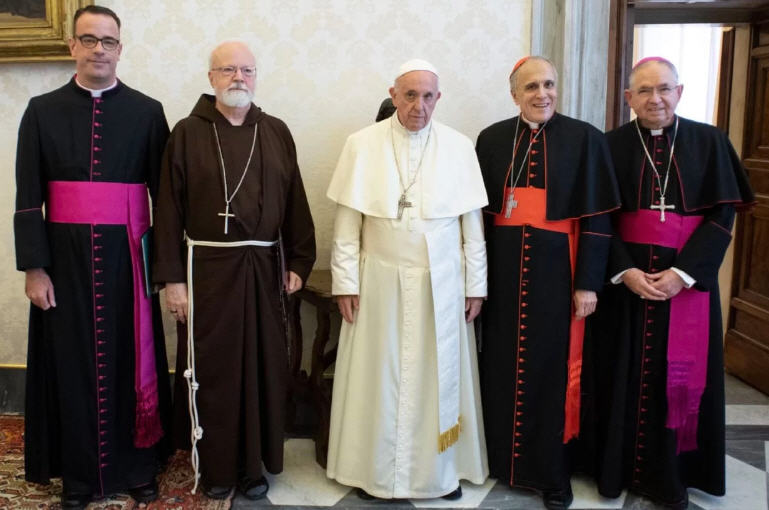
VATICAN CITY—Following a private audience with Pope Francis this morning in Vatican City, Cardinal Daniel DiNardo of Galveston-Houston and President of the United States Conference of Catholic Bishops has issued the following statement regarding the recent moral crisis in the American Catholic Church.
“WE are grateful to the Holy Father for receiving us in audience. We shared with Pope Francis our situation in the United States – how the Body of Christ is lacerated by the evil of sexual abuse. He listened very deeply from the heart. It was a lengthy, fruitful, and good exchange.
As we departed the audience, we prayed the Angelus together for God's mercy and strength as we work to heal the wounds. We look forward to actively continuing our discernment together identifying the most effective next steps.”
|
|
|
|
|
|
|
|
|
|
|
|
|
|
Bishop Holley |
|
|
|
|
|
|
|
|
|
|
|
|
|
Thursday, September 13
BALTIMORE, MD, September 13—Following his acceptance of the letter of resignation of Bishop Michael Bransfield, the Holy Father, Pope Francis, appointed Archbishop William E. Lori Apostolic Administrator of the Diocese of Wheeling-Charleston, while remaining Archbishop of Baltimore. The Holy Father further instructed Archbishop Lori to conduct an investigation into allegations of sexual harassment of adults against Bishop Bransfield.
The Diocese of Wheeling-Charleston is a suffragan diocese in the Metropolitan See of Baltimore.
“My primary concern is for the care and support of the priests and people of the Diocese of Wheeling-Charleston at this difficult time,” Archbishop Lori said. “I further pledge to conduct a thorough investigation in search of the truth into the troubling allegations against Bishop Bransfield and to work closely with the clergy, religious and lay leaders of the diocese until the appointment of a new bishop.”
Archbishop Lori, who was instructed by the Holy See to announce the forthcoming investigation, will meet with clergy and lay leaders of the Diocese today and Friday. Archbishop Lori will celebrate Mass in Wheeling on Saturday, September 15 at 6:00 p.m. at the Cathedral of St. Joseph.
A hotline has been established for those wishing to share any information related to this investigation. The hotline number is 1-833-272-4225.
BISHOP Bransfield worked at the National Shrine of the Immaculate Conception in Washington D.C. from 1980 and was rector of the shrine from 1990 to 2004, when he was made bishop. Archbishop McCarrick was Archbishop of Washington from 2000 to 2006 and was a co-consecrator at the ordination of Bishop Bransfield.
On July 19, 2019, The Holy See, via the U.S. nunciature issued the following statement of restrictions:
“BASED on the findings of the investigation, the Holy Father has decided the following disciplinary measures for Bishop Emeritus Bransfield:
1. the prohibition to reside in the Diocese of Wheeling-Charleston.
2. the prohibition to preside or to participate anywhere in any public celebration of the Liturgy.
3. the obligation to make personal amends for some of the harm he caused; the nature and extent of the amends to be decided in consultation with the future Bishop of Wheeling-Charleston.”
|
|
|
HOLY SEE PRESS OFFICE BULLETIN
Resignations and Appointments, 24.10.2018
http://press.vatican.va/content/salastampa/en/bollettino/pubblico/2018/10/24/181024c.html
Appointment of apostolic administrator “sede vacante et ad nutum Sanctae Sedis” of the diocese of Memphis, U.S.A.
THE Holy Father
Francis has removed from the pastoral care of the diocese of Memphis, United
States of America, H.E. Msgr. Martin D. Holley, and has appointed as
apostolic administrator “sede vacante et ad nutum Sanctae Sedis” of the same
diocese H.E. Msgr. Joseph E. Kurtz, archbishop of Louisville.
FROM
the CATHOLIC
NEWS
AGENCY
https://www.catholicnewsagency.com/news/holley-says-revenge-not--mismanagement-led-to-his-removal-99505
THE removal follows a Vatican investigation into the Diocese of Memphis in June to address concerns about major changes Bishop Holley, 63, had made. Among these was the reassignment of up to two-thirds of the 60 active priests in the diocese. He had been installed as bishop of Memphis Oct. 19, 2016, after serving as auxiliary bishop of Washington, D.C. for 12 years.
ACCORDING to an interview with the Catholic News Agency Bishop Holley maintained that his removal from the Diocese of Memphis is Cardinal Wuerl's “revenge” for impeding the cardinal's appointment as Vatican Secretary of State: “I stood in his way for something he wanted.”
Bishop Holley had been accused of sexual misconduct by a seminarian in 2009, but he asserts: “I am not a part of the lavender [mafia].”
|
|
|
On October 31, 2018, Cardinal Dolan of New York announced that a New York Auxiliary Bishop, John Jenik had been reliably accused of abusing a 16-year old boy in the nineteen-eighties. Bishop Jenik denies the accusation, has stepped aside from all pastoral activities, and has appealed the decision to Rome.
|
|
|
[...] Archbishop Jose H. Gomez said, “I regret to inform you that in 2005, a year after he had been ordained a bishop, the archdiocese was made aware of an allegation against Bishop Salazar of misconduct with a minor.” The allegation “was never directly reported to the archdiocese,” he said, but “it was investigated by law enforcement in 2002 and the district attorney did not prosecute.”
Salazar has consistently denied the allegation.
“Since he was a bishop at the time the allegation was received, the archdiocese referred the matter to the Congregation for the Doctrine of the Faith at the Holy See, which conducted an investigation and imposed certain precautionary measures on the ministry of Bishop Salazar,” Gomez said. Without providing details, a separate statement from the archdiocese said the doctrinal congregation “investigated and permitted Bishop Salazar to remain in ministry subject to certain precautionary conditions, which he has respected.”
[…] The archdiocese specified that Archbishop Gomez requested and received permission from the Vatican Congregation for Bishops to have the oversight board include a review of the past allegation against Salazar.
The board, it said, “found the allegation to be credible and recommended to Archbishop Gomez that Bishop Salazar should not have faculties to minister. Archbishop Gomez accepted the recommendation and submitted it to the Holy See.”
|
|
|
... As part of recently announced protocols governing the conduct of bishops in the Archdiocese, Archbishop Lori determined that […] restrictions were warranted in the case of former Auxiliary Bishop of Baltimore, Gordon Bennett, S.J., who served within the Archdiocese of Baltimore from 1998 until 2004, when he was appointed Bishop of Mandeville, Jamaica. Since that time, he has not resided in or received any assignment in the Archdiocese of Baltimore or the Diocese of Wheeling-Charleston.
In May 2006, the Archdiocese learned of an allegation of sexual harassment of a young adult by Bishop Bennett. Upon receiving the allegation, the Archdiocese immediately reported it to the Apostolic Nunciature in Washington, D.C. Bishop Bennett resigned from the Diocese of Mandeville in August 2006.
As a result of these restrictions, which the Holy See recently gave permission to the Archbishop to announce, Bishop Bennett is prohibited from exercising any priestly or episcopal ministry in the Archdiocese of Baltimore and the Diocese of Wheeling-Charleston.
In 2008, Bishop Bennett became the Peter Faber SJ Fellow in Pastoral Theology at Loyola Marymount University in Los Angeles. A spokesman for LMU told the Catholic World Report by phone that Bishop Bennett left the university in 2018, but could not immediately offer further details. Later in the day, the university issued a statement saying the “LMU has no record of allegations of misconduct against Bishop Bennett during his time at the university.”
Neither the LMU spokesman nor the statement addressed the question whether LMU knew of the allegation against Bishop Bennett.
The Jesuits West province — encompassing the US states of Alaska, Arizona, California, Hawaii, Idaho, Montana, Nevada, Oregon, Utah, and Washington — issued a statement saying Bishop Bennett had been cleared of the allegation. “In 2009, after being cleared of this allegation [?], the Congregation [for Bishops] reinstated Bishop Bennett to limited episcopal ministry subject to oversight [?!?].”
The statement goes on to say, “For nearly a decade following, he
served both the Archdiocese of Los Angeles and the Jesuits, leading retreats and
conducting formation programs for lay men and women.”
“In August of 2018,” the statement goes on to say, “as the Catholic Church
grappled with ongoing painful questions about how allegations of misconduct had
been handled in the past, Bishop Bennett’s case was reexamined to ensure it met
the standards adopted in recent years to deal with allegations of misconduct.”
“Recently, after concluding its review,” the statement continues,
“the Congregation determined that Bishop Bennett should not continue to exercise
episcopal ministry.” With regard to priestly ministry, the statement says
Congregation for Bishops has left the decision in the hands of Bennett’s Jesuit
superiors.
“Bishop Bennett is not presently engaged in public ministry,” the statement
adds, “nor has he been since late August of 2018.” Bennett is undergoing
treatment for cancer. “His current priority is caring for his health,” the
Jesuits’ statement says.
|
|
|
|
|
|
|
|
|
|
|
|
|
|
|
|
|
|
|
|
|
Communiqué of the Council of Cardinals, 12.09.2018
THE Holy Father Francis, after hearing the Council of Cardinals, has decided to convene a meeting with the presidents of the Episcopal Conferences of the Catholic Church on the theme of the “protection of minors”.
The meeting with the Pope will be held in the Vatican from 21 to 24 February 2019.
During the 26th meeting, which took place from 10 to 12 of this month, the Council reflected extensively together with the Holy Father on the theme of abuse, issuing the Communiqué published by the Holy See Press Office on 10 September.***
As it proceeds in the work of the reform of the Roman Curia, the Council has concluded its rereading of the texts already prepared; the pastoral care of the staff who work there has also been a cause of attention.
Vatican City, 12 September 2018
***
Declaration of the Council of Cardinals, 10.09.2018
http://press.vatican.va/content/salastampa/en/bollettino/pubblico/2018/09/10/180910c.html
The Council of Cardinals, in the first meeting of its twenty-sixth session, it which it prepares to submit to the Holy Father its proposal on the reform of the Roman Curia drawn up in its first five years of activity, and in view of its continuation, has decided to ask the Pope to reflect on the work, structure and composition of the Council itself, also taking into account the advanced age of some of the members.
The Council expressed its satisfaction for the good outcome of the Ninth World Meeting of Families in Dublin, congratulating Cardinal Kevin J. Farrell and the Dicastery for the Laity, Family and Life, which along with Archbishop Diarmuid Martin, organized the event.
It expressed its full solidarity with Pope Francis with regard to the events of recent weeks, aware that in the current debate the Holy See is about to make the eventual and necessary clarifications.
Vatican City, 10 September 2018
IT was subsequently reported that the theme of the meeting had been amended to: “prevention of abuse of minors and vulnerable adults.”
|
|
|
|
|
|
|
|
|
|
|
St.Benedict, Monte Olivetti |
|
|
|
|
|
|
|
|
|
IN 2018 The English Independent Inquiry on Child Sexual Abuse published a 222 page report on Ampleforth and Downside, two Benedictine abbeys with schools. The report was based in part on transcripts of interviews conducted in December, 2017. A further investigation concerning Ealing Abbey and school will begin in early 2019. (The former abbot of Ealing was convicted of child abuse, fled England, and was arrested and imprisoned after hiding incognito for several years.)
IT was widely reported in September, 2018, that Fr. Bernard Green, OSB, a monk of Ampleforth, had been employed as a tutor at St. Benet's Hall, an Oxford permanent private hall in Oxford founded and run by Ampleforth Abbey. Fr. Bernard had previously been convicted of abusing a child while serving as a housemaster at Ampleforth.
ON October 14 The Tablet reported that the abbot of Ampleforth, Cuthbert Madden, intends to sue Abbot Christopher Jamison, Abbot President of the English Benedictine Congregation, demanding £10,000 (“to be given to charity”) as well as re-instatement as abbot of Ampleforth. On October 17 the Tablet reported that the Congregation for Religious will conduct an Extraordinary Visitation into this question and make a recommendation regarding Abbot Cuthbert's re-instatement.
|
|
|
|
|
|
|
|
|
|
|
Xavier Becerra, Attorney General of California |
|
|
|
|
|
|
|
|
|
SEE ALSO: BISHOP SALAZAR; BISHOP GORDON BENNETT, S.J.
ON November 8 the Los Angeles Times reported that the California State Attorney General had tweeted:
If you believe you’ve been
a victim of or have information regarding incidents of sexual abuse by
clergy members in California, please report it at:
https://oag.ca.gov/clergyabuse
The CA DOJ is
gathering information from the public regarding complaints of this nature in
California.
THE State of California has created a webpage specifically devoted to clergy abuse, containing the following text:
CLERGY
ABUSE
In light of the news
surrounding the sexual abuse of children by members of clergy or religious
organizations across the country, the Department of Justice is gathering
information from the public regarding complaints of this nature in
California.
If you believe you have been a victim of sexual abuse or have
information regarding incidents of sexual misconduct by clergy members,
please fill out our online complaint form. If you would like to provide
other information, please email
ClergyAbuse@doj.ca.gov.
|
|
|
|
|
|
|
|
|
|
|
|
|
|
|
|
|
|
|
|
|
ON the flight back from the Emirates Pope Francis responded to a question, becoming the first pope to publicly acknowledge the scandal of nuns abused by priests and bishops [Full Text: Question; Answer]
Nicole Winfield, AP: “Holy Father, last week ‘L'Osservatore Romano’s women’s magazine published an article that reported the sexual abuse of consecrated women in the Church — adult women, sisters — by the clergy. Some months ago the International Union of Major Superiors also made a public complaint about this problem. We know that the meeting at the Vatican in a few weeks will address the abuse of minors but can we expect the Holy See to do something to face this problem too, perhaps a document or some guidelines? Thank you.”
Pope Francis:
“It is true, within the Church there have also been clerics who have done this; in some cultures it is somewhat more prevalent than in others; it is not something everyone does, but there have been priests and even bishops who have done it. And I believe it may still be happening, because it doesn’t cease just by becoming aware of it. It continues this way. We have been working on this for some time. We have suspended a few clerics, dismissed them, for this. And also — I don’t know if the trial is over — we had to dissolve some female religious congregations that were highly linked to this, a form of corruption. I cannot say: “In my house there is no such thing...”. True. Should something more be done? Yes. Do we have the will to do it? Yes, we do. But it is a journey that goes further back [in time].
“Pope Benedict had the courage to dissolve a congregation of a certain standing, because there had been a form of manipulation of women, even sexual manipulation by the clerics or the founder.
[as explained by the interim director of the Press Office, the Holy Father, in using the term ‘slavery’, meant ‘manipulation’, a form of abuse of power that is also reflected in sexual abuse]
“Sometimes the founder takes away freedom, deprives the sisters of freedom, and it can come to this. With regard to Pope Benedict, I would like to stress that he is a man who had the courage to do very many things about this. There is an anecdote: he had all the papers, all the documents, about a religious organization that had internal sexual and financial corruption.
[The (French) Community of of St. John & founder, Fr. Marie-Dominique Philippe]
“[As a Cardinal] he went, and there were filters, and he could not get there. In the end the Pope [Saint John Paul II], wanting to understand the truth, had a meeting, and Joseph Ratzinger went there with the file and all the papers. And when he [Ratzinger] returned he said to his secretary: “Put it in the archive, the other party won”. We must not be scandalized by this, they are steps in a process. But then, when he became Pope, the first thing he said was: “Bring those papers from the archive”, and he began...
“The folklore about Pope Benedict portrays him as so good, yes, because he is good, kind — a piece of bread does more harm than he does. He is good! But it [this folklore] also portrays him as weak, and instead he is anything but weak! He was a strong man, a man consistent in things. He started... And there, in that congregation, there was this problem that you mention. Pray that we can move forward. I want to go forward... There are cases, in some congregations, new ones in particular, and in some regions more than others. Yes, this the issue. We are working [on it].”
THE (Nov. 2018) statement from the UISG to which Nicole Winfield alluded condemned "abuse of all kinds” and hinted at the problem of abuse of nuns by clerics:
“We ask that any woman religious who has suffered abuse, report the abuse to the leader of her congregation, and to church and civic authorities as appropriate.”
THE article to which Nicole Winfield alluded in her question was more forthright and had appeared in the Women's companion to Osservatore Romano, Donne Chiese Mondo, Mensille dell' Osservatore Romano, no. 76, (Feb, 2019, Vatican City).
Without any touching -A serious wound
(Engl.Transl.)
by Lucetta Scaraffia. Feb 1, 2019.
... BUT the situation of women remains quite ambiguous. Within in the ecclesiastical institution in particular centuries of culture focused on the idea of a woman as a dangerous temptress lead people to classify these acts of violence, even if they have been reported, as sexual transgressions freely committed by both parties. [...] The difference in power and the difficulty of denouncing such acts because of fear – with good reason – of retaliation aimed not only at the religious herself but also at the order to which she belongs explain the silence which has shrouded this bullying arrogance for years.
Recent history also reveals this: towards the end of the 1990s two religious, Sr Maura O’Donohue and Sr Marie McDonald, had the courage to present precise and substantiated reports, in-depth investigations and analyses of the situations most exposed to this type of bullying arrogance. Their denunciations were met with silence and it is well known that silence de facto contributes to giving security to rapists, who become ever surer of their own impunity.
During the past year many newspapers have lifted the veil from this tragedy and many women religious, in the Third World but also in the developed countries, have begun to speak out and make denunciations; they know they have the right to be respected, and know that the condition of women, in the Church too, must change. And they know that to bring about this transformation it is not enough to appoint a few women to serve on commissions. If eyes continue to be closed to this scandal – rendered even more serious by the fact that the abuse of women entails procreation and is thus at the root of the scandal of imposed abortions and of the children not recognized by priests – the condition of oppression of women in the Church will never change.
The perspective in which Pope Francis has framed the problem of abuse is therefore the right one. It intersects with another of his requests to the Church: that the role which belongs to women should be recognized.
ARTICLES documenting abuse of this kind had appeared in the summer of 2018, based chiefly on much earlier (evidently unheeded) reports from the mid-to-late 1990s, published by National Catholic Reporter in 2001. Chief among these are:
Two Confidential Reports by Sr. Maura O’Donohue, MMM:
1994 Urgent Concerns for the Church in the Context of HIV/AIDS
1995 Memo of a Meeting at the Sacred Congregation for Religious (SCR)
A Confidential Paper/Report by Marie McDonald, MSOLA:
1998 The Problem of The Sexual Abuse of African Religious in Africa and in Rome
FOLLOWING Pope Francis’ acknowledgement of this issue, the (U.S.) Leadership Conference of Women Religious (LCWR) issued a statement on February 7 that concluded:
“We hope that Pope Francis’ acknowledgement is a motivating force for all of us in the Catholic Church to rectify the issue of sexual abuse by clergy thoroughly and swiftly. The upcoming summit of bishops on sexual abuse provides the opportunity for decisive action. Among the actions we recommend are:
1. The creation of mechanisms for the reporting of abuse in an atmosphere where victims are met with compassion and are offered safety.
2. Refashion the leadership structures of the church to address the issue of clericalism and ensure that power and authority are shared with members of the laity. The revelations of the extent of abuse indicate clearly that the current structures must change if the church is to regain its moral credibility and have a viable future.”
Among the significant norms of this Motu Proprio are the following statements:
|
Art. 1 – Scope of application |
Art. 1 - Ambito di applicazione |
|
§1. These norms apply to reports regarding clerics or members of Institutes of Consecrated Life or Societies of Apostolic Life and concerning: |
§1. Le presenti norme si applicano in caso di segnalazioni relative a chierici o a membri di Istituti di vita consacrata o di Società di vita apostolica e concernenti: |
|
a) delicts against the sixth commandment of the Decalogue consisting of: |
a) delitti contro il sesto comandamento del Decalogo consistenti: |
|
i. forcing someone, by violence or threat or through abuse of authority, to perform or submit to sexual acts; |
i. nel costringere qualcuno, con violenza o minaccia o mediante abuso di autorità, a compiere o subire atti sessuali; |
|
ii. performing sexual acts with a minor or a vulnerable person; |
ii. nel compiere atti sessuali con un minore o con una persona vulnerabile; |
|
iii. the production, exhibition, possession or distribution, including by electronic means, of child pornography, as well as by the recruitment of or inducement of a minor or a vulnerable person to participate in pornographic exhibitions; |
iii. nella produzione, nell’esibizione, nella detenzione o nella distribuzione, anche per via telematica, di materiale pedopornografico, nonché nel reclutamento o nell’induzione di un minore o di una persona vulnerabile a partecipare ad esibizioni pornografiche; |
|
b) conduct carried out by the subjects referred to in article 6, consisting of actions or omissions intended to interfere with or avoid civil investigations or canonical investigations, whether administrative or penal, against a cleric or a religious regarding the delicts referred to in letter a) of this paragraph. |
b) condotte poste in essere dai soggetti di cui all’articolo 6, consistenti in azioni od omissioni dirette a interferire o ad eludere le indagini civili o le indagini canoniche, amministrative o penali, nei confronti di un chierico o di un religioso in merito ai delitti di cui alla lettera a) del presente paragrafo. |
|
|
|
IN 2019 Pope Emeritus Benedict 16 wrote a long essay on the subject of sexual abuse. He identified contributing factors in the general mores of society, the spiritual and theological formation of Catholics in general and of priests in particular, as well as problematic (and possibly contributory) shifts in the fields of Catholic moral theology and canon law.
|
|
|
|
|
|
|
|
|
|
|
|
|
|
|
|
|
|
|
|
|
CLAIMS that the sexual abuse of children by priests is a thing of the past, or that it is the result of liberal priestly formation in the nineteen-sixties or -seventies, are difficult to maintain in light of the arrest in August, 2020, of Fr. Michael Zacharias, a priest of the Diocese of Toledo, Ohio. The evidence against Fr. Zecharias is alleged to include text messages and videos he made of his victims.
This Webpage was created for a workshop held at Saint Andrew's Abbey, Valyermo, California in 2018
DUKE HELFAND
12 AM PT
Ziemann died Thursday of pancreatic cancer at a monastery in Arizona, said his brother, Joe.
The bishop gave up his post at the Diocese of Santa Rosa after a priest filed a lawsuit alleging that Ziemann had coerced him into a two-year sexual relationship in exchange for keeping silent about the priest’s admitted theft of money from a Ukiah parish.
Ziemann publicly acknowledged his affair with Father Jorge Hume Salas after the lawsuit was filed but said the relationship was consensual.
The Santa Rosa Police Department and the Sonoma County district attorney’s office investigated Salas’ allegations of sexual coercion, bolstered by a secret tape-recording of Ziemann apologizing to the priest.
Authorities declined to file criminal charges, however, questioning Salas’ credibility. Their investigation showed that Salas had been expelled from several seminaries and posed as a priest before he was ordained.
The Santa Rosa diocese agreed to a $535,000 settlement with Salas, who has since left the priesthood and returned to his native Costa Rica.
Church leaders, meanwhile, found Ziemann had squandered $16 million in diocese money -- the result of poor oversight, bad investments and overspending, diocese officials said.
The shortfall forced the diocese to lay off about a third of its staff and cut funding for religious education, youth ministry and other programs, angering many local Catholics who had contributed money, the officials said.
Diocese leaders said Ziemann did not personally benefit from his financial decisions.
Ziemann later apologized for the turmoil. In a letter read on his behalf at services throughout the diocese after his resignation, he wrote: “I acknowledge with deep regret my responsibility for the current state of affairs, about which you are justly angry. I cannot express to you enough the deep remorse and repentance I feel for letting you down.”
Ziemann’s legacy continues to reverberate across the diocese of 150,000, the diocese’s spokeswoman said.
“It undermined . . . trust in the church,” said Deirdre Frontczak, the spokeswoman and professor of business communications at Santa Clara University. “Many people stopped going to church [and] still have never come back.”
Still, Frontczak and others said they hoped Ziemann would also be remembered as an inspiring, if flawed, leader. To many, he was simply “Bishop Pat,” known for his charisma, spirituality and an ability to motivate young people.
One close friend said the experiences that ended Ziemann’s seven-year tenure in Santa Rosa changed him. “He is the first one to say, ‘I violated my vows,’ ” said Joe Piasta II, the bishop’s onetime attorney who visited him in Arizona shortly before his death. “The whole crisis made him very human.”
Ziemann grew up in Pasadena, the third of eight children born into a devout family. His grandfather, Joseph Scott, was a well-known defense attorney, and his father, J. Howard Ziemann, was a Los Angeles County Superior Court judge and dean of Loyola Law School. Two of his uncles were diocesan priests in the Los Angeles area; he was named after them -- George Patrick.
Ziemann seemed destined for the priesthood at an early age, said his brother, Joe.
“I don’t think there was ever a doubt where Pat was headed,” Joe Ziemann said. “He always seemed to fit right in with the priesthood.”
Ziemann was ordained in 1967 in the Archdiocese of Los Angeles, where he worked as a parish priest, high school teacher and dean and vice rector at Our Lady Queen of Angels high school seminary in the San Fernando Valley. He was appointed auxiliary bishop of the Los Angeles archdiocese in 1987 and named bishop of Santa Rosa five years later.
Ziemann’s family did not speak publicly about his troubles at the time, but Joe Ziemann lamented recently that the problems had come to define his brother’s legacy.
“We knew Pat long before the ’99 incident or whatever it was,” he said. “There are just too many years before and after when so much good was done. We’ll let the judgment of that take place on the other side of the veil.”
Even as Ziemann began life anew in 2000 at Holy Trinity Monastery in Arizona (Olivetan Benedictine - painfully supressed), however, he faced fresh allegations of alleged misconduct related to his time in the Los Angeles archdiocese.
He was named in two lawsuits that accused him of molesting three boys. The archdiocese settled the claims for $2.8 million, according to plaintiffs’ attorneys. Ziemann adamantly denied the charges, said his former attorney. A Los Angeles archdiocese spokesman declined to comment on the litigation.
At the monastery near Tucson, Ziemann prayed in the chapel, although he did not lead Mass. And he worked in the kitchen. The monastery’s superior, Father Henri Capdeville, said he never asked Ziemann about his past but instead tried to provide a sanctuary for the bishop to deepen his spirituality.
“I know he did some wrong in Santa Rosa,” Capdeville said. “But he did his time at the monastery. He did some reparations for the harms he did in the best way he could.”
In addition to his brother Joe, Ziemann is survived by four brothers and a sister.
A sister of the Presentation of the Blessed Virgin order, Kelly repeatedly confronted Santa Rosa bishop Ziemann in the 1990s. Kelly served for many years at a Ukiah parish school and at a center for the poor and homeless. In 1992 Ziemann sent a seminarian named Jorge Hume Salas to the parish (ordained in 1994), whom Ziemann seemed to rush to ordain. Kelly’s concerns about Salas grew as parishioners complained that he had “young men” sleep with him in the rectory. In 1996 she caught Salas stealing parish money, and he was moved to another parish. Kelly admonished Ziemann, saying “Appointing Jorge to another parish is only perpetuating the real possibility of repeating his scandalous actions.” Frustrated by the inaction of diocesan officials, in January 1999 Kelly decided to go to a reporter with the information about Salas. She said, “It was the hardest, scariest decision I made in my life,” and “I couldn’t live with my conscience if I didn’t.” Subsequently, Salas accused Ziemann of coercing him into a sexual relationship, and Ziemann resigned. Ziemann was later accused of the past sexual abuse of at least three boys. Kelly was sent to a mental hospital by her order, which then expelled her. She was 75 years old. Kelly has said, “The scandal is one thing. The cover-up by these cardinals and these bishops, it’s a crime. They should all be in jail.”
Bishop Gabino Zavala -
California: Bishop Who Fathered 2 Children Resigns
https://www.nytimes.com/2012/01/05/us/california-bishop-who-fathered-2-children-resigns.html
By Ian Lovett
Jan. 4, 2012
A Roman Catholic bishop in Los Angeles has resigned after the revelation that he
has two adult children. Gabino Zavala, an auxiliary bishop in the Los Angeles
Archdiocese, submitted his resignation to the pope, which was accepted,
according to a letter sent out Wednesday by the archbishop of Los Angeles, Jose
H. Gomez. Bishop Zavala will cease taking part in the ministry. The letter
stated that the two children, whose identities have not been made public, live
with their mother in another state. The archdiocese has offered to help finance
the children’s college costs. Roman Catholic priests are required to remain
celibate