|
|
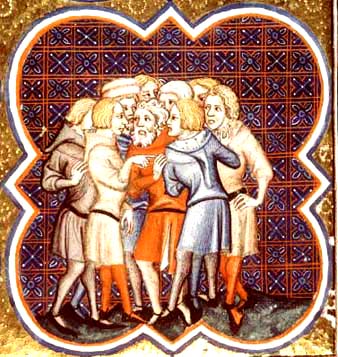
Lay Council, Med. illum. ms. The Siege of Troy, Med. illum. ms. |
|
|
|
Lay Council, Med. illum. ms. The Siege of Troy, Med. illum. ms. |
|
* McLean, et.al., eds., The Concise Oxford Dictionary of Politics (3rd ed., Oxford Univ.Pr. 2010).
LIBERALISM in politics encouraged reaction and revolution against monarchy, hereditary privilege, and state religion in order to replace them with representative democracy, rule of law, and equality under the law, and religious freedom. The latter presupposes religious toleration: however, Catholicism was widely perceived as supportive of (or eager to restore) the ancien régime. Thus anti-Catholicism (sometimes anti-Christianity) often co-existed with with supposed religious toleration.
Liberalism in religion is the doctrine that there is no positive truth in religion, but that one creed is as good as another, and this is the teaching which is gaining substance and force daily. It is inconsistent with any recognition of any religion, as true. It teaches that all are to be tolerated, for all are matters of opinion. Revealed religion is not a truth, but a sentiment and a taste; not an objective fact, not miraculous; and it is the right of each individual to make it say just what strikes his fancy. Devotion is not necessarily founded on faith…
Saint John Henry Cardinal Newman, The Biglietto Speech, delivered on being raised to the College of Cardinals
BEWARE LIBERALISM: THE US’S PROBLEM IS NOT VIOLENT SPEECH
Beginning in December 2024, the United States has lately experienced a series of high-profile political assassinations and other acts of murderous violence. One could choose any of a number of earlier dates from which to account for the rash of political and ideological violence in the US.
Earlier in 2024, for example, Donald Trump was the target of two (known) assassination attempts, one that was nearly successful. But starting with the assassination on 4 December 2024 of the chief executive officer of UnitedHealthcare, extending through the assassination of Charlie Kirk, and yet another school shooting (this time in Colorado) on 10 September 2025, we have seen a concentration of such violence.
Between the incidents of 4 December and 10 September, a Minnesota legislator and her husband were murdered, and two children were murdered while attending Mass at a Catholic primary school (after which the shooter killed himself). These recent murders have been framed by a dramatic increase in violent political speech.
Thus, the typical response has been that we need to cool our rhetoric and refrain from speech that advocates or at least implicitly incites violence. This is a fool’s errand. The problem is not violent speech, it’s liberal speech.
Given the foundational moral and political theory of the US, we should not be surprised that Americans substitute murderous violence for rational discourse. Regardless of variations in emphasis, the basis of modern liberal politics is the assertion that every human person is the enemy of every other human person, entitled to claim whatever one wishes in a “state of nature”.
By “liberal” in this context, I do not mean merely the left side of the American political spectrum. Nor do I mean a sentiment of tolerance and civility liberality. Rather, by liberal, I am referring to the fundamental individualist political philosophy of the American Founding, inherited from Thomas Hobbes, albeit somewhat straitened by John Locke.
It is the theory that there is no common good to which our politics should order us, but rather that we are the possessors of inherent possessive rights claims, one against all. By this definition, almost everyone in the US, from the far right to the far left, is a liberal, sharing (divided by?) the same political rhetoric.
Denying the very notion of a common political good, we instead assert possessive individual rights claims. To avoid the obvious and inevitable end of such a view of politics, we have entered into an implicit contract by which we mutually agree to curb some of our rights to every thing and against every one. “I have a right to take your stuff, but I’ll refrain from exercising it in exchange for your agreement to do the same.”
But in liberalism there is no moral principle that transcends and enforces this fragile contract. If I decide to break it, I am not constrained by our shared moral principle of radical individualism. This implies that if I don’t get what I want, or I feel that you are inhibiting me from asserting my rights, I will reject the contract and resort to the state of nature of a war of every man against every man.
This is America in 2025. But the guiding star that has led us so far astray is the very one that we think can lead us home. It cannot. In a thoughtful attempt to analyse the assassination of Charlie Kirk, New York Times columnist Ezra Klein asserts that
“American politics has sides … But both sides are meant to be on the same side of a larger project we are all, or most of us, anyway, trying to maintain the viability of the American experiment.
“We can live with losing an election because we believe in the promise of the next election; we can live with losing an argument because we believe that there will be another argument. Political violence imperils that.”
Klein believes that if we would only reiterate commitment to argument, we will recapture the goodness of the “American experiment”, and thus avoid such violent episodes. The opposite is the truth.
More liberalism does not cure the pathologies of liberalism. It aggravates them. If we seek to reiterate the moral philosophy of modern liberalism as the antidote, we are swallowing more of the very poison that has led ineluctably to the kind of violence and violent rhetoric that characterises American public life. We are depleting the capital and hurtling toward bankruptcy.
As Catholic Christians, we must understand that our moral and political commitments are not on the right-to-left continuum of liberal political theory. If we think we are asserting Catholic theological principles by identifying with one end or the other of the spectrum, we are asserting the very principles that have led to the moral, political and social bankruptcy to which we are cascading.
If we invoke liberalism to correct the errors of liberalism, we will contribute to the illness, not the cure.
Photo: A young attendee sits in the stands ahead of the memorial service for political activist Charlie Kirk at State Farm Stadium in Glendale, Arizona, 21 September 2025. (Photo by Eric Thayer/Getty Images.)
Dr Ken Craycraft is Professor of Moral Theology at Mount St Mary’s Seminary and School of Theology in Cincinnati, Ohio
A CLASH of LIBERALISMS
[Liberalism and Natural Law]
https://www.catholicworldreport.com/2025/10/18/a-clash-of-liberalisms/
When framing out a room, everyone knows that the first corner must be square, or else the second will be off at the far end of the wall. Even if the first corner is imperceptibly off, the second corner will reveal the problem. The longer the wall, the more the error will be evident.
Ideas work the same way across time. Even if an idea is ever so slightly off in the beginning, down the road, the original error will become glaringly obvious. I am using this metaphor to describe the understanding of liberty that originates in the Enlightenment, which emphasized “negative liberties” and freedom from external interference. At the founding of our nation, the definition of individual liberty seemed Christian, when in fact it was not—at least not entirely.
“Classical” Liberalism gave primacy to the individual over the common good in basically all circumstances and endorsed each person’s absolute right to self-determination. The Church has always had difficulty with this philosophy precisely because of its unqualified blending with atomistic individualism and personal autonomy. Pope Leo XIII laid out the problem in his encyclical Libertas Praestantissimum (On Human Liberty, 1888, hereafter Libertas), as has nearly every pope since.
The Church has always embraced the good of human liberty but has struggled with the moral implications of Liberalism as a philosophy of social life. Pope Leo XIII distinguished natural liberty—our human capacity for voluntary acts of free decision and the various forms of civil liberty, which, for the Church, is the right to act according to the precepts of the natural law and the requirements of the common good (see Libertas, nos. 1–11).
[The Catholic Church has traditionally favored censorship and opposed a completely free press]
From a Catholic perspective, even freedom of speech is tethered to capital T truth and the common good, or else a society will morally degenerate. Leo XIII explains it like this:
Men have a right freely and prudently to propagate throughout the State what things soever are true and honorable, so that as many as possible may possess them; but lying opinions, than which no mental plague is greater, and vices which corrupt the heart and moral life should be diligently repressed by public authority, lest they insidiously work the ruin of the State. The excesses of an unbridled intellect, which unfailingly end in the oppression of the untutored multitude, are no less rightly controlled by the authority of the law than are the injuries inflicted by violence upon the weak. And this all the more surely, because by far the greater part of the community is either absolutely unable, or able only with great difficulty, to escape from illusions and deceitful subtleties, especially such as flatter the passions.
If unbridled license of speech and of writing be granted to all, nothing will remain sacred and inviolate; even the highest and truest mandates of nature, justly held to be the common and noblest heritage of the human race, will not be spared. Thus, truth being gradually obscured by darkness, pernicious and manifold error, as too often happens, will easily prevail. Thus, too, license will gain what liberty loses; for liberty will ever be more free and secure in proportion as license is kept in fuller restraint. In regard, however, to all matter of opinion which God leaves to man’s free discussion, full liberty of thought and of speech is naturally within the right of everyone; for such liberty never leads men to suppress the truth, but often to discover it and make it known. (Libertas, no. 23, emphasis added)
Such a statement before the digital age and the advent of social media is truly prophetic. It explains so much of what’s ill about our society today—e.g., pornography, identity politics, violence, the life issues, suicide, mental health, etc.
And yet, Leo XIII’s stance rubs uncomfortably against our American sensibilities. When one reads through Libertas, the Pope qualifies every form of civil liberty along similar lines, which leaves us not entirely able to embrace American liberalism even on the right. As he explains, if liberty is not grounded in truth and directed to the common good, it will degenerate into moral chaos. Thus, the government must assume its moral role to safeguard the basic tenets of natural law, without which we cannot have a free society. We might be tempted by the liberal belief in the neutrality of the state in such matters. However, the state never does remain neutral—and that’s the problem. Almost from the beginning, our society has been shifting slowly away from the precepts of natural law.
From its origins, Liberalism’s understanding of freedom was divorced from a traditional natural law framework and a proper theory of human nature. However, this is something some conservative Christians do not necessarily understand or like to hear. Some tend to side with Locke over Aquinas on the nature of human liberty. Hence, some Catholics who embrace the idea that America was fundamentally Christian at its origin argue that all we need is a return to our roots.
However, if we follow the Church’s critique of Liberalism over nearly 150 years, we will admit that this is not exactly what the Church would recommend. Were we once a nation comprised mostly of Christians? Yes. Is the Constitution a Christian system of law? Not necessarily. It’s a mostly secular piece of jurisprudence—albeit a fantastic one—that assumes a Christian people who maintain its moral rectitude.
Yet it cannot guarantee that we the people will remain Christian or embrace Judeo-Christian moral values. No civil law can do this, if we are honest, but when civil law is grounded in natural law, at least we don’t have legal grounds to support moral licentiousness. I believe the Framers knew this to some extent, but could not imagine a world where health professionals, educators, and politicians would ever advocate for abortion, euthanasia, and transgenderism in the name of individual liberty. Pope Leo XIII, however, had a strong sense that the Liberal experiment in freedom would degenerate morally, giving “right” to our most wayward passions exactly as we have seen. This is why the Church has always argued that civil law must be grounded by the government in the natural law.
To clarify, the problem is not with the Constitution as such, which is an unsurpassed source of sound jurisprudence, but with the Enlightenment’s concept of individual liberty that has historically specified the parameters of our civil liberties in a way that doesn’t square perfectly with Christian anthropology. What the Church saw with clarity is that the moral logic of Liberalism would end up exactly where we find ourselves—in a titanic struggle for the conscience of Western civilization.
Yet this poses a serious dilemma for conservative Christians who routinely advocate for a return to classical Liberalism, which, in fact, brought us to this point in the first place. The Church proposes a natural law framework and not a Liberal one, and some conservative Christians continue to ignore this warning. Pope Leo XIII goes so far as to set up a cause-and-effect relationship between the right and the left. Specifically, he states that classical Liberalism ends up creating the conditions for the rise of socialism and communism. He stated this over a century ago in his encyclical Diuturnum illud (On the Origin of Civil Power, 1881):
[T]here arose in the last century a false philosophy—a new right as it is called, and a popular authority, together with an unbridled license which many regard as the only true liberty. Hence, we have reached the limit of horrors, to wit, communism, socialism, nihilism, hideous deformities of the civil society of men and almost its ruin. And yet too many attempt to enlarge the scope of these evils, and under the pretext of helping the multitude, already have fanned no small flames of misery. (no. 23)
In another encyclical on atheistic communism, Divini Redemptoris (On Atheistic Communism, 1937), Pope Pius XI further explains how the propagation of the left’s agenda is the consequence of having rejected the Church’s warnings against classical Liberalism:
There would be today neither Socialism nor Communism if the rulers of the nations had not scorned the teachings and maternal warnings of the Church. On the bases of liberalism . . . they wished to build other social edifices which, powerful and imposing as they seemed at first, all too soon revealed the weakness of their foundations, and today are crumbling one after another before our eyes, as everything must crumble that is not grounded on the one corner stone which is Christ Jesus (no. 38).
If we look to the Church to understand better why conservative Christians find ourselves in a profound cultural struggle with the far left, we will see that a classical Liberal society is vulnerable to the adverse effects of moral relativism and hedonism, which in recent years has become painfully obvious and highly political at the same time.
Before the full force of the Woke revolution had crested the horizon of mainstream culture, Pope John Paul II presented an argument that some Catholics may not realize was a critique of Western democracies, including our own. This is what he says in Evangelium vitae (The Gospel of Life, 1995):
The basis of these [moral] values cannot be provisional and changeable “majority” opinions, but only the acknowledgment of an objective moral law which, as the “natural law” written in the human heart, is the obligatory point of reference for civil law itself…. [I]t is easy to see that without an objective moral grounding not even democracy is capable of ensuring a stable peace, especially since peace which is not built upon the values of the dignity of every individual and of solidarity between all people frequently proves to be illusory. Even in participatory systems of government, the regulation of interests often occurs to the advantage of the most powerful, since they are the ones most capable of maneuvering not only the levers of power but also of shaping the formation of consensus. In such a situation, democracy easily becomes an empty word. (no. 70)
Again, this is a hauntingly accurate description of where we are now. Over the past decade, we have seen the aggressive push to create a moral consensus with Critical Theory by means of government policy, media censorship, propaganda, and the cancel culture movement. Since Trump took office for a second term, we have seen his administration resume its aggressive pushback on the far left’s agenda. Trump has taken a wrecking ball to every one of those structures of influence and deployed his own to achieve his America First agenda.
Competing moral frameworks have become the driver of opposed structures of influence that shape public opinion in the name of securing a majority consensus, which is then imposed on the nation by powerful influencers and “majority” consensus politics. The propaganda machine issuing forth from every media outlet in recent years is striking in this regard. In America today, propaganda seems far more important than reasoned discourse to impose world views. The result has been a rise in political polarization and even violence, which Leo XIII predicted as the logical fruit of individualistic liberty. Charlie Kirk’s assassination has brought this into sharp focus.
Our nation is at a tipping point where what the Church has said about Liberalism all along seems remarkably accurate. As an American conservative Catholic, I would be less apt to accept that classical Liberalism harbors an innate flaw were it not for the Church’s constant witness to the contrary and her prophetic predictions about how it would play out over time. As the Church prophesied over a century ago, we now live in a society where the freedom to realize the most unnatural expressions of human subjectivity and individualism has made the West a laughingstock of absurdity. The relativism of today’s Liberalism has become truly tyrannical over the most ridiculous things a natural law framework would never even question—like men in women’s sports.
Like the wall metaphor I began with, over time and by way of logical necessity, the subtle error of Liberalism’s notion of individual liberty has finally been exposed for what it is—a parody of true freedom and the rule of law. If as Liberalism espouses, the exercise of individual liberty is checked only by the exercise of another person’s liberty through social contract—and if law (the just arrangement of things) originates in the will of the people by way of a majority (and not in natural law)—Christians will have no way to oppose the moral revolution of the far left except by resorting to the very mechanisms of social “revolution” against which the Church has consistently warned us.
The direction our society has taken is logically consistent with the Enlightenment’s philosophical definition of individual liberty. It is not, however, logically consistent with the Christian idea of liberty. And that is the huge problem we face. Two hundred and fifty years into the American experiment, we can finally see the subtle error of Liberalism’s deviancy from Christian anthropology. It leads to the tyranny of individual choice for those with the power to deploy their influence on others. And it further leads to the loss of the rights of all who might oppose them—even their right to life. We now find ourselves living amidst a destructive clash of Liberalisms that only a return to natural law will resolve.
What we need now is for Christians to stop filtering the remedy to our moral problems through the lens of Liberalism’s philosophical framework of individualism. As Catholics, we have such an amazing tradition on human nature, true liberty, and its relationship to law and governance. Maybe conservatives should take a deeper look at the Church’s wisdom rather than continue to embrace the philosophical Liberalism that has gotten us here.
As disciples of Jesus Christ, first and foremost, we need to change people’s hearts (not just their minds) on the issues. As Americans, we can still use due process and amend our Constitution by further specifying what life, liberty, and happiness mean according to a natural law framework. For example, we might pass an amendment stating that life begins at conception and ends with natural death. The Constitution works; we just need a more solid moral grounding for the exercise of our civil liberties. In the decade ahead, or so long as common sense holds the upper hand, we may have a span of time to accomplish this, although I’m not very optimistic. A return to the grounding principles of nature, which is the basis of all liberty, is what will ultimately safeguard the freedom for which Christ has set us free. In the long run, it will also bring peace to our nation.
This Webpage was created for a workshop held at Saint Andrew's Abbey, Valyermo, California in 2014