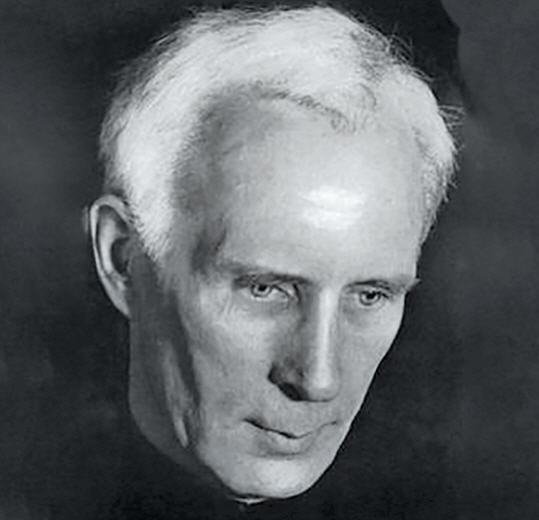
The Following is adapted from: The Oxford Dictionary of the Christian Church, ed. Cross, Livingstone; (OUP, 1983).
Henri de LUBAC (1896-1991),French Jesuit theologian. Born in Cambrai, he became a Jesuit in 1913. He fought in the French Army in the First World War and was severely wounded. After studying in England, the Channel Islands, and France, he was ordained priest in 1927 and taught theology at Lyons from 1929 (as professor from 1934); here he had many distinguished pupils, incl. Jean Danielou and H.U.von Balthasar. A peritus at the Second Vatican Council, he was made a cardinal in 1983.
His Mémoire sur l’occasion de mes écrits (1989) recounts a vast literary output, covering a wide range of subjects. He wrote on the doctrine of the Church in Catholicisme (1938; Eng. tr., 1950) and Corpus Mysticum (1944) and on grace and the supernatural in Surnaturel (1946), Augustinisme et théologie moderne (1965; Eng. tr., 1969), and Le Mystère de surnaturel (1965; Eng. tr., 1967). He produced two important works on the history of exegesis and the value of allegory: Histoire et esprit (1950), in which he supported the position of Origen, and Exégèse médiévale (1959–64; Eng. tr., 1998 ff.), which contains an appreciation of Renaissance humanism as well as discussion of the apocalyptic views of Joachim of Fiore. These interests were developed in his study of Pico della Mirandola (1974) and in La Posterité spirituelle de Joachim de Flore (1979–81).
He was appreciative, but not uncritical, of the work of P. Teilhard de Chardin; he edited a number of volumes of his correspondence and devoted three books to his thought: La Pensée religieuse de Père Teilhard de Chardin (1962; Eng. tr., 1967), La Prière du Père Teilhard de Chardin (1964; Eng. tr., 1965), and L’Éternel féminin (1968; Eng. tr., 1971). His other works include Le Drame de l’humanisme athée (1944; Eng. tr., 1949), Aspects du bouddhisme (1951–5; Eng. tr. of vol. 1, 1953), La Rencontre du bouddhisme et de l’occident (1952), and Athéisme et sens de l’homme (1968). De Lubac was one of the thinkers who created the intellectual climate that made possible the Second Vatican Council, largely by opening up the vast spiritual resources of the Catholic tradition which had been cramped by post-Tridentine ‘baroque’ theology. Together with his Jesuit confrere Jean Danielou he was one of the founders of the collection ‘Sources Chrétiennes’, an important series of patristic and medieval texts, with French translation, now involving scholars from all over the world.
L’Homme devant Dieu: Mélanges offerts au Père Henri de Lubac (Théologie, 56–8 [1964]), with bibl. of his works, 3, pp. 347–56. K. H. Neufeld and M. Sales, Bibliographie Henri de Lubac S. J. (Einsiedeln, 1971; 2nd edn., 1974). H. U. von Balthasar, Henri de Lubac: Sein organisches Lebenswerk (ibid. [1976]). J.-P. Wagner, La théologie fondamentale selon Henri de Lubac (1997). Polgár, 2 (1990), pp. 449–52. J. Guillet, SJ, in DHCJ 3 (2001), pp. 2430–2, with bibl.
See Hans Urs von Balthasar, The Theology of Henri de Lubac: An Overview, trans. Joseph Fessio, SJ, and Michael M. Waldstein (San Francisco: Ignatius Press, 1991); Jean-Pierre Wagner, Henri de Lubac, Initiations aux théologiens (Paris: Cerf, 2007); Wagner, La théologie fondamentale selon Henri de Lubac, Cogitatio Fidei, 199 (Paris: Cerf, 1997); Rudolf Voder-holzer, Meet Henri de Lubac (San Francisco: Ignatius Press, 2008); John Milbank, The Suspended Middle: Henri de Lubac and the Debate concerning the Supernatural (London: SCM, 2005); a collection of essays in Communio, 35 (2008) `Henri de Lubac’s Catholicism at 70 Years’ with an important article by Georges Chantraine, SJ, `Catholicism: On “Certain Ideas”, Communio, 35 (2008), 520-34; Paul McPartlan, The Eucharist Makes the Church: Henri de Lubac and John Zizioulas in Dialogue (Edinburgh: T&T Clark, 1993).
This Webpage was created for a workshop held at Saint Andrew's Abbey, Valyermo, California in 1990