|
|
|
|
|
|
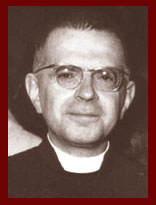
LOUIS JEAN BOUYER ( 17 February 1913, Paris-). Education: studied at State Univ. of Strasbourg, 1932-36; State Univ. at Paris, 1940-42; S.T.D., Institut Catholique, Paris, 1946. Career: after membership in various Protestant congregations in Paris, became a Lutheran pastor; professor, Institut Catholique, 1946; ordained Catholic priest and became member of French Oratory, 1947; taught at the Univ. of Notre Dame, summer sessions after 1951.
The productive and creative Bouyer must be numbered among that distinguished group of European theologians whose scholarship made possible the firm grounding of the theological and liturgical renewals of Vatican II. Bouyer had been raised a Protestant and had studied with the Calvinist Auguste Lecerf and with the Lutheran biblical scholar Oscar Cullmann. Before he became a Catholic priest, moreover, he was influenced by Sergei Boulgakoff, a Russian Orthodox scholar.
Bouyer’s Protestant background left him with an unshakable conviction of the primacy of the Bible, which for him was the Christian text, especially as the Bible is proclaimed in the liturgy. For Bouyer all renewal begins with the Bible. One can read about his move from Protestantism to Catholicism in his The Spirit and Forms of Protestantism (ET 1958). A central idea that gave direction to all Bouyer’s thought was the necessity of returning to the sources, the great French theological principle of ressourcement. From the beginning Bouyer maintained a corporate sense of Christianity and of the liturgy. He opposed all individualistic piety; in fact, in 1943 he published a work in the famous Unam Sanctam series on the Body of Christ in the theology of Athanasius of Alexandria. This emphasis on the Body of Christ gave a distinctively ecclesial foundation to all of Bouyer’s theology.
His interests and publications have been cast widely: the Bible, liturgy, ecumenism, ritual, history of spirituality, systematic theology, mariology, monasticism, and biography. Bouyer even wrote pseudonymously three novels. Many of his books have been translated into English, some of which have remained standard, much consulted studies. At first Bouyer espoused the ideals of the Second Vatican Council, but he subsequently became less amenable to and more cautious about some of the Council’s results. Bouyer was never one to disguise his convictions, although in the 1940s he advised caution and restraint about liturgical changes that could come as too much too soon. He favored careful, pastoral groundwork in the revision of the liturgy.
For some time those interested in the revival of studies in Christian spirituality had at hand only the collaborative effort The History of Christian Spirituality, in which Bouyer took a major role. (Original French editions were published in 1960, 1961, 1965, and 1966). Louis Bouyer’s scholarship and strongly held liturgical positions became well known and influential not only in Europe but also in North America especially through books like Liturgical Piety (1954), Christian Initiation (1958), and Eucharist (1968). Many, though not all, of Bouyer’s ideas on the liturgy became prime elements in the liturgical renewal initiated by Vatican II.
Bibliography
A. Le métier du théologien. Entretiens avec Georges Daix ( Paris, 1979); Karin Heller , Ton Créateur est Ton Éoux, Ton Rédempteur; Contribution à la Théologie de l’Alliance à Partir des Écrits du R. P. Louis Bouyer, de ‘Oratoire’. Thesis ad Doctoratum in Theologia ( Paris, 1996), 431-46; Martin Klöckener, “Bio-bibliographisches Repertorium der Liturgiewissenschaft”, in Archiv für Liturgiewissenschaft 35-36 ( 1993-94): 285-357; “Letter to Father Duployé”, Communio 16 (Summer 1989): 283-91; Orbis Liturgicus, ed. Anthony Ward and Cuthbert Johnson ( Rome, 1995), 577.
B. LThK3 2:620; Erasmo Leiva-Merikakis, “Louis Bouyer the Theologian”, Communio 16 (Summer 1989): 257-76, to which is added (pp. 277-82) a bibliography of books from 1938 to 1988; Grant Sperry-White, “Louis Bouyer, Theologian, Historian, Mystagogue”, in Robert L. Tuzik, How Firm a Foundation: Leaders of the Liturgical Movement ( Chicago, 1990), 96-104.
Keith J. Egan
Biographical Dictionary of Christian Theologians. Contributors: Patrick W. Carey
- editor, Joseph T. Lienhard . (Greenwood Press, Westport, CT, 2000) pp.
89-90.
This Webpage was created for a workshop held at Saint Andrew's Abbey, Valyermo, California in 1990