|
|
|
|
|
|
The following is adapted from the Oxford Dictionary of the Christian Church
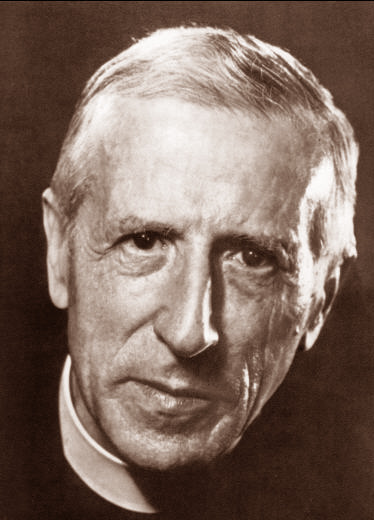
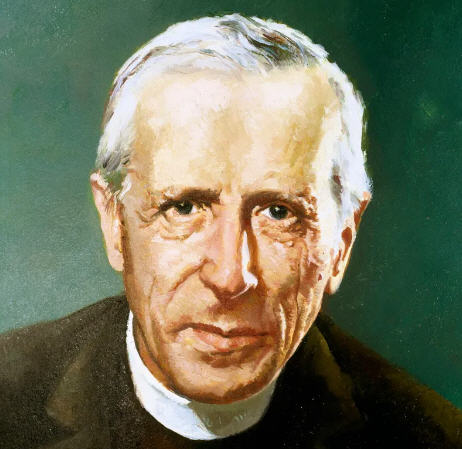
TEILHARD de CHARDIN, S.J. (1881–1955), French theologian and scientist. Born near Clermont in central France, he entered the Jesuit novitiate at Aix-en-Provence in 1899, and was ordained priest in 1911. During this long training he studied theology but was also strongly attracted to the natural sciences, especially geology and palaeontology. He is unfortunately associated with the 1912 “discovery of Piltdown Man” in England, later debunked as a deliberate fraud.
After service in the First World War, he was able to devote himself to his scientific studies. For many years he worked in China and gained a notable reputation as a palaeontologist. He participated in the 1920s-era discovery of “Peking Man” in China, a find that seemed to confirm a gradual development in the human species. His last years were spent in the USA.
At the time of his death he had published only scientific papers, for he had not been able to obtain permission for the publication of his religious and theological works. These appeared from 1955 onward and at once made a powerful impression as a new synthesis of science and religion. Le Phénomène humain (1955; Eng. tr., The Phenomenon of Man, 1959) is probably his best-known work and contains the essence of his ideas.
The universe is seen as an evolutionary process in which the movement is always towards systems of greater complexity.
Correlated with this movement towards complexity is the movement towards higher levels of consciousness.
The whole process has included several critical moments or thresholds at which leaps to new levels have been made. Such thresholds were
the emergence of life on earth and then
the emergence of rational self-consciousness in man.
This latter emergence has special significance, since it means that evolution no longer takes place in accordance with the laws of nature only, but that man now takes part in directing it.
The whole process moves towards a fulfilment in which all things will be gathered up in God. [the OMEGA POINT]
Teilhard’s philosophical theology is reflected in his devotional writings, notably Le Milieu divin (1957; Eng. tr., 1960). For him, matter has a sacramental character, and the whole universe is in process of ‘Christification’ as a consequence of the Incarnation. Though he has been criticized for the philosophical weaknesses of his work and for an uncritical optimism, Teilhard’s thought is a remarkable effort to relate the Christian tradition to the contemporary scientific understanding of nature.
Collected edn. of his works, 13 vols., Paris, 1955–76. Eng. tr. of other individual works incl. Letters from a Traveller (1962); The Future of Man (1964), and Hymn of the Universe (1965). The standard biog. is C. Cuénot, Pierre Teilhard de Chardin: Les grands étapes de son évolution (1958; Eng. tr., 1965). Other studies incl. H. de *Lubac, SJ, La Pensée religieuse du Père Pierre Teilhard de Chardin (1962; Eng. tr., 1967); id., La Prière du Père Teilhard de Chardin (1964; Eng. tr., 1965); R. W. Kropf, Teilhard, Scripture, and Revelation: A Study of Teilhard de Chardin’s Reinterpretation of Pauline Themes [1980]; T. M. King, Teilhard’s Mysticism of Knowing (New York, 1981); J. A. Lyons, The Cosmic Christ in Origen and Teilhard de Chardin (Oxford Theological Monographs, 1982); A. Hunt Overzee, The Body Divine: The Symbol of the Body in the Works of Teilhard de Chardin and Rāmānuga (Cambridge, 1992); D. H. Lane, The Phenomenon of Teilhard: Prophet for a New Age (Macon, Ga., 1996). J. E. Jarque, Bibliographie générale des œuvres et articles sur Pierre Teilhard de Chardin parus jusqu’à fin décembre 1969 (Fribourg, 1970). Works on Teilhard de Chardin have also been listed annually since 1956 in the Archivum Historicum Societatis Iesu. Polgár, 3 (1990) L. Polgár, SJ, Bibliographic sur l’Histoire de la Compagnie de Jésus 1901–1980, 3: Les Personnes (3 vols., Rome, 1990)., pp. 359–553. P. Noir, SJ, in Dict. Sp. 15 (1991), cols. 115–26, s.v.; C. d’Armagnac, SJ, in DHCJ 4 (2001)Diccionario Histórico de la Compañía de Jesús, ed. C. E. O’Neill, SJ, and J. M. Domínguez, SJ (4 vols., Rome and Madrid, 2001)., pp. 3714–17, s.v.
|
|
|
https://www.pillarcatholic.com/p/is-teilhard-de-chardin-being-rehabilitated
LUKE
COPPEN September 4, 2023
The French Jesuit priest Pierre Teilhard de Chardin has been called many things since his death in New York in 1955.
To some, he is a creative thinker “in the same league as Einstein.” To others, he is “the most influential heretic of the 20th century.”
The theologian, philosopher, theologian, scientist, and teacher — dubbed the “Catholic Darwin — was just as controversial in his lifetime. He prompted decidedly mixed assessments within both the Catholic Church and the scientific establishment.
But what does he mean to the world’s first Jesuit pope? Francis offered some clues Sunday when he marked the 100th anniversary of one of Teilhard’s most celebrated works: The essay “The Mass on the World.”
The mystical text was borne out of an experience in 1923, when Teilhard was crossing the Ordus Desert in northwestern China and was unable to celebrate Mass due to a lack of bread, wine, and an altar.
The text, published posthumously in the 1961 book “Hymn of the Universe,” has had a significant cultural impact, inspiring everything from a jazz album to personal prayers during the coronavirus pandemic.
Speaking after he celebrated Mass for Mongolia’s tiny Catholic community Sept. 3, Pope Francis said: “The Mass is itself a way of giving thanks: ‘Eucharistía.’ To celebrate Mass in this land brought to my mind the prayer that the Jesuit Fr. Pierre Teilhard de Chardin offered to God exactly a hundred years ago, in the desert of Ordos, not far from here.”
“He prayed: ‘My God, I prostrate myself before your presence in the universe that has now become living flame: beneath the lineaments of all that I shall encounter this day, all that happens to me, all that I achieve, it is you I desire, you I await.’”
“Fr. Teilhard de Chardin was engaged in geological research. He fervently desired to celebrate Holy Mass, but lacked bread and wine. So he composed his ‘Mass on the World,’ expressing his oblation in these words: ‘Receive, O Lord, this all-embracing host, which your whole creation, moved by your magnetism, offers you at the dawn of this new day.’”
The pope went on: “A similar prayer had already taken shape in him when he served as a stretcher-bearer on the front lines during the First World War. This priest, often misunderstood, had intuited that ‘the Eucharist is always in some way celebrated on the altar of the world’ and is ‘the living center of the universe, the overflowing core of love and of inexhaustible life” (Laudato sì, 236), even in times like our own, marked by conflicts and wars.”
“Let us pray this day, then, in the words of Fr. Teilhard de Chardin: ‘Radiant Word, blazing Power, you who mold the manifold so as to breathe life into it, I pray you, lay on us those your hands — powerful, considerate, omnipresent.’”
The pope’s extensive citation of his fellow Jesuit’s work raises several questions.
Who was Teilhard de Chardin? Why is he so polarizing? And he is undergoing a rehabilitation within the Church? The Pillar takes a look.
Teilhard’s life was marked by the tensions and upheavals of the 20th century.
He was born in a chateau in central France in 1881, the fourth of 11 children. His father was a librarian and his mother the great-grandniece of the writer Voltaire, a withering critic of the Catholic Church. The “de Chardin” part of the family’s name was the remnant of an aristocratic title, so their son was known formally as Pierre Teilhard.
His early Jesuit formation was disrupted by the anti-clerical policies of French Prime Minister Émile Combes, an ex-seminarian turned freemason. He moved to England to continue his studies, becoming a passionate reader of John Henry Newman.
After his priestly ordination in 1911, he focused on paleontology, the study of ancient life on Earth. But following the outbreak of the First World War, he was mobilized and served as a stretcher-bearer. In Paissy, northern France, he celebrated Masses for soldiers in a cave that today has a sign in his honor.
After the war, he completed his studies and began making research trips to China. He was part of a team that discovered Peking Man, an example of the extinct species Homo erectus.
But his writings began to encounter opposition. In 1927, the Jesuit curia forbade the publication of his work “The Divine Milieu,” which was not released until after his death.
Asked to sum up his personal credo in 1934, he wrote: “I believe the universe is an evolution; I believe evolution proceeds towards spirit; I believe spirit, in the human, completes itself in the personal; I believe the supreme personal is the Cosmic Christ.”
Following a trip to the U.S. in 1937, his reputation grew across the Atlantic.
But in 1944, he learned that Rome had refused him permission to publish his work “The Phenomenon of Man,” in which he expressed his conviction that evolution would culminate in what he called the “Omega Point.” It was also only published posthumously.
After spending several years in America, he died on Easter Sunday 1955 and was buried at the Jesuit cemetery of St. Andrew-on-Hudson, near Poughkeepsie, New York state, a site that now belongs to the Culinary Institute of America.
When his posthumously published books began to capture Catholics’ imaginations, the Vatican’s Holy Office issued a monitum, or official warning, in 1962. It stated that the works “abound in such ambiguities and indeed even serious errors, as to offend Catholic doctrine.”
“For this reason, the most eminent and most revered Fathers of the Holy Office exhort all Ordinaries as well as the superiors of religious institutes, rectors of seminaries, and presidents of universities, effectively to protect the minds, particularly of the youth, against the dangers presented by the works of Fr. Teilhard de Chardin and of his followers,” the warning said.
Meanwhile, Teilhard cast a long cultural shadow. He inspired artists from Salvador Dalí, who reputedly drew on his theories for his monumental 1960 painting “The Ecumenical Council,” to the U.S. writer Don DeLillo, who riffed on his ideas in the 2010 novel Point Omega. He is also thought to be an inspiration for Fr. Lankester Merrin, the archaeologist played by Max von Sydow in the 1973 horror film “The Exorcist.”
A stained-glass window (top left) depicting Pierre Teilhard de Chardin, S.J., at St. Anna Church in Heerlen, the Netherlands. Rijksdienst voor het Cultureel Erfgoed via Wikimedia (CC BY-SA 4.0).
Why does Teilhard divide opinion so sharply?
There are clues in his biography.
In his lifetime, there were Catholics who believed that he was a genius boldly expanding the scope of theology, while others concluded that he was a heretic whose ideas verged on pantheism.
The Jesuit theologian Henri de Lubac, who devoted several books to the paleontologist, once wrote: “We need not concern ourselves with a number of detractors of Teilhard, in whom emotion has blunted intelligence.”
In contrast, the Catholic philosopher Dietrich von Hildebrand was shocked to hear Teilhard criticize St. Augustine of Hippo when he met the Jesuit in 1949. He wrote that the criticism conveyed “Teilhard’s lack of a genuine sense of intellectual and spiritual grandeur.”
“It was only after reading several of Teilhard’s works, however, that I fully realized the catastrophic implications of his philosophical ideas and the absolute incompatibility of his theology fiction (as Étienne Gilson calls it) with Christian revelation and the doctrine of the Church,” Hildebrand wrote.
These polarized views of Teilhard remain present in the Catholic world today, with the difference that since the publication of a 2017 essay by the ethicist John P. Slattery, critical attention has focused on the Jesuit’s attitude toward eugenics.
The essay argued that “from the 1920s until his death in 1955, Teilhard de Chardin unequivocally supported racist eugenic practices, praised the possibilities of the Nazi experiments, and looked down upon those who he deemed ‘imperfect’ humans.”
Slattery contended that these ideas were not incidental, but rather formed the groundwork for his celebrated “cosmological theology.” He added that this should prompt a review of Teilhard’s place in 21st-century theology.
The Jesuit’s champions have responded by noting that Teilhard appeared close to his disabled sister, Marguerite-Marie, and arguing that he supported the spiritual improvement of humanity rather than biological eugenics.
Pierre Teilhard de Chardin’s grave near Poughkeepsie, New York state. Ɱ via Wikimedia (CC BY-SA 4.0).
The Vatican has long faced pressure to lift the 1962 warning concerning Teilhard’s works.
In 1981, on the centenary of his birth, the then Vatican Secretary of State Cardinal Agostino Casaroli published an article in L’Osservatore Romano praising “the testimony of the coherent life of a man possessed by Christ in the depths of his soul.”
Amid speculation that this signaled the Jesuit’s rehabilitation, the Vatican’s doctrinal office issued a statement clarifying that the warning still stood.
Pope Benedict XVI, the former head of the Vatican’s doctrinal office, raised eyebrows in 2009 when he cited Teilhard positively during a reflection on St. Paul’s Letter to the Romans.
“We ourselves, with our whole being, must be adoration and sacrifice, and by transforming our world, give it back to God,” said the German pope in a homily at Aosta Cathedral in northwest Italy.
“The role of the priesthood is to consecrate the world so that it may become a living host, a liturgy: so that the liturgy may not be something alongside the reality of the world, but that the world itself shall become a living host, a liturgy.”
“This is also the great vision of Teilhard de Chardin: in the end we shall achieve a true cosmic liturgy, where the cosmos becomes a living host.”
Commentators were divided over how much significance should be attributed to the comment. But the then Vatican spokesman Fr. Federico Lombardi, a Jesuit, said: “By now, no one would dream of saying that [Teilhard] is a heterodox author who shouldn’t be studied.”
Following Pope Francis’ election in 2013 and the publication of his 2015 ecological encyclical Laudato si’ (which cited Teilhard in a footnote), members of the Pontifical Council for Culture voted to recommend that Pope Francis remove the warning.
“We unanimously agreed, albeit some of his writings might be open to constructive criticism, his prophetic vision has been and is inspiring theologians and scientists,” the members said in a 2017 statement.
Around that time, a petition calling for Teilhard to be named a Doctor of the Church began to gather thousands of signatures.
In May this year, Jesuits opened the Teilhard de Chardin Center in a Paris suburb known as the French Silicon Valley to serve as “a place of dialogue between sciences, philosophy and spirituality.”
Pope Francis’ comments in Mongolia did not directly address the monitum or the controversies swirling around Teilhard. But by citing the paleontologist’s essay at significant length, he is undoubtedly encouraging Catholics to read “The Mass on the World,” possibly as a gateway to the “often misunderstood” Jesuit’s other works.
So, for now, we have no formal rehabilitation. What we have perhaps instead is what some have called a “long rehabilitation”: A haphazard process in which the Church’s highest authorities make positive references to aspects of Teilhard’s work, without committing themselves to an exhaustive reappraisal.
Rehabilitation won’t do much for Teilhard, but symbolically it matters
John Allen
https://angelusnews.com/voices/rehabilitation-wont-do-much-for-teilhard-but-symbolically-it-matters/
[...] On Nov. 18, a large majority of the assembly of the Council for Culture voted to recommend that Pope Francis revoke a “monitum,” or official warning, imposed on Father Teilhard’s work by the Sacred Congregation of the Holy Office, the forerunner to today’s Congregation for the Doctrine of the Faith, in 1962.
That monitum was reaffirmed by the Vatican in 1981, on the 100th anniversary of Father Teilhard’s birth.
“We believe that such an act [of revoking the monitum] would not only rehabilitate the genuine force of the pious Jesuit in his effort to reconcile the scientific vision of the universe with Christian eschatology, but would also represent a formidable stimulus to a Christian anthropological model which, following the indications of the encyclical Laudato Si’, naturally situates itself with the marvelous story of the cosmos,” the assembly declared.
Father Teilhard, who died in 1955 at the age of 73, was a French Jesuit who studied paleontology and participated in the 1920s-era discovery of “Peking Man” in China, a find that seemed to confirm a gradual development in the human species. Father Teilhard has also been linked to the 1912 discovery of “Piltdown Man” in England, later exposed as a hoax.
On the basis of his scientific work, Father Teilhard developed an evolutionary theology asserting that all creation is developing towards an “Omega Point,” which he identified with Christ as the Logos, or “Word” of God. In that sense, he broadened the concept of salvation history to embrace not only individual persons and human culture, but the entire universe. In short order, Father Teilhard’s thought became the obligatory point of departure for any Catholic treatment of the environment.
To be honest, to the extent that Father Teilhard’s reputation needed rehabilitation, it already happened a long time ago.
In 1966, just four years after the monitum, Blessed Pope Paul VI delivered a speech in which he said Father Teilhard was a scientist who “scrutinizing the material, knew how to find the spiritual,” and who had offered “an explanation of the universe capable of revealing the presence of God in it, the traces of an intelligent principle and creator.”
In 1981, Italian Cardinal Agostino Casaroli, then St. Pope John Paul II’s secretary of state, published an article in L’Osservatore Romano, the Vatican newspaper, marking the 100th anniversary of Father Teilhard’s birth, in which Cardinal Casaroli praised the “astonishing resonance of his research, as well as the brilliance of his personality and richness of his thinking.” Cardinal Casaroli wrote that Father Teilhard had anticipated St. John Paul II’s call to “be not afraid,” embracing “culture, civilization and progress.”
Flash forward to 2009, when Pope Benedict XVI publicly praised Father Teilhard’s notion of the cosmos as a “living host.” At the time, the Vatican spokesman, Jesuit Father Federico Lombardi, said, “By now, no one would dream of saying that [Father Teilhard] is a heterodox author who shouldn’t be studied.”
As for Pope Francis, he cited Father Teilhard approvingly in footnote 53 to “Laudato Si’ ” (“Praise Be to You”), suggesting basic admiration for his legacy.
In all honesty, Father Teilhard’s problem with officialdom was never really his own work so much as the uses to which it was put.
In a long-ago commentary on the final session of the Second Vatican Council (1962-65), a young Father Joseph Ratzinger, who would later become Pope Benedict, complained that “Gaudium et Spes,” the “Pastoral Constitution on the Church in the Modern World,” played down the reality of sin because of an overly “French,” and specifically “Teilhardian,” influence.
Father Ratzinger and many of his colleagues after Vatican II felt that some French theologians, inspired by Father Teilhard’s vision, were wearing rose-colored glasses, neglecting the doctrine of original sin and the impact of sin on a fallen world.
Later, some of the most envelope-pushing and controversial Catholic theologians of the late 20th century, such as Father Diarmuid O’Murchu, Father Thomas Berry, ex-Dominican priest Matthew Fox, Rosemary Radford Ruether and Brian Swimme, all claimed inspiration from Father Teilhard, which tended to leave a bad taste in the mouth among more conservative thinkers and the official watchdogs of orthodoxy.
None of that, however, really ever diminished the esteem in which Father Teilhard has been held by many in senior positions in the Church.
In 2007, for instance, Italian Archbishop Celestino Migliore, who was then the permanent observer of the Holy See to the U.N. and is now the papal envoy to Russia, told me that whenever he had occasion to go to upstate New York, he would visit Father Teilhard’s grave in Poughkeepsie and pray over his vision of the “Christification” of the cosmos.
(Ironically, the location where Father Teilhard is buried, which contains a Jesuit cemetery that was part of a Jesuit novitiate, is now owned by the Culinary Institute of America.)
As a result, should Pope Francis take up the recommendation to officially lift the 1962 monitum on Father Teilhard, it probably won’t mean much in terms of how widely read and studied his writings actually are in Catholic circles.
Nonetheless, it could have important symbolic value.
It could make a statement, perhaps, about how the Church, despite its understandable caution about protecting the deposit of faith, eventually does justice to the thinkers who serve it. It could also make a statement of openness to the world of science, and would doubtless be appreciated by scientists who’ve always thought of Father Teilhard as one of them.
In the end, “rehabilitating” Father Teilhard would be a very Pope Francis thing to do — and, of course, it would give the pope another chance to do a solid for a fellow Jesuit, all of which means the betting odds are probably pretty good that Pope Francis may just do it.
This Webpage was created for a workshop held at Saint Andrew's Abbey, Valyermo, California in 1990
_creute_m%C3%A9morial_de_guerre_Teilhard_de_Chardin_(01).JPG)
_creute_m%C3%A9morial_de_guerre_Teilhard_de_Chardin_(02).JPG)