|
|
|
|
|
|
Essays On Faith and
Immortality by George Tyrrell
Arranged by M. D. Petre London Edward Arnold 1914,
CHAPTER
IX, “A Perverted Devotion,”
Weekly Register, 16th December 1899. This article, which scarcely belongs to the series, is inserted here on account of its particular interest as marking a crisis in the development of its author’s life. (See vol. ii. of Autobiography and Life of George Tyrrell.)
A
PERVERTED
DEVOTION
Weekly Register,
16th December 1899
A “Devotion” in the sense here implied is not quite easy to define, but may be explained by way of induction. We have the Church’s doctrine or dogmatic teaching about the Blessed Sacrament, the Sacred Heart, the Blessed Virgin, Purgatory, Indulgences ; and in all these cases, as well as in others, the teaching, which is essential, constant, and universal, has given rise to corresponding devotions, which are variable for differences of time, place, character, need, and the like. As to the doctrines, all Catholics must agree ; as to the devotions, it is “everyone to his taste.” A devotion implies something more than an accommodation of our will and our practical judgment to the doctrine in question. Every Catholic must take practical as well as theoretical account of the doctrine of the Eucharist, or of absolution, yet need not have a devotion to the Blessed Sacrament or to the Sacrament of Penance. It seems, then, that a devotion means a special attrait towards some particular point of Catholic teaching, as harmonizing with the peculiar and personal needs of the mind and soul of the individual in question. Although commonly embodied in some kind of pious practice, yet this is hardly essential to a devotion, except so far as pleasurable and affectionate contemplation can be considered a pious practice. Thus devotion to the Blessed Trinity, to one or other of the Divine attributes, to the Immaculate Conception, does not directly embody itself in outward practice in the same way as does devotion to the Holy Souls, which is shown in helping them ; or to Indulgences, which is shown in gaining them.
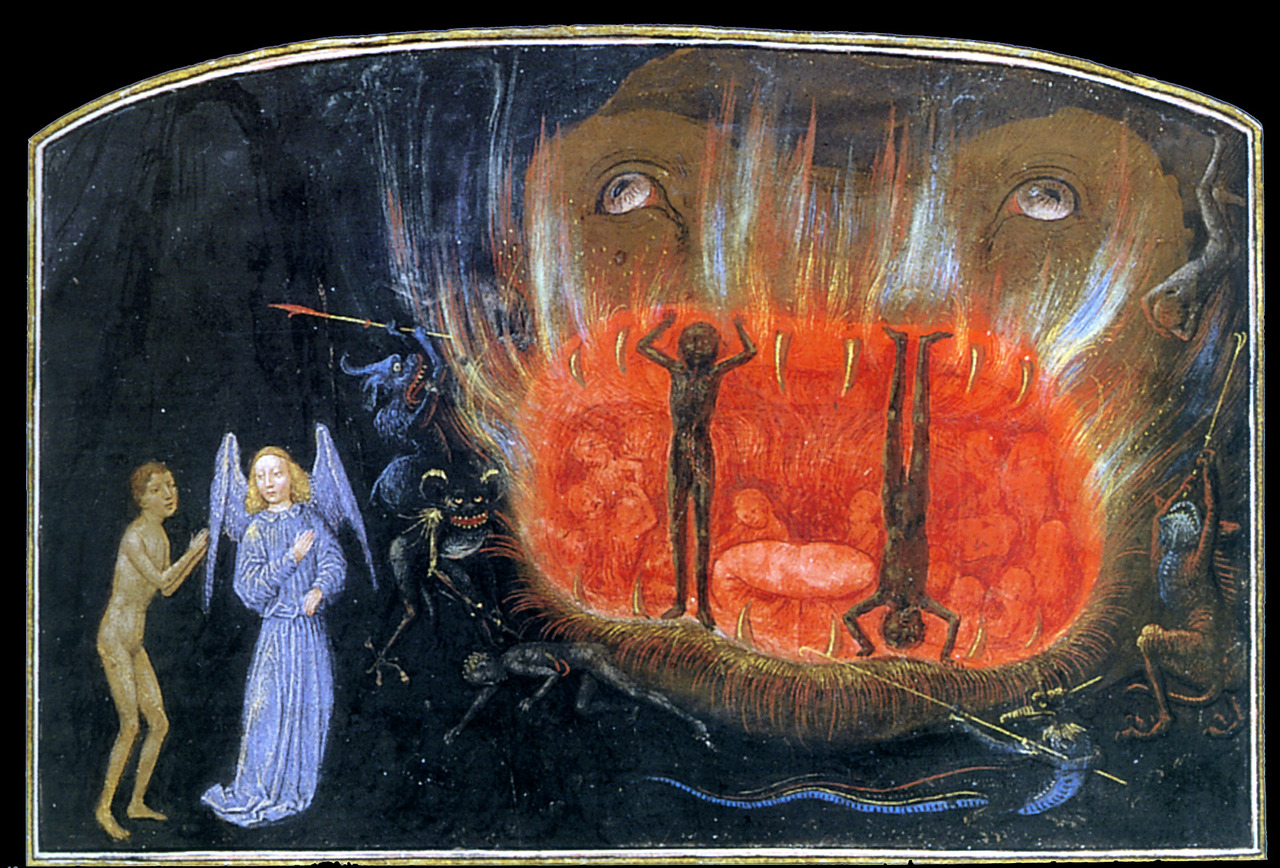
As regards the doctrine of Hell, all Catholic Christians are agreed; but as to what we might call the “devotion to hell,” there is a lawful liberty and variety. The very idea of a “devotion to hell” may seem strange to some minds; and yet when we remember that it is only a particular form of a general devotion to the divine attribute of Justice, the strangeness must at once vanish. The eventual righting of what is wrong, the straightening of what is crooked, the triumph of every seemingly strangled truth, the strangling of every seemingly triumphant lie, is a consummation postulated imperatively by what is best in the human soul ; longed for, prayed for, fought for, not only by saints and prophets, but by every true and just man who has ever walked this earth, with a power of divine indignation in his heart. Dilexisti justitiam and Odisti iniquitatem, “Thou has loved justice” and “Thou hast hated iniquity “ are inseparable correlatives; and it is only the growing decay of belief in human responsibility that has, by weakening the first impulse, also weakened the other, and has canonised this emasculated morality, this flaccid indifferentism, under the name of benevolence. There can be no adequate love of the divine goodness that leaves out any factor of that goodness ; and justice no less than mercy, majesty no less than meekness, strength no less than gentleness, go to the building up of our conception of God’s moral excellence.
So far then as there may be, and is, in certain souls, a special responsiveness to the beauty of justice ; and so far as the doctrine of hell can be regarded as bound up with the notion of God’s justice, we can conceive a person having a special devotion towards that doctrine and dwelling upon it frequently with a certain pleasurable complacency. But every devotion is liable to perversions and excesses, and needs to be curbed and brought into harmony with every other part and principle of Catholic truth ; just because each feeling (and devotion implies feeling) tends of its own blind nature to assert itself to the exclusion of every other, and to tyrannise over the mind and reason. Hence so many heresies are simply perverted devotions. We have an example of this in Tertullian, whose “devotion to hell” is about the earliest instance on record. Here what may have been originally a love of God’s justice, a sympathy with the divine indignation, quickly degenerated into an angry and egoistic vindictiveness, a hatred of wrongdoers and misbelievers, ostensibly, as opponents of truth and right ; really, as his own personal opponents—as members of. a hostile party, section, clique. Tertullian was yet orthodox in his own eyes, and in those of others, when he dwelt with a cruel gleefulness on the prospect of contemplating hereafter the torments of his adversaries in hell ; but the seed of death was already in him—charity had no part in that thought, and faith, next to none ; it was a mere outbreak of personal vindictiveness, of the pent-up heat generated by acrimonious controversy.
I say “faith, next to none”; because, as far as theology goes in its own abstract line, we are constrained by logic to say: The blessed in Heaven rejoice in the will of God : but the torments of the reprobate are the will of God ; therefore the blessed in Heaven rejoice in the torments of the reprobate. This we can stand from the theologians so long as it is clearly understood that the minor is not an obvious truth of common-sense, but a very profound mystery, and a very grievous burden to our faith ; that it is true in some sense beyond our present sense ; that it finds its full justification in certain supplementary facts which we know not now, but shall know hereafter. But when faint illustrative analogies from reason are put forward as satisfactory and adequate explanations of a difficulty which is only aggravated by such futile alleviations, we at once resent this intrusion of pert rationalism into the arcana fidei, and send the would-be theologian about his business. Still more are we justly disgusted and irritated if, rightly or wrongly, we suspect that the wish has been father to the thought, that, as in the case of Tertullian, a certain residual savagery, latent in our composition to a less degree or a greater, is gratified by that mask of severity and cruelty which the doctrine wears ; and that a mere heartlessness and lack of moral sense is disguising itself under the garb of vigorous faith and zealous devotion to the justice of God. If there is intellectual provincialism and narrowness in being surprised that the absolute view of things, as known to God alone, and as revealed to us by Him, should seem utterly unintelligible from our little corner of immensity, there is a still greater degree of mental and moral obliquity in one who finds in such a doctrine as that of hell no perplexity for his reason, no shock to his affections, no violation of his sentiments. That what seems black to me may seem white to God (and what it seems to Him, that it is, absolutely and all round) ; that the cloud, which looms dark as I look up to it, may be a bright sea of glory as He looks down upon it, is a general truth that well-taught reason assures me of—however my faith may stumble in applying it to particular cases ; nay, more than this, it is evident to reason that the absolute and all-round view of things, attainable only to that Mind which gathers the whole into one simple unity, must reveal order and goodness and intelligence where I can see nothing but confusion and evil and folly; that no view, comprehensible and wholly satisfactory to a finite mind, can possibly be the ultimate and absolute view. But though God and reason demand that I should often believe that to be white which seems black to me, yet never am I asked to believe that what seems black to me seems white to me. And so, if 1 must believe that what seems to me cruelty and injustice in the doctrine of hell is only an illusory appearance due to my imperfect comprehension of the dogma—an appearance which will vanish in the light of supplementary facts as yet inaccessible to me ; yet I am not bound to believe that the doctrine does not seem cruel and unjust, or that reason can find for it a positive justification, as well as a negative defence. Until I have a key to the riddle I can and even ought to say that, as stated, it seems, and is intended to seem, absurd and impossible ; for it causes man to appear more just, more kind, than his Maker, thus allowing the river to rise higher than its source. When God appears to us in blood-stained garments and terrifying aspect, doubtless He intends that we should be terrified, and yet that, at the same time, we should surmount or go behind appearances by a faith which, in this matter, is only the very perfection of reasonableness. Indeed it is hard to think He should be pleased with the disposition of one so out of sympathy with the Divine character as to experience no shock for faith to withstand.
What we have said as to hell holds good in reference to other difficulties against our faith in the absolute goodness and wisdom of God, arising from the existence of suffering, the permission of sin, the problem of predestiny. The attempt to rationalise these mysteries, to level them down to our range of vision, to patch them up, to whittle them away, is responsible for the widespread decay of faith which they have occasioned—well-meant ingenuity no doubt, but surely misguided and ill-judged ! As far as the matter is presented to us, we should say frankly that, were. any man to act with such calculated cruelty as God seems to act with, according to the commonly expounded doctrine of predestiny,euch a man should die the death. But God cannot be cruel, therefore the matter is only partially and inadequately presented to us; and supplementary facts will make the crooked straight and the rough smooth ; filling up the lacuna in our knowledge and levelling the obstacles and scandals. When God chastises us He certainly does not expect us to like it; nor does He expect the discipline of faith to be agreeable and easy. Thousands would willingly submit to these mysteries were they allowed to preserve that agnosticism in their regard which is one of the elements of real faith ; but they will not, nay, they should not, give up their liberty of shuddering at appearances, while trusting in realities.
Where there is a seeming antinomy, as between the truth of God’s goodness on one side, and the truth of predestiny on the other, intelligent faith will hold the two irreconcilables together, without attempting any premature and impertinent synthesis,donec dies elucescat et lucifer oriatur; but since such balance is rare, and the mind always inclines to rule one of the truths into agreement with the other, at least we should follow Joubert’s advice, and make that which is clearer the rule of the less clear. The goodness and wisdom of God is a clear truth, whereas the doctrine of pre-destiny or of hell is an obscure truth ; yet the Calvinistic temperament ever tends to take the latter as luminously self-evident and as throwing shadows of doubt over the former; to make a thesis of the difficulty and a difficulty of the thesis.
It is in this temperament that we sometimes find a morbid perversion of the “ devotion to hell,” a pleasurable complacency, not merely in the essential reality signified by the doctrine of eternal punishment, but in those very features of its presentment that faith tells us are but due to our relative and imperfect mode of apprehension ; which exults in the seeming cruelty and injustice, rather than in the absolute justice and love which, reflected through our dim atmosphere, present this distorted appearance. Stranger still is the desire that no one shall have the bitter pill sugar-coated for him, but shall swallow it without a grimace, with not so much as a drop of water to wash it down ; nay, he must swallow, not only the kernel of truth, but the very husks and shells, the opinions, theories, and illustrations with which it has been set forth by popular preachers or writers. It is these strange, but not inexplicable, tendencies to extravagance that make the attitude of some towards the doctrine of hell justly comparable to a devotion ; for it is only some engagement of the affections that can play such tricks with the understanding. He that touches their hell, touches them in the apple of their eye; all that would lighten the burden of faith, or sweeten its yoke for them, is heterodox; all that aggravates and embitters it is orthodox ; and when we ask ourselves : Why should it not be just the other way about ? the answer is that the darker truth of the antinomy has been chosen as thesis, and the clearer is consequently treated as a difficulty—this choice being the result of a certain Tertullianism of temperament, fostered by education, which exercises a selective influence in the free formation of the mind.
The nature of the pains of hell, the nature of its eternity, and the proportion of mankind that goes there, are all matters of some dispute, where this temperament can display its selective influence, choosing ever what is more, rather than less, difficult to normal intelligence and moral sense. One would not think, at first sight, that the precise mechanism by which the pains of sense are produced was a matter of vital moment ; still, if indeed it be a revealed point, we are willing to believe that material fire is the agency by which the fallen angels are tormented. But the particular gratification that certain minds get out of the materiality of the fire can only be accounted for by a nervous dread of in any way making the doctrine mysterious, or removing it from the jurisdiction of common-sense—of that semi-rationalism, which delights to express and explain things spiritual in terms of matter and motion, of chemistry and mechanics. The pain of loss, they admit, is, no doubt, the substantial and principal part of hell; but then it is something mystical, spiritual, unreal, immaterial, so let us have our good familiar hearth-stone fire that we all understand ; there are difficulties, no doubt, but they can be smoothed away with a little ingenuity. Rather than part with the materiality of the fire, they will endow it with a special, supernatural, “spirit-paining” quality, which is tantamount to saying that the pain is not produced by fire at all ; or they will tell us that, though it does not affect the spiritual substance per modum combustionis, or by way of burning, it does so per naodum alligationis, or by way of bondage ; not, however, that the withes and straps by which the spirit is fastened to the flames gall its limbs and members, but that its sense of propriety and self-respect is hurt by its unseemly embodiment in gross material flames — an explanation which upholds the existence of material fire while depriving it of its proper function, which is the disintegration of matter ; and which unwittingly substitutes moral
for physical pain. Whatever meaning, therefore, may be hid away in the affirmation of the materiality of hell-fire, it is no meaning clearly accessible to us, until we know a good deal more than even philosophers know about the precise nature of matter, and of fire, and of combustion, and of spirit, and of sensation in general, and of pain in particular. Far from bringing the doctrine of hell within the scope of our vulgar reason, it pushes it further than ever from the reach of our intelligence, and warns us more emphatically that we are in the region of faith and mystery, and must wait the answer to these riddles in patience and humility.
Eternity, again, admits of a dangerously mystical and spiritual mode of conception, painful to the devotees of matter and common-sense, who accordingly prefer to explain it as time multiplied by infinity ; and who rather resent the seeming—though, indeed, only seeming—alleviation, given to the terrors of hell by taking eternity strictly as a tota sisnul duration. For this sounds to them like saying that it will all be over in an instant—a cruel injustice to themselves, who have borne the burden and heat of the day. Of course this is a misconception, for, as Aquinas explains the matter, it is not that there will not be the equivalent of infinitely protracted time in eternity, but that the protraction of time is something indifferent to the penalty. When a man is sentenced to six months of hard labour the penalty is not sudden and complete in the first instant, but part is added gradually to part till the sum is fulfilled ; but when he is sentenced to lose life or limb, the eternity that follows his penalty does not augment it, or otherwise affect it. Still, just because there is a mere semblance or sound of alleviation of the intellectual and moral difficulty in this mode of presentment, our devotees will have none of it, but will go on with their studies in celestial mechanics, their æonian calculus, piling century upon century and age upon age; sitting down breathless at times to rejoice in the reflection that they have only just begun.
But it is more especially in the peopling of hell that there is room for the play of temperament and personal devotion, in selecting one or other of the many free views open to Catholic Christians. I read, in a recent number of an ecclesiastical periodical, that two eminent theologians have satisfactorily refuted the work of another theologian defending the opinion that the majority of mankind will be saved. It might not at first sight, and apart from the grave authorities, patristic and otherwise, on the opposite side, seem an altogether rash and extravagant opinion that, out of the some fourteen hundred millions of the present population of the globe, something less than seven hundred millions should perish everlastingly ; or, to put it in other words, that only forty-nine per cent. of the people we meet any day in London are doomed to eternal flames. Still, we may more than suspect that this lax theologian, sadly weak in devotion to the doctrine of hell, and with a strong Sacré Cæur or anti-Calvinist bias, really meant, in the naughtiness of his heart, much more than he dared to say; that, g ven an inch, he had it in petto to take an ell, and, once over the crest of the hill, to run down the other side at a gallop. For ourselves, while respecting the goodness of his heart and the amiability of his intentions, we have no belief in the wisdom of his • endeavour, and without pretending to analyse the spirit of his opponents, or to determine whether or not they be of those whose devotion finds rest in “the greatest possible misery of the greatest possible number,” we have no difficulty whatever in embracing their conclusions, or others still more rigorous, were they, too, shown to be part of Catholic doctrine.
For, indeed, as we scholastics say, Magis et minus non mutant speciem— “More or less does not change the quality.” That a man has been convicted twenty times, rather than two hundred times, for pocket-picking is a point quite indifferent to my estimation of his moral character. Whatever sense of transcendental benevolence in me might be faintly gratified, could I accept the more lenient view, I should not, on that account, wish to entrust the gentleman with the management of my purse.
The real difficulty proposed to our faith in the doctrine of hell is that God, foreseeing that even one soul should be lost eternally, should freely suffer things to take their course, when He could (not only de potentia absoluta, but, as theology confesses, de potentia ordinata) have hindered the tragedy. This, in default of supplementary knowledge, which faith expects hereafter but does not possess now, is so appalling a mystery to those who reflect, that the mere multiplication of the seeming offence is a matter of but little concern, a mere straining at a gnat after having swallowed a camel. But the same intellectual humility, the same unshakable trust in the truth that no man has ever conceived any thought of mercy or loving kindness comparable to the thought of God, who put that conception into his heart, makes faith as easy in one case as in the other—if only rationalism would cease its elucidations. God will save His word in all things ; no particle of the Church’s accredited teaching but shall be found true in some higher and grander sense than our poor muddled wits ever dreamt of ; and yet all shall be well. Thus we can hold, on the one hand, that the gate is strait and the way narrow that leads to life, and that few find it ; and, on the other, that “ somehow good shall be the final goal of ill”; we can hold that there is a higher truth that binds these contraries together, and, by supplementing, harmonises them. And far deeper and higher is the faith that not only holds firmly to both the seemingly conflicting views, and waits confidently for their synthesis hereafter, but reverently rejects all attempts of intrusive rationalism to rob faith of its crown, and to anticipate the dawn of God’s own day.
Those who are in a position to know how much distress and difficulty is caused to many souls inside the Church, and how much scandal is offered to men of goodwill outside, through short-sighted attempts to accommodate to reason what can only be accepted on faith, will not take these reflections amiss. If, in behalf of those who possess the faith, the attempt to sever tares from wheat may often be dangerous, for those who are seeking the faith, which they have lost or which they never had, the severance is all-important. As a rule, it is not the truth that is doubted or rejected, but the setting in which the truth is embedded, the husk which encases the kernel and makes it all-repulsive and unappetising.
It would almost seem, from many indications, that the same rationalism in religion which occasioned the defection of the sixteenth century has, like a fever, worked itself out, and brought about its own cure by an experimental demonstration of its insufficiency as a substitute for faith. In a saner spiritual philosophy, born of a revolt against materialism—the last and lowest form of rationalism—a basis is found for a certain temperate agnosticism, which is one of the essential prerequisites of intelligent faith ; the attempt to build up and interpret the higher by the lower is definitively abandoned; the essential incapacity of finite mind to seize the absolute end, which governs and moves everything towards itself ; the natural necessity of seeming contradictions and perplexities in our estimate of God’s thoughts and ways, is accepted as inevitable. This sense of our mental insufficiency is no reason for credulity; nor does it relieve the “ apologist” of his burden of establishing the fact of revelation ; but it prepares the way for Christ, by showing that something equivalent to a revelation is as much an exigency of our nature as religion is. Thus God’s spirit working outside the Church is preparing for Himself an acceptable people; and we within must co-operate and go forward to meet this movement, by purging out of our midst any remnant of the leaven of rationalism that we may have carried with us from earlier and cruder days, when faith needed the rein more than the spur.
This Webpage was created for a workshop held at Saint Andrew's Abbey, Valyermo, California in 1990