|
|
|
|
|
|
Sixth
impression..Longmans, Green, and co.
39 Paternoster Row, London New York and Bombay 1904.
Nihil Obstat: Gulielmus Roche,
S.J., Censor Deputatus.
Imprimatur : Herbertus Card. Vaughan, Archip,. Westmonast.
The Author wishes to thank those who have in various ways helped him in the task of producing the present volume; and more especially Mr. C. Kegan Paul, who kindly read through the proofs.
“
Durus est hic sermo, et quis potest eum audire?
”—Jn.
6.61.
[This saying is hard,
and who is able to hear it?]
INTRODUCTION
ALTHOUGH the following conferences and meditations were in no way originally designed to be parts of a whole, written, as they were, at sundry times and in divers manners, yet there has been some imperfect attempt at method in their selection and arrangement which, though not very apparent on the surface, may make itself felt in the unity of their effect upon the reader’s mind. Their purport is to illustrate and, so to say, turn over in various ways a very few of the deepest and most wide-reaching principles of Catholic Christianity, by which they are pervaded and upon which they have been built up with a somewhat dialectical severity which can hardly escape unfavourable criticism, as seeming to encourage an excessive rationalizing in matters too delicate for the coarse hands of the logician. The writer has had this danger continually before his mind as something to guard against, but since his aim has been confessedly to simplify, explain, and coordinate, it would be too much to hope that he has avoided all the errors and extremes which usually beset such an undertaking.
For indeed there is a most unpardonable narrowness as well as impertinence in the desire to represent the intercourse between the created spirit and its indwelling Creator in terms as sharp and exact as those which describe the dealings of father and son, master and servant, ruler and subject, husband and spouse. These familiar relationships bear a distant analogy to those subsisting between God and the soul, but fall immeasurably short of the reality. They are as a few rough, suggestive strokes drawn by a skilful hand, which will serve to bring to our mind all the meaning and expression of a face if only it be already familiar to us by experience. But an inordinate love of clearness, an over-pressing of analogies and similitudes is a form of rationalism very fruitful in fallacies, and not very uncommon in ascetical writings. If, however, we use these metaphors with a full reflex consciousness of their imperfection, then indeed we may do so fearlessly and abundantly, trusting that where one is weak another may be strong, and that from many faulty adumbrations some vague image of the whole truth may shape itself in the mind.
What we have to guard against is the narrow pride of that rationalism which inclines some to be impatient of all ideas that are in any way obscure and imperfectly defined; to cast out of the mind as worthless those that are not clear and distinct ; to apply the methods and criteria of the “exact sciences” to matters of a wholly different order; to be abhorrent of all that savours of mysticism. For this is to forget that every new idea that enters our soul, so far as it is new and incomparable, and unlike what we have previously known, is fringed with mystery, and is only very gradually defined and analyzed as to its full contents; it is to ignore the simple fact that our mind comprehends fully only what it has itself created—forms and numbers, and figures and relations ; and that of the least atom of God’s creations it can at best grasp a side or a surface or a corner, but can penetrate nothing. Still more evident is it that most of the truths relating to the commerce of God with the soul are necessarily veiled, amid obscure to us in our present embodied condition, since they can never be properly expressed in terms of anything that falls under our senses—in terms of the only language we are skilled in. Ultimate truths, those which are concerned with the Alpha and Omega of our existence, are from their very nature set at the extreme limit of our intellectual horizon, so that we never see all round them or beyond them. Our mind is made for what lies between : for movements and processes and the laws by which they are governed; but before the “ Ultimates,” the unchanging realities of the timeless, spaceless world, whose existence is postulated in our every thought, our progress is abruptly arrested as by a dead wall, behind which all is impenetrable mystery: “ Hitherto shalt thou come and no further, and here shalt thou break thy swelling waves.”
Yet these are the truths most essential to our spiritual life, and ignorance of which is chiefly to be deplored. They are, moreover, truths for which man has by nature a most insatiable intellectual curiosity that breaks out everywhere, even in the most barbaric and uncultivated minds ; and yet with regard to which he is as helpless, as much in need of God, as the babe is of its mother’s breast ; and if his craving for the mysterious, the wonderful, the supernatural, be not fed by true religion, it will feed itself on the garbage of any superstition that is offered to it.
Indeed, the soul will never be raised higher or further strengthened by any truth which it has once thoroughly penetrated or comprehended, and which therefore retains for it no element of mystery or wonder, for it is only by straining to comprehend what exceeds its present grasp that it grows great.
Mysticism deals with such half-veiled, half-revealed truths as we speak of. There is no doubt a false mysticism which values obscurity for its own sake, and wraps up the simplest truisms of morality in clouds of confusion till they loom great and mysterious ; and which on this score lays claim to special gnosis and prophetic insight. But this child of affectation, or self-delusion, or ignorance, no more discredits the true mysticism of à Kempis or of St. Teresa, than spiritualism discredits spirits, or jugglery discredits the miracles of Christ.
Having thus insisted on the reasonableness and necessity of mysticism, as opposed to crude rationalism and to the nonsense of soidisant “common sense “ in spiritual things, we must equally insist on the importance of using all the light and help that reason rightly used affords us in these matters; of recognizing here, as elsewhere, progress and development in our understanding of Divine truth (itself unchanging)—a progress in distinctness and coherence of idea and statement ; a continual and faithful retranslation of the words and forms of one age or country into those of another; an adaptation of immutable principles, to the ever mutable circumstances of human life. For where this work is neglected, the language and conceptions of a former generation become, first, tasteless and commonplace; and then distasteful and repugnant to the changing fashions of thought and speech in succeeding generations—except in the case of those rare works of genius and inspiration which, like the Scriptures or the Imitation, are catholic and \ eternal.
Thus much, then, in justification of what might seem to be a too dialectical treatment of subjects to a great extent beyond the reach of so rude a method.
Again, the writer may be reproached with a certain indecency and irreverence in attempting to make bare to the public gaze many. of those deeper mysteries of our holy religion which the instinct of more delicate minds has ever hidden in a language “ not understanded of the people.” This disciplina arcani the Church has learnt from her Divine Master, whose parables were “ words to the wise,” mercifully veiling from the many the light which they could not bear, and which would have been only to their ruin and not to their resurrection. Also there is a sacred duty of guarding the higher truths of the Eternal Kingdom from the profanation of being discussed, perhaps ridiculed and blasphemed by those whose minds and hearts are void of the first principles whence a sympathetic understanding of them might be evolved. As it is, there is scarce a hireling journalist who is not as ready with his flippant criticisms on the mysteries of the Kingdom of God as he is with those on political or scientific or literary topics. Nothing is sacred from his omniscient pen. Is it then seasonable thus to cast pearls before those who will but trample them under foot and turn again and rend us ?
If after some hesitation the writer has determined to face the possibility of such ill-consequences, it has been from a conviction that it is rather through an insight into the high and all-satisfying ethical conceptions of the Catholic religion that men are drawn to embrace it than through any more speculative considerations. Loquere ad cor populi hujus—Speak unto the heart of this people, was the Prophet’s commission ; nor can it be denied that it was because He knew what was in man that Christ had such irresistible power over the hearts of men ; for here if anywhere knowledge is power. So there is nothing that establishes and confirms our implicit faith in the Catholic religion of Christ more than the clear conviction that she alone knows what is in man, and holds the secrets of life’s problems ; that she alone has balm for the healing of the nations; that she alone can answer firmly and infallibly what all are asking, with an answer harsh at first sounding, and austere, but on reflection kind and consolatory, and, like the “hard sayings” of her Master, “ full of grace and truth.”
It is not till men’s hearts are deeply drawn towards the Church for one reason or another, that their minds are sufficiently freed from the natural bias against a creed so exacting and imperious in many ways, to make them desirous or capable of listening to her claims.
For this reason, therefore, it is to the heart we must make our first appeal, by bringing together as far as we can those various truths which embody the Church’s explanation of life as we find it; by showing their mutual bearings, their harmony with one another, and with the stern facts they deal with and explain. If the Church has an answer which will give a meaning to pain and temptation and sin and sorrow, which will point to law and order where otherwise there is nothing apparent but painful darkness and confusion, which will verify and connect what is to all seeming manifold and disconnected, even though that answer be hard and repulsive in its very simplicity, surely it should make every honest truth-seeking mind pause to see if indeed these things be so, if indeed darkness can be so touched with light, and sorrow so turned into joy. If the solution fits the problem it may indeed be the result of chance, but it is a chance that becomes ever more incredible as the conditions of the problem are seen to be multiple and intricate: and the more we know of life’s complications on the one hand and of the Church’s simplification on the other, the less possible is it for us to doubt that she is from on high, the work of those hands which fashioned the human soul, and which provide for the needs of every creature they have fashioned.
We do not mean that our needs demand and explain every point of Catholic teaching, as though that religion were merely the complement of our nature’s exigencies, and were not also supernatural, giving more than our heart as yet knows how to desire. But the whole idea of personal trust and faith is that those whom we have found loving and true to us in matters we can test, should ever be accredited with the same love and truth in matters beyond our criticism. So it is with faith • in God, with faith in Christ, with faith in the Catholic Church ; we understand enough to warrant full trust in what we cannot understand, or cannot even expect to understand.
It is, then, the belief that a deeper and more comprehensive view of the Church’s ethical and spiritual ideals; of her conception as to the capacities, the dignity and destiny of the human soul, of the hope that she inspires in the midst of so much that is otherwise disheartening, of the light which she sheds over the dark abyss of sin and temptation and sorrow—it is the belief that such a comprehensive view may in some cases serve far more effectually than any direct apologetic to win, to establish, or to confirm an abiding faith in her divine origin and operation, that must partly excuse or justify an otherwise reprehensible popularizing of the “ secrets of the King.”
Not indeed that any one mind however broad and deep can ever hope to grasp the Catholic idea in its entirety, or can ever count itself to have comprehended perfectly what by reason of its magnitude must elude all but an infinite thought. If every advance in the knowledge of Nature advances us in knowledge of our ignorance of Nature, the same holds good of our study of the Christian revelation, of the idea of Christ and the Church. Man’s brain grows to and outgrows religions that are its own creation, the provisional expression and images of that Reality which touches him in conscience, and cries out to him in Nature. But it does not, and cannot, outgrow that revelation in which God has expressed for him, albeit in faltering human language, realities which are beyond all reason and experience. Our conception of one whom we meet and observe daily will grow in depth, in volume, in accuracy; but our conception of one whom we know only by hearsay cannot go beyond what is contained in that hearsay. Yet this content may be infinite in potentiality, like some mathematical expression from which a process of endless building-up can be started. And so it is with that conception of Himself and of His Christ and of His Church which God has given us in the Christian revelation.
It is an idea which admits of infinite evolution, which the Church keeps and broods over and ponders in her heart ; in which the best thought of every age finds its highest ideals satisfied and surpassed. Superficial critics who shrink from the labour of a wide induction, are perpetually treating this idea as it is found in some particular mind or nationality or period, and by consequence confounding what is accidental with what is essential, and failing to distinguish its morbid from its legitimate developments.
And indeed it is to the Church, who watches over this process, that we must look for our guidance as to results already obtained. But starting where she leaves off and following in the direction of the lines she has laid down, the minds of her children will ever press on towards a fuller intelligence of the mysteries of faith, turning back at times to gain her approval or to receive her rebuke or to listen to her counsel; and thus, under her supervision, they will purify the Catholic idea more and more from all foreign admixture and build it up member by member, nearing, yet never reaching, a perfect disclosure of its organic unity, its simplicity in complexity, its transcendent beauty.
Finally, in choosing Hard Sayings for a title, allusion is made to the occasion when many of the disciples of Jesus turned back and walked with Him no more, because of His doctrine concerning the great Mystery of Divine Love, in which all the other mysteries of the Catholic faith are gathered up. That this Man should give us His Flesh to eat, that bread should be His Body, is indeed a “hard saying” for the many who are the slaves of their imagination, and who fancy that they know something of the constitution of matter and the limits of Divine omnipotence. But for the more thoughtful it is a far harder saying that God should so care for man’s love as to come down from Heaven, and take flesh that He might woo man in man’s own language—the language of suffering. And if these things are hard to the understanding, it is still harder for the weak will to hear that God must be loved back as He has loved us, with a love that yields pain for pain, sacrifice for sacrifice, death for death.
Here the Church has ever been faithful to her Master. Others have, with false kindness, mitigated the “ hard sayings,” and prophesied smooth things, and drawn away the weak from her side. But with all her human frailty, ever shrinking from the stern ideal of the Cross, from the bitterness of the Chalice of her Passion, when asked she has but one ruthless answer, namely, that it is only through many tribulations that we can enter the Kingdom of God; that Christ’s yoke is easy, not because it is painless, but because love makes the pain welcome.
To whom then shall we go but to her who has the words of eternal life, who for two thousand years has kept all these sayings and pondered them in her heart ?
G. T.
Wimbledon.
SS. Peter and Paul, 148.
|
CONTENTS |
[9] “QUID EXIT NOBIS ?” |
152 |
|
|
INTRODUCTION |
vii |
[10] THE LIFE EVERLASTING |
169 |
|
[1] THE SOUL and HER SPOUSE |
1 |
[11] THE ANGELIC VIRTUE |
194 |
|
[2] THE HIDDEN LIFE |
15 |
[12] A GREAT MYSTERY |
220 |
|
[3] THE PRESENCE of GOD |
29 |
[13] THE WAY of THE COUNSELS |
261 |
|
[4] GOD in CONSCIENCE |
45 |
[14] THE DIVINE PRECEPT |
295 |
|
[5] SIN JUDGED by FAITH |
69 |
[15] THE MYSTERY of FAITH |
314 |
|
[6] SIN JUDGED by REASON |
93 |
[16] IDEALISM, ITS USE and ABUSE |
345 |
|
[7] SIN and SUFFERING |
111 |
[17] DISCOURAGEMENT . |
376 |
|
[8] THE GOSPEL of PAIN |
131 |
[18] THE MYSTICAL BODY |
397 |
|
APPENDIX.—Note to “ The Gospel of Pain |
449 |
||
|
|
|
|
[1] THE SOUL and HER SPOUSE
Veni,
Electa Mea, et ponam in Te
thronum meum.
“Come,
My Chosen One, and I will stablish My throne in thee.”
THE end of man is, to save his soul—Salus anime. But what this health and well-being consists in is specified when St. Ignatius1 tells us that it is in praising, reverencing, and serving God, in these three manifestations of Divine love, that salvation is realized. Health lies in the right balance of nutrition, in regularity of function, in the orderliness of our bodily conditions; and our spiritual health, in like manner, means ordination; the due proportion and subjection of all our faculties to God their Creator and Lord; the submission of our mind to the rule of Divine truth; of our affections to the rule of Divine love. Hence the whole aim of the Spiritual Exercises is to secure ordination; to induce that all-mastering love of God in which the soul is saved, perfected, and brought to its highest state and noblest activity.
1 This discourse has reference to the opening words of the Spiritual Exercises of St. Ignatius Loyola. [“The cares of the pastoral charge of the whole flock of Christ entrusted to Us and Our devotion to the glory and praise of God impel Us to embrace what helps the salvation of souls and their spiritual profit...”,]
As the natural life of the soul depends on God’s dwelling in its substance, so the supernatural life or Eternal Life of the soul is God, who dwells as light in the mind and as love in the heart, and who is the object of that light and love.
Here, as hereafter, the life of the soul is to see God and to love Him, though the mode of seeing is different; here, it is through a glass darkly, in a riddle, there, face to face; here, in part, there, wholly and perfectly ; here, as a child, there, as one who has put away the things of a child. A little girl thinks herself absolutely happy when she nurses her first doll. As a woman, with a living babe at her breast, she looks back on that former bliss and laughs. In Heaven she greets her child once more; and once more she wonders that she could ever have rejoiced before.
Eternal life is God in the soul. God is the soul’s soul. As the body corrupts when abandoned by the soul, so too, the soul corrupts, morally and intellectually, it becomes foetid, loathsome, disintegrated, deformed, apart from God. God is the beauty, the health, the salvation of the soul. We speak too exclusively of entering into Heaven, into life, into God ; forgetting that the relation is truly—perhaps more truly—expressed by saying that God, and Heaven, and life, enter into us. We dwell in God, just because God dwells in us. The branch abides in the vine and the vine in the branch ; but principally the vine in the branch. We feed upon Christ, He does not feed upon us. “ The Kingdom of God is within you ; “ it is in your midst ; therefore we pray: Adveniat regnum tuum. We speak of that Kingdom coming to us, not of our going to it,
|
Vegna vêr noi la pace del
tuo regno |
Thy Kingdom
come, that peace with us may reign; |
(Dante, Purg. xi.)
Heaven, in its substance and apart from mere accessories, is simply the love of God perfected in the soul; the entire cleaving of the soul to God, whom she embraces with mind and heart—Inveni quem diligit anima mea; tenui nec dimittam s And again : Mihi adhærere Deo bonum est. “I have found Him whom my soul loveth: I have laid hold on Him, and I will not let Him go.”— My sovereign good, my heaven, consists in cleaving to God. And as eternal life is the love of God elevated and carried to its extreme perfection, so eternal death is the disease of sin worked out to its last consequences. Hell, in its substance and apart from all accessories, is in the soul, as truly as the soul is in Hell—perhaps more truly.
This answer alone explains man, and proves its own verity by its fitness. Were the soul a simple problem, chance might stumble on many an apparent solution ; but so complicated a riddle is past guesswork. A lock with a hundred intricate wards is the only possible explanation of the key which alone fits it, and which fits it alone. The soul, apart from God, is as meaningless, as useless as a stray key. Its whole structure and movement cries out for God. Who could understand the eye, with its lenses and mirrors and inexplicable mechanism, who knew nothing of light? Everything in the eye has reference to light, and everything in the soul has reference to God. Everything in the ear is unintelligible to one born deaf, and everything in the soul is incoherent and senseless for one who is dead to God. When we see the vine straggling over the ground, its tendrils are unexplained ; but when it climbs and clings to the prop we know what they were made for. God is the soul’s prop. The soul is simply and wholly a capacity for God, and nothing else; just as the monstrance with all its golden rays and gleaming jewels is simply and wholly a receptacle for His Sacramental Presence—a crystal shrine through which the faithful may see and adore the Bread of Angels. Our soul is such a monstrance; and its highest beauty and glory is from Him who dwells in it, and shines through it. He is the light, she is the lamp. On Protestant altars we sometime see (or used to see) candles which are never to be lighted. “How unmeaning!” is our first thought. The soul is God’s candle, on which He descends like a flame and transforms her substance into His own likeness. The candle was evidently made for the flame which crowns it, beautifies it, quickens it. God is not the soul, nor is the soul God; but as the candle is for the flame, so is the soul for God.
When Adam slumbered, God drew from his side a help meet for him ; a being altogether made for him, soul and body, inexplicable without him. God drew the soul of man from His own side, and she is restless till she returns thither again. The soul is God’s spouse; made for His embrace, made to bring forth in herself His Word, His Image, His - Beloved Son. And the passion of the purest and noblest heart of man is but the far-removed symbol of the ardent love of God for His spouse. To Him her whole being cries out : Thou hast made me for Thyself, as the casket for the jewel, as the mirror for the sun, as the eye for light, as the ear for sound, as the harp for music. My mind craves for truth, and Thou art the Truth ; my will for good, and Thou art the Good; my heart for love, and Thou art Love ; mine eye for beauty, and Thou art the Beautiful; my ear for music, and Thou art Song; my soul for eternity, life, and salvation, and Thou art Eternity, Life, and Salvation.
We may say of the soul what is said of Divine Wisdom: Thesaurus est infinitus quo qui usi sunt facti sunt amici Dei ; she is an unending treasure which few are aware they possess; a secret and unsuspected fount of perennial joy; a well of living water springing up unto life everlasting; a deep and difficult well for those who have not wherewith to draw. With most of us our soul is as a musical instrument in unskilled or half-skilled hands; but from which trained fingers can draw forth melody and sweetness. We are too slothful to go through the preliminary drudgery of practice. Impatient for some little present gratification, we pick out little tunes by ear, and never become masters in the art of spiritual music. Or it is like a great poem which to a child or a rude-minded person seems tiresome and overrated, because a certain amount of education is needed before the mind can answer to its appeal, and enter into its joy ; or it is as one of the old masters whom the crowd hurries by in our picture-galleries in order to pause enraptured before some flaring vulgarity, while the true artist lingers over every line and shadow with a pleasure which is accentuated and not blunted by use. Qui edunt me adhuc esurient—” They that eat me shall hunger for more,” is true of God and of every good that is Divine.
Plainly our chief care must be to learn to use this treasure aright, to extract as much value out each moment as we possibly can, to bring the highest faculties of our soul into perfect play. For “they who use it aright are made the friends of God,”—not as though friendship were an added reward, but because friendship with God is itself that very use for which the soul was created, and in which its best faculties reach their highest development. We know how wonderfully mere human friendship opens up the soul and betrays to it depths of which before it was all unconscious, how all that is best in it slumbers and sleeps till it is wakened to energy by the touch of love, by the cry in the midnight of its darkness : “Behold, the Bridegroom cometh.” And herein every other love but shadows forth some aspect of that one all-satisfying, all-transforming love which is the soul’s eternal life, which alone immortalizes her—the love of the Heavenly King and Bridegroom, to whom she is drawn by every need of her spiritual nature ; from whose side she was taken that she might be a spouse meet for Him, as it is written :
Virgins
shall be drawn to the King in her train,
Her
neighbours shall be brought unto thee,
They
shall be brought in joy and exultation,
They shall be led into the temple of the King.’
[Psalm 44.15-16.]
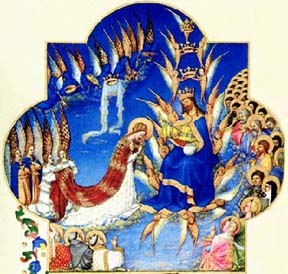
These words are usually, and not unreasonably applied by Holy Church to our Blessed Lady as to the Queen of souls, through whom the souls of the elect are brought to Christ in one living mass, as it were, of swarming bees clustered round their queen. She is the very centre and heart of that great soul-world which God created and redeemed to be a Kingdom for Himself; to be subject to Him as the bride is subject in love to the bridegroom. Virgins shall be drawn in her train to the King; virgins of whom St. Paul writes, “ I am jealous of you with the jealousy of God Himself, for I have espoused you to one Husband, to present you as a chaste virgin unto Christ.” He speaks, indeed, of the entire Church, the whole congregation of elect souls ; but what is true of all is true of each ; each is a kingdom, each a chaste virgin to be presented spotless and undefiled to Christ, her Spouse and her King. “ Glorious things are spoken of thee, O thou city of God, O thou soul of man, thou city of peace, thou city of the great King.” Mary is indeed the Virgin of virgins, whose whole heart was His with a wholeness unsurpassable ; but every soul, however soiled and sin-stained, recovers its virginity when it has been purified for God’s embrace and taught through many tribulations to love God not only above all things, but alone. Therefore we are told that the King proves His elect bride as gold is proved in fire seven times. And St. Paul, who like the holy Baptist, is the paranymph, the friend of the Bridegroom, who has His interests at heart and prefers them to his own, is jealous with the jealousy of God for those souls he is preparing for the King; jealous lest the purity of their affection should be tarnished by the least spot of any love not for God, or from God, or in God. And God Himself is jealous and says: “I, the Lord thy God, am a jealous God ; thou shalt have none other gods but me;” thou shalt give Me all thy love, for I will have nothing less. He is jealous for that He knows that He alone is our Peace, our Life, our all-satisfying eternal Good.
And now see how souls are brought to God: “Virgins shall be drawn to the King in her wake ; “ drawn and not driven, drawn through their affections with the silken cords of love, willing captives to that most blessed tyranny. Drawn by the spell of the King’s beauty, whom at first they behold, not face to face, but mirrored in His created reflex, yet nowhere so fully, so faultlessly as in the Queen of souls who stands at His right hand in her vesture of pure gold, fringed round with many-coloured broiderings. For if He is Speciosus præ filiis hominum— “fair before all the sons of men,” she too is all-fair, and “grace is poured forth upon her lips.” And as we turn from a sudden light to see the source whence it proceeds, so our eye travelling instinctively from the glory which flashes upon Mary’s gold mantle, climbs to Heaven. It is as when we see one whose eyes are fixed in rapture on something we cannot see, and whose face is lit with a joy we cannot understand; yet we fain would know that secret, and are drawn to wonder, and seek, and knock till it be opened to us.
Thus it is that God draws souls to Himself, one through another. Thus it is that we are each to draw souls to Him in the wake of our own, Donec occurramus omnes in unitatem fidel et agnitionis Ai Dei—until we are all run together in oneness of faith and knowledge of the Son of God, until we are all made into one vast body centred round Mary and wedded to Christ, our Head and Spouse.
Proximo ejus afferentur tibi— “Her nearest shall be brought unto Thee.” It is those nearest to Mary who are most quickly, most potently drawn ; those in whose souls there is the least alloy, whose mind and affection has been purged in the fire from all dross and impurity. As the soul nears Mary, it also nears its own birth-place in the heart of its Creator, and is drawn with an ever-quickening speed to its final repose. It is drawn in laetitia et exultatione—” in joy and exultation,” which grows every moment of its nearing. “ In joy,” for “though the strife be sore, yet in His parting breath, Love masters agony.” Like all coming to birth, this throwing off the bands of our narrower self, is not without pain and anguish and cracking of the heart-strings. If the soul is to come to the King, she must forget her own people and her father’s house; yet, labor ipse amatur, the pain itself is loved as the expression and the relief of love. “In exultation,” “leaping, and walking, and praising God,” as the once-lame, glorying in his new-found, God-given strength, or as Mary herself who when carried to the Temple of the King, and being set down on the sacred steps from her mother’s arms, “ danced with her feet,” as the old legend says. “ I was glad when they said to me, Let us go into the house of the Lord ; our feet shall stand within thy courts, O City of Peace.” And the thronging souls who are drawn after her to be presented to the King, they too have tasted the sweet bitterness of sacrifice and offering, and in joy and exultation have cried : “Lord, in the singleness of my heart, gladsome I offer Thee this day all, without reserve” —Domine in simplicitate cordis mei laetus obtuli universa hodie.
But what manner of King is this that the home to which His spouse is brought should be called a temple rather than a palace; that He should be loved with a love of adoration and worship; with sacrifice and offering and absolute self-surrender? Ipse enim est Dominus Deus tuus, says our Psalm, et adorabunt eum— “For He is the Lord thy God whom all shall adore.” “Thy Maker is thy husband,” says Isaias. His love and His absolute right of kingship is founded on His creator-ship, on the entire dependence of the soul upon His abiding thought and care, a dependence whereof that of the child upon the mother in whose womb it lives, is but a feeble hint, even as that mother’s love is but a faint reflex of the love of the Creator for the soul ever new-born in His bosom.
And He rules as King in the soul when all her affections are so given to Him that she loves Him, not only above all things, in such sort that she would leave all else for Him, but alone, loving nothing else but in relation to Him, in the way that He loves it, and desires that she should love it ; and for this consummation He moves her to long, and pray, and labour, and suffer, and cries out within her: Adveniat regnum tuum.
“Oh, when will there be an end to these miseries ; when shall I be delivered from the wretched bondage of these vices; when shall I be mindful of Thee, O Lord, alone ; when shall I rejoice in Thee to the full; when shall I be without all let of true liberty, without burdening from mind or from body; when shall I contemplate the glory of Thy Kingdom; when wilt Thou be to me all in all ; when shall I be with Thee in Thy Kingdom, which from eternity Thou hast been getting ready for Thy dear ones ?”[Imitation, iii. 48.]
Of Mary, “the world’s sad aspiration’s one success,” the one soul in which God has had His own way unimpeded, in which He has fully asserted His presence and shone forth as through a faultless crystal, of Mary it is said, “ The Queen hath stood at Thy right hand in vesture of gold with many-coloured broiderings. Hearken, My daughter, behold, and incline thine ear. Forget thy own people and the house of thy father ; and the King shall long after thy beauty; for He is the Lord thy God, whom all shall adore.” For the soul is indeed a queen, when she is all glorious within, and when Christ rules over her with absolute unimpeded dominion. Subject to any other rule but His, she is so far a slave, nor has she yet perfect liberty, perfect self-mastery. But subject to Christ, she is by the very fact raised to a throne at His side and shares His rule over her every faculty and movement; thus dying to live, and losing to gain, and forsaking all to find a hundred-fold now, and everlasting liberty in the life to come. For what is liberty but the perfect development and exercise of all our powers in due order. Thus, King and Queen, they reign side by side ; God and His little creature. And she is His consort, con-sors, one who shares the same lot or portion. She is ever with Him at His right hand ; whether by His Cross on Calvary or by His throne in Heaven. “ If we suffer with Him,” says St. Paul, “we shall also reign with Him.” If His kingship over her was purchased with sorrow, her queenship is bought no cheaper; there is no way to His side but through thorns and brambles.
How is the queen clad? Like Mary, in her broidered vesture of gold ; in her mantle of worldwide universal charity, big enough to shelter a thousand worlds-full of sinners who fly thither for refuge as chickens to their mother’s wings; that mantle which enfolds the redeemed world as a sunlit sky thinly curtaining off the place Christ is preparing for us in secret, woven of gold purified seven times by her seven sorrows, for what love is so pure as the love we bear those for whom, and even from whom, we have suffered? And the many-coloured fringes with which this mantle is decked around, what are they but the virtues midst which charity rules as mother and mistress, which spring from her bosom, and draw their life from her ; for love is the fulfilling of the law, the sum and substance of all its precepts.
Finally, the vocation of Mary is in some measure the vocation of every soul: “Hearken, My daughter, and forget thy own people and thy father’s house,” forget thyself and every other affection so far as it is debased by any undue infusion of self; lose thy life that thou mayest save it, give and it shall be given to thee, full measure, pressed down, shaken together, and running over; “ leave all, and thou shall find all ; quit thy desires, and thou shalt find rest.” We Catholics need not to be told that the call to closer union with God, to love Him alone, far from deadening or quenching any right and healthy nature affection, or warping or maiming the soul ; perfects, purifies, deepens, and exalts all that it regulates and restrains. None love father or mother or brother or friend so tenderly, truly, eternally, as they who love God more than all, and all for God’s sake, as Jesus loved Mary or John or Lazarus, or the Magdalen, for Divine love is the myrrh which embalms all other love and saves it from taint and corruption. Ungoverned by that over-ruling affection, our other affections are a disorderly riotous mob, weak individually and collectively, and dangerous by reason of their very weakness and waywardness; but under that sway they are disciplined, strengthened, and welded together into the unity of an army with one mover, one action, one end, and licence and confusion give place to order and true liberty. This is that life bought at the cost of death and mortification, in which the self, forgotten in the remembrance and thought of God, is found again in Him, recognized almost as part of Him, and loved rightly for His sake and in sympathy with Him. Precious in the eyes of God is this death of the soul in which she is buried in Him and from which she rises to a new life—the death which Mary embraced when she elected to be the sorrowful Mother of the Man of Sorrows, and said, Ecce ancilla Domini.
Into the soul thus purified God looks as into a burnished mirror and sees there the reflex of His own beauty, “without spot or wrinkle,” and longs for that soul and draws it to Himself with the impetuous ardour of the love He of necessity bears towards the very least shadow of His own Divine goodness; even as the earth draws back to her bosom whatever would vainly fly from her thrall. “The King shall then long for thy beauty, for He is the Lord thy God ;” it is from His bosom thou wert taken; it is from Him thou wouldst vainly flee; it is to Him thou must return of necessity, in the measure that the mirror of thy soul is purged of selfishness and His nature and image shines out in thee. “ Glorious things are spoken of thee,” O thou soul of man, thou city of the great King.
This Webpage was created for a workshop held at Saint Andrew's Abbey, Valyermo, California in 1990