|
|
|
|
|
|
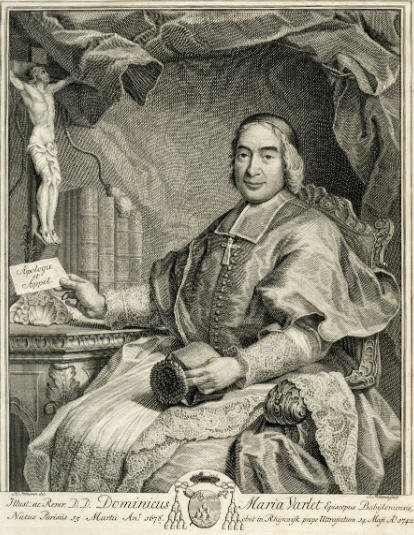
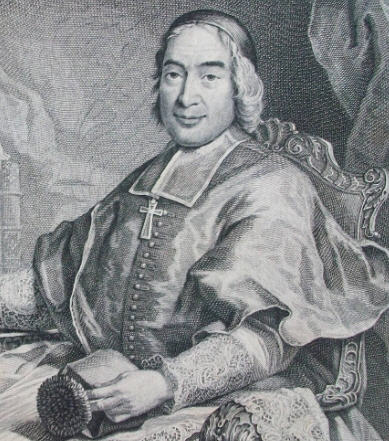
Dominique-Marie VARLET, (1678-1742) was an unsuccessful parish priest in Paris educated in pro-Jansenist circles. Forced to resign in 1712 after alarming his parishoners and clerical colleagues with liturgical innovations,* he was encouraged by the pro-Jansenist Bishop Noailles to join the Missions Étrangères, whose superiors sent him as a missionary to the American South and Quebec in 1713. Suddenly and unexpectedly recalled to France in 1718, he was mysteriously named coadjutor Bishop of Babylon and consecrated at a private ceremony attended only by the consecrating bishops in the chapel of the Missions Étrangères Whether intentionally or inadvertently he failed to visit the Papal Nuncios in Paris and Amsterdam to make the required vow of obedience to the Holy See and acknowledgement of the papal condemnation of Jansenism in the 1713 bull Unigenitus. While en route to his see in 1719, he was informed that he had been deprived of his title and faculties by the Congregation for the Propagation of the Faith. After failed appeals against his deposition, he returned to the Netherlands, where on his previous visit he had illicitly celebrated the sacrament of confirmation for 400 persons .
IN exile in Holland he came to regard the schismatic Jansenist Church of Utrecht as “souls abandoned by Rome;” and in 1724 he acceded to the request of the Chapter of Utrecht to consecrate Cornelius van Steenoven as the first (Old Catholic) Archbishop of Utrecht not in communion with Rome. In 1725 Varlet and all bishops consecrated by him were excommunicated. He later consecrated Jansenist Bishops of Haarlem and Deventer as well as three Archbishops of Utrecht including Petrus Johannes Meindaerts, from whom Old Catholic bishops claim to derive Apostolic Succession. Perhaps conscious of the great disunity he had wrought, he wrote several Apologies and a rueful Spiritual Testimony in 1741 in which he attempted to explain and justify his actions, depicting them as those of a missionary concerned for “abandoned souls.” He died in 1742, excommunicate and unreconciled to the Catholic Church.
* “Dominique-Marie Varlet De
l’Église de Québec à la réforme d’Utrecht,” Serge A. Thériault, Revue
d’histoire de l’Amérique française Vol.36, no.2, Sept. 1982, 197-198:
[Avec Jacques Jubé, le pasteur de la paroisse d’Aisnières, il
aurait travaillé à un aggiornamento de la liturgie qui a beaucoup en commun avec
la messe, dite de Paul VI, qu’on a publiée après le concile Vatican II. Cette
liturgie mérite qu’on s’y attarde tant elle innove pour l’époque. D’abord, on
pourrait croire à l’influence de la Réforme: le prêtre entrait dans l’église par
une procession qui mettait en lumière le livre de la Parole de Dieu et il ne
montait à l’autel que pour l’offertoire. Toute la première partie de la
messe se célébrait dans le choeur et on attachait une grande importance à
l’homélie qui devait consis¬ter en un approfondissement des Écritures. Ensuite,
pour ce qui est de l’offertoire, on en donnait une interprétation qui se
rapprochait de celle de la grande prière juive du «pater familias», la berakoth.]
With Jacques Jubé, the pastor of the parish of
Aisnières, he is said to have worked on an aggiornamento of the liturgy
that has much in common with the so-called Mass of Paul VI, which was published
after the Second Vatican Council. This liturgy deserves attention as it was so
innovative for the time. First, one might believe in the influence of the
Reformation: the priest entered the church in a procession which highlighted the
book of the Word of God and he only went up to the altar for the offertory. The
entire first part of the Mass was celebrated in the choir and great importance
was attached to the homily, which was to consist of a deepening of the
Scriptures. Then, as for the offertory, an interpretation was given which was
close to that of the great Jewish prayer of the “pater familias”, the
berakoth..
|
|
|
“Spiritual Testament of Dominique-Marie Varlet,” French text and footnotes: “Dominique-Marie Varlet De l’Église de Québec à la réforme d’Utrecht,” Serge A. Thériault, Revue d’histoire de l’Amérique française Vol.36, no.2, Sept. 1982, 129-136
|
IN the name of the Father and of the Son and of the Holy Spirit. |
l’Au nom du Père et du Fils et du Saint-Esprit. T |
|
Considering before God that my infirmities and various accidents which have afflicted me for some years, warn me to concern myself only with eternity, and with the care of preparing myself to appear before the Sovereign Judge of the living and the dead, who is at the same time my Redeemer and my Savior, I prostrate myself in spirit and humble myself as deeply as I can before God, to give him thanks for his benefits, and to ask him through the merits of Jesus Christ, and through the intercession of the Blessed Angels and all the Saints, particularly the Blessed Virgin, the pardon of all my sins, the grace to live and die in his love, and the glory to which I have the confidence that he has deigned to predestine me before all ages. |
Considérant devant Dieu que mes infirmités et divers accidents dont j’ai été attaqué depuis quelques années, m’avertissent de ne m’occuper que de l’éternité, et du soin de me préparer à paraître devant le Souverain Juge des vivants et des morts, qui est en même temps mon Rédempteur et mon Sauveur, je me prosterne en esprit et m’humilie le plus profondément qu’il m’est possible devant Dieu, pour lui rendre grâce de ses bienfaits, et pour lui demander par les mérites de Jésus-Christ, et par l’intercession des Bienheureux Anges et de tous les Saints, particulièrement de la Sainte-Vierge, le pardon de tous mes péchés, la grâce de vivre et de mourir dans son amour, et la gloire à laquelle j’ai la confiance qu’il a daigné me prédestiner avant tous les siècles. |
|
I also believe I must account to his Church for the sentiments in which I desire to live and die, especially since it is my duty to explain and even correct some steps which could be abused; and that in relation to the others which I have only taken to conform to his spirit, I have requested his Judgment by Acts of Appeal in which I persist. |
Je crois aussi devoir rendre compte à son Eglise des sentiments dans lesquels je désire vivre et de mourir, d’autant plus qu’il est de mon devoir d’expliquer et même de corriger quelques démarches dont on pourrait abuser; et que par rapport aux autres que je n’ai faites que pour me conformer à son esprit, j’ai demandé son Jugement par des Actes d’Appel dans lesquels je persiste. |
|
I declare, therefore, firstly, that by the grace of God I wish to live and die in the faith and unity of the Roman Catholic Apostolic Church, to whose judgment I submit all that I have written; that I embrace with unreserved docility all the decisions that she has made, or that she will make in the future on dogma; that I revere the Laws of her discipline as the rule that must be followed; that I regard Our Holy Father the Pope as the first of the Vicars of Jesus Christ, and the See of Saint Peter as the center of Catholic unity; that I believe that it is never permissible to separate oneself from it, and that one must seek by all legitimate means immediate Communion with the Holy See, when the malice of men prevents one from actually and perfectly enjoying it. |
Je déclare donc premièrement que par la grâce de Dieu je veux vivre et mourir dans la foi et dans l’unité de l’Eglise Catholique Apostolique et Romaine, au Jugement de laquelle je soumets tout ce que j’ai écrit; que j’embrasse avec une docilité sans réserve toutes les décisions qu’elle a faites, ou qu’elle fera à l’avenir sur le dogme; que je révère les Lois de sa discipline comme la règle que l’on doit suivre; que je regarde Notre Saint Père le Pape comme le premier des Vicaires de Jésus-Christ, et le Siège de Saint-Pierre comme le centre de l’unité Catholique; que je crois qu’il n’est jamais permis de s’en séparer, et qu’on doit rechercher par tous les moyens légitimes la Communion immédiate avec le Saint-Siège, lorsque la malice des hommes empêche qu’on n’en jouisse actuellement et parfaitement. |
|
I declare secondly that when I subscribed at the Sorbonne in the year 1702 to the Formulary of the Clergy and the Censorship of Mr. Arnauld,1 this was due to a lack of clarity, and on bad advice that I followed with too much docility. |
Je déclare en second lieu que quand je souscrivis en Sorbonne en l’année 1702 le Formulaire du Clergé et la Censure de M. Arnauld,’ ce fut par défaut de lumière, et sur de mauvais conseils que je suivis avec trop de docilité. |
|
1 Required by a Arrêt du Conseil (Major Ruling of the French Council of State), 23 April 1661, against Arnauld’s distinction between “the fact and the law”. |
|
|
I was not unaware from then on that the Church itself is not infallible on recent, contested, obscure and doubtful facts, indifferent to Religion, and which are the object of criticism and not of faith. I knew consequently that it cannot demand belief in them by virtue of its own authority alone; that the “fact” of Jansenius was of this nature; that thus one could not be obliged to believe it and to attest to belief; that all that could be required of individuals in this regard was that they not rise up against the Judgment that Pope Alexander VII and some Bishops had dissented from this “fact;” 2 and that this was incontestable, not only by the principles of faith, but also by all that had happened at the time of the Peace concluded under Pope Clement IX with the concurrence of the two Powers.3 |
Je n’ignorais pas dès lors que l’Eglise même n’est pas infaillible sur des faits récents, contestés, obscurs et douteux, indifférents à la Religion, et qui sont l’objet de la critique et non de la foi. Je savais par conséquent qu’elle ne peut en exiger la croyance en vertu de sa seule autorité; que le fait de Jansénius était de cette nature; qu’ainsi on ne pouvait être obligé de le croire et d’en attester la croyance; que tout ce qu’on pouvait exiger des particuliers à cet égard, était qu’ils ne s’élevassent point contre le Jugement que le Pape Alexandre VII et quelques Evêques avaient porté sur ce fait;2 et que cela était incontestable, non seulement par les principes de la foi, mais encore par tout ce qui s’était passé lors de la Paix conclue sous le Pape Clément IX avec le concours des deux Puissances.’ |
|
2 Reference to the bull Regiminis apostolici (15 February 1665) and to the appeal to a future Council by the bishops of Boulogne (de Langle), Mirepoix (de Labroue), Montpellier (Colbert), and Senez (Soanen), in 1717. 3 The Peace of Pope Clement IX or, Peace of the Church, lasted from 1668 to 1705, seconded by both the spiritual and temporal powers. |
|
|
But it was these very principles that were abused to delude me. I was persuaded that it was so well known that the Church was content with a submission of respect and discipline on the part of Jansenius that there was no reason, especially since the Peace of Clement IX , to regard the subscription of the Formulary as a mark of belief. This feeling was then as common as it was convenient, and the Syndics themselves declared to the Candidates that the intention of the Faculty was not to demand anything more than respectful silence. 4 |
Mais c’est de ces principes même qu’on abusa pour me faire illusion. On me persuada qu’il était si notoire que l’Eglise se contentait sur le fait de Jansénius d’une soumission de respect et de discipline, qu’il n’y avait point lieu, surtout depuis la Paix de Clément IX de regarder la souscription du Formulaire comme une marque de croyance. Ce sentiment était alors aussi commun qu’il était commode, et les Syndics même déclaraient aux Candidats que l’intention de la Faculté n’était point de rien exiger de plus que le silence respectueux.4 |
|
4An attitude that was condemned by Clement XI in the bull Vineam Domini, July 16 , 1705. |
|
|
This principle was extended to the subscription of the Censure of Mr. Arnauld. The Faculty, it was said, did not claim to proscribe the doctrine or the language of the Holy Fathers. It is always permissible to say that one cannot do good without efficacious grace. The Faculty has understood Mr. Arnauld’s proposition in the sense of an absolute and antecedent impotence, or at least in the sense of a deprivation of a supernatural power in the Just. It is in this sense that the Censure must be taken; all that the Faculty asks is that its members condemn this error with it, and that they do not rise up against its Judgment, under the pretext that it has misunderstood Mr. Arnauld’s meaning.5 |
On étendait ce principe jusqu’à la souscription de la Censure de M. Arnauld. La Faculté, disait-on, n’a point prétendu proscrire la doctrine ni le langage des Saints Pères. Il est toujours permis de dire qu’on ne peut faire le bien sans la grâce efficace. La Faculté a entendu la proposition de M. Arnauld dans le sens d’une impuissance absolue et antécédente, ou au moins dans le sens d’une privation d’un pouvoir surnaturel dans les Justes. C’est dans ce sens qu’on doit prendre la Censure; tout ce que la Faculté demande, est que ses membres condamnent avec elle cette erreur, et qu’ils ne s’élèvent pas contre son Jugement, sous prétexte qu’elle aurait mal pris le sens de M. Arnauld.’ |
|
5 Note from the Nouvelles ecclésiastiques: In the first proposition of fact, Mr. Arnauld says that he read Jansenius’s book exactly, and that he did not find there the propositions condemned by the late Pope [Innocent X], and nevertheless that as he condemns these propositions wherever they are found, he condemns them in Jansenius, if they are there. Second proposition of law: The grace without which nothing can be done, was lacking in St. Peter in his fall. |
s Note from the Nouvelles ecclésiastiques: Dans la première proposition de fait, M. Arnauld dit qu’il a lu exactement le livre de Jansénius, et qu’il n’y a point trouvé les propositions condamnées par le feu Pape [Innocent X], et néanmoins que comme il condamne ces propositions en quelque lieu qu’elles se rencontrent, il les condamne dans Jansénius, si elles y sont. IIe Proposition de droit: La grâce sans laquelle on ne peut rien, a manqué à St Pierre dans sa chute. |
|
It is in this spirit and on these assurances that I signed; but I recognize that I did wrong. Mr. Arnauld’s proposition regarding the law is so consecrated in Tradition that, as Mr. Bossuet, Bishop of Meaux, has noted, to condemn it is to deliver all the Fathers to Jansenism. 6 |
C’est dans cet esprit et sur ces assurances que j’ai signé; mais je reconnais que j’ai mal fait. La proposition de M. Arnauld qui regarde le droit est tellement consacrée dans la Tradition, que, comme l’a remarqué M. Bossuet Evêque de Meaux, la condamner, c’est livrer tous les Pères au Jansénisme.6 |
|
6 Bishop Bossuet made this observation in his Censura et declaratio conoentus generalis cleri gallicani congregati in palatio San-Germano..., Paris, 1700. |
|
|
Moreover, the Censure to which I subscribed also condemns the first proposition of this Doctor, which concerns the “fact” of Jansenius. Now those who urged me to subscribe recognized that it was indubitable that, as this proposition states, the Church could only demand respectful silence on a fact such as that of Jansenius. To condemn this proposition was to fix the subscription of the Formulary to signify the belief in the “fact.” It was even to make this belief an indispensable duty, not only for those who signed, but also for all those who knew that the Fifth Propositions had been condemned as extracted from Jansenius, and in the sense of this author.7 |
De plus, la Censure à laquelle je souscrivais, condamne aussi la première proposition de ce Docteur, qui concerne le fait de Jansénius. Or ceux-mêmes qui m’engageaient à souscrire, reconnaissaient qu’il était indubitable qu’ainsi que l’énonce cette proposition, l’Eglise ne pouvait exiger sur un fait tel que celui de Jansénius qu’un silence respectueux. Condamner cette proposition, c’était fixer la souscription du Formulaire à signifier la croyance du fait. C’était même faire de cette croyance un devoir indispensable, non seulement pour ceux qui signaient, mais encore pour tous ceux qui savaient que les V Propositions avaient été condamnées comme extraites de Jansénius, et dans le sens de cet auteur.’ |
|
7 Condemned in the bulls Cum Occasione (31 May 1653) and Ad Sacram (16 October,1656). |
|
|
Moreover, independently of this Censure, the very words of the Formulary indicate belief in the “fact,” and that of the Clergy indicates that Jansenius had badly explained the doctrine of Saint Augustine. I should not therefore have purely and simply signed the Formulary, since I did not believe this fact, and it seemed to me at least doubtful. The Peace of Clement IX may well authorize inferiors to sign with explanation, and it must engage Superiors to be content with the explained signatures, which this Pope admitted with great prudence; but it does not authorize one to sign what one does not believe, nor consequently to subscribe purely and simply to a Formula which expresses the belief of a fact about which one is in doubt. Finally, nothing was more opposed to the conduct of the Fourth Bishops than this subscription that I made at the Sorbonne.8 |
D’ailleurs, indépendemment de cette Censure, les paroles même du Formulaire marquent la croyance du fait, et celui du Clergé porte que Jansénius a mal expliqué la doctrine de Saint Augustin. Je ne devais donc pas signer purement et simplement le Formulaire, puisque je ne croyais pas ce fait, et qu’il me paraissait au moins douteux. La Paix de Clément IX peut bien autoriser les inférieurs à signer avec explication, et elle doit engager les Supérieurs à se contenter des signatures expliquées, que ce Pape a admises avec beaucoup de prudence; mais elle en’autorise point à signer ce qu’on ne croit pas, ni par conséquent à souscrire purement et simplement une Formule qui exprime la croyance d’un fait sur lequel on est dans le doute. Enfin rien n’était plus opposé à la conduite des IV Evêques que cette souscription que je faisais en Sorbonne.’ |
|
8 The appeal mentioned in note 2 above. |
|
|
These Prelates had subscribed and had others subscribe with explanation, and I subscribed purely and simply. They had explained the very dogma and the condemnation that they made of the Fifth Propositions, by declaring that it was without giving the least attack to the doctrine of grace effective in itself; and in subscribing to the Formulary: I subscribed at the same time to a Censure which really attacked the necessity of this grace; since if it were not true that without it one can do nothing, it would not be necessary for every act of Christian piety. These Bishops, explaining the submission that they rendered to the Constitutions on the point of fact, made it consist in not contesting the decision; and this is what I condemned with the Faculty by subscribing to the Censure. |
Ces Prélats avaient souscrit et fait souscrire avec explication, et je souscrivais purement et simplement. Ils avaient expliqué le dogme même et la condamnation qu’ils faisaient des V Propositions, en déclarant que c’était sans donner la moindre atteinte à la doctrine de la grâce efficace par elle-même; et en souscrivant le Formulaire, je souscrivais en même temps à une Censure qui donnait réellement atteinte à la nécessité de cette grâce; puisque s’il n’était pas vrai que sans elle on ne peut rien, elle ne serait pas nécessaire pour tout acte de piété chrétienne. Ces Evêques expliquant la soumission qu’ils rendaient aux Constitutions sur le point de fait, la faisaient consister à ne point contester la décision; et c’est ce que je condamnais avec la Faculté en souscrivant à la Censure. |
|
This is why I have retracted this subscription, which I had the misfortune to make on false principles, and at an age when it was not surprising that I should have allowed myself to be dazzled. I ask forgiveness from God and the Church. I appeal to the Peace of Clement IX to which I should have conformed. I regret that by signing purely and simply it has been annulled, and I join with the late Bishops of Montpellier and Senez, 9 who appealed to the Holy See and to the future Council, against the violation of this Peace so just and so precious, which is being undermined, either by demanding pure and simple subscriptions, or by condemning those which are in conformity with the Minutes of the Fourth Bishops. |
C’est pourquoi j’ai retracté cete souscription, que j’ai eu le malheur de faire sur de faux principes, et dans un âge où il n’était pas étonnant que je me laissasse éblouir. J’en demande pardon à Dieu et à l’Eglise. Je réclame à la Paix de Clément IX à laquelle j’aurais dû me conformer. Je regrette qu’en signant purement et simplement on ait donné lieu à l’annéantir, et je me joins à feu MM. les Evêques de Montpellier et de Senez,9 qui ont interjeté appel au Saint Siège et au futur Concile, du vio-lement de cette Paix si juste et si précieuse, à laquelle on donne atteinte, soit en exigeant des souscriptions pures et simples, soit en condamnant celles qui sont conformes aux Procès-verbaux des IV Evêques. |
|
9 Charles-Joachim de Colbert de Croissy, bishop of Montpellier, and Jean Soanen, bishop of Senez. See their Act of appeal of the Bishops of Senez and Montpellier by which renewing and confirming the appeal lodged by them on March 1, 1717, s.l.. [1727] |
9 Charles-Joachim de Colbert de Croissy, bishop of Montpellier, and Jean Soanen, bishop of Senez. See their Acte d’appel de Msgrs les évêques de Senez et de Montpellier par lequel renouvellant et confirmant l’appel par eux interjeté le 1er mars 1717..., s.l. [1727] |
|
Nothing better demonstrates the necessity of the precautions taken by these wise Prelates in the matter of the Formulary than the Constitution Unigenitus. 10 |
Rien ne fait mieux voir la nécessité des précautions que prirent ces sages Prélats dans l’affaire du Formulaire, que la Constitution Unigenitus.10 |
|
10 Bull promulgated against 101 propositions from Pasquier Quesnel’s Réflexions morales (1668) by Clement XI on 8 September 1713 and which sharply divided opinion in France. “ |
|
|
This decree highlights that the adversaries of grace were condemning it under the vague and equivocal terms of the meaning of Jansenius, since Clement XI was made to say that those of the CI Propositions which concern grace, contain the meaning condemned in the V Propositions proscribed by Innocent X and by Alexander VII. [11 See note 2 above.] This alone should be enough to prevent the Bulls from being subscribed to without explanation, which Clement XI explains so poorly, and to urge the absolute rejection of the latter. 12 |
Ce décret met en évidence que les adversaires de la grâce faisaient condamner sous les termes vagues et équivoques du sens de Jansénius, puisque on a fait dire à Clément XI que celles des CI Propositions qui regardent la grâce, renferment le sens condamné dans les V Propositions proscrites par Innocent X et par Alexandre VII.” Cela seul devrait suffire pour empêcher de souscrire sans explication les Bulles que Clément XI explique si mal, et pour engager à rejeter absolument cette der-nière.12 |
|
12 Not only the bull Unigenitus (see note 10 above), but also the bull Vineam Domini (see note 4 above). |
|
|
But it also contains a multitude of other defects which have been exposed in different Writings; 13 and I was so struck by this at first that I always avoided giving the slightest mark of approval to this Decree, which one would try in vain to reconcile with the dogma, the discipline, or the language of the Church.This is apparently what began to make me suspect to the Officers of the Court of Rome, when I left to go to Persia, as my duty required me to do so obliged. |
Mais elle renferme d’ailleurs une multitude d’autres défauts qui ont été exposé en différents Ecrits;13 et j’en ai été si frappé d’abord que j’ai toujours évité de donner la moindre marque d’approbation à ce Décret, qu’on tenterait en vain de réconcilier avec le dogme, la discipline, ou le langage de l’Eglise. C’est apparemment ce qui commença à me rendre suspect aux Officiers de la Cour de Rome, lorsque je partis pour me rendre en Perse, comme mon devoir m’y obligeait. |
|
13 See the Bibliography of DMV’s writings appended hereto. |
|
|
I soon became odious to them by the commitment in which divine Providence placed me to render some service to the Church of Holland which this Court wanted to deprive of its rights, and to govern by precarious and destitute Ministers, as it does the new Missions. It is already a great abuse not to found the new Churches, as the Apostles and the Apostolic men of all centuries did, by establishing ordinary Pastors there, to lead a flock of which they are the Heads, with a just subordination to the first of the Pastors, and to the Universal Church. |
Je leur devins bientôt odieux par l’engagement où la divine Providence me mit de rendre quelque service à l’Eglise de Hollande que cette Cour voulait priver de ses droits, et gouverner par des Ministres précaires et destituables, comme elle fait les nouvelles Missions. C’est déjà un grand abus que de ne point fonder les nouvelles Eglises, comme ont fait les Apôtres, et les hommes Apostoliques de tous les siècles, en y établissant des Pasteurs ordinaires, pour y conduire un troupeau dont ils soient les Chefs, avec une juste subordination au premier des Pasteurs, et à l’Eglise Universelle. |
|
But it is a far more glaring abuse to want to overthrow this beautiful order in a Church that has existed for a thousand years, and which, for having lost its temporal goods while preserving the faith, has only become more worthy of all spiritual goods and rights. I did not know all the disputes that there were on this subject in relation to the Church of Holland; but finding myself in this portion of the flock of Jesus Christ while I was waiting for an opportunity to leave for Persia, I did not believe I could refuse to give Confirmation to the Faithful presented to me by their ordinary Pastors, established by Bishops whom the Holy See itself had appointed and consecrated. This is nevertheless what gave rise to the first suspension that was notified to me in Persia, the nullity of which I demonstrated in my first Apology. 14 [Ibid.] |
Mais c’est un abus bien plus criant, que de vouloir renverser ce bel ordre dans une Eglise qui subsiste depuis mille ans, et qui, pour avoir perdu ses biens temporels en conservant la foi, n’en est devenue que plus digne de tous les biens et de tous les droits spirituels. Je ne savais pas tous les démêlés qui’il y avait sur ce sujet par rapport à l’Eglise de Hollande; mais me trouvant dans cette portion du troupeau de Jésus-Christ tandis que j’attendais une occasion de partir pour la Perse, je ne crus pas pouvoir refuser de donner la Confirmation à des Fidèles que me présentaient leurs Pasteurs ordinaires, établis par des Evêques que le Saint-Siège avait lui-même nommés et consacrés. C’est néanmoins ce qui donna lieu à la première suspense qui me fut signifiée en Perse, dont j’ai démontré la nullité dans ma première Apologie.14 |
|
The inability in which I found myself, as a consequence of this alleged Censure, to be useful to the particular Church for which I had been ordained, led me to return to Europe; and not being able to reconcile myself with the Court of Rome without betraying my conscience, I believed I should fix my stay in the Church of Holland. I ordained Priests and four consecutive Archbishops there, and did not believe that, after having devoted a part of my life to going to the aid of distant Churches in Asia and in the New World, I should refuse to a Church so close to France assistance of which it had the most pressing need. I believed in this that I was doing only what episcopal charity demanded. 15 |
L’impuissance où je me trouvais en conséquence de cette prétendue Censure d’être utile à l’Eglise particulière pour laquelle j’avais été ordonné, m’engagea à revenir en Europe; et ne pouvant me réconcilier avec la Cour de Rome sans trahir ma conscience, je crus devoir fixer mon séjour dans l’Eglise de Hollande. Je lui ai ordonné des Prêtres et quatre Archevêques consécutifs, et n’ai pas cru qu’après avoir consacré une partie de ma vie à aller secourir des Eglises éloignées en Asie et dans le Nouveau Monde, je dusse refuser à une Eglise si voisine de la France une assistance dont elle avait le plus pressant besoin. J’ai cru en cela ne faire que ce que demandait la charité épiscopale.15 |
|
15 The Netherlands had been without a Roman Catholic bishop since the deposition of Pierre Codde in 1704; Cornélis Steenhoven was the first to fill the void and was consecrated by DMV October 15, 1724. |
|
|
I took my steps in concert with the Prelates and Theologians most worthy of being consulted. I have given an account of this in my second Apology;16 [ibid.] and I desire with all my heart that the Council to whose Tribunal I have brought this matter by a canonical Appeal , 17 [Ibid.] will be willing to take cognizance of it; and this is not so much so that it may do me justice, as in the hope that the Council will put an end to this kind of schism in the Church of Holland which separates the majority of Catholics in the countries from their legitimate Pastors. I would very much like Our Holy Father the Pope to warn the Council about this, and that by canonically examining this matter, on which some of his predecessors were undoubtedly ill-informed, he would restore peace to the children who revere him. |
J’ai concerté mes démarches avec les Prélats et les Théologiens les plus dignes d’être consultés. J’en ai rendu compte dans ma seconde Apologie;lb et je désire de tout mon coeur que le Concile au Tribunal duquel j’ai porté cette affaire par un Appel17 canonique, veuille bien en prendre connaissance; et ce n’est pas tant afin qu’il me rende justice, que dans l’espérance que le Concile fera cesser dans l’Eglise de Hollande cette espèce de schisme qui y sépare la plupart des Catholiques des pays de leurs légitimes Pasteurs. Je souhaiterais fort que Notre Saint Père le Pape prévînt sur cela le Concile, et qu’en examinant canoniquement cette affaire, sur laquelle quelques-uns de ses prédécesseurs ont été sans doute mal-informés, il rendît la paix à des enfants qui le révèrent. |
|
I recommend with all possible insistence and with all the affection of which I am capable, to the Archbishop of Utrecht, 18 to the MM. of the Chapter, to all the clergy, and to the people of these Provinces, never to stray from this spirit of respect for Our Holy Father the Pope, of the canonical obedience which is due to him, of the love of Unity, and of the disposition in which they are to sacrifice everything to such a great good, as much as conscience can permit. |
Je recommande avec tout l’instance possible et avec toute l’affection dont je suis capable, à M. l’Archevêque d’Utrecht,” à MM. du Chapitre, à tout le clergé, et au peuple de ces Provinces, de ne s’éloigner jamais de cet esprit de respect de Notre Saint Père le Pape, de l’obéissance canonique qui lui est due, de l’amour de l’Unité, et de la disposition où ils sont de tout sacrifier à un si grand bien, autant que la conscience le peut permettre. |
|
18 Pieter-Jan Meindaerts, consecrated by DMV 18 October 1739. |
|
|
I believe I must recommend in particular to the Archbishop, and entreat him very earnestly never to proceed with the consecration of a bishop, whether under the title of Bishop of Haerlem, or under that of Coadjutor, or in any other manner whatsoever, except with the advice and consent of all the orthodox Prelates who will honor this Church with their benevolence; and who, being instructed in its rights, will be affected by its state, there being only a spirit of schism which could ever lead to doing otherwise. |
Je crois devoir recommander en particulier à M. l’Archevêque, et le conjurer très instamment de ne jamais procéder à la consécration d’un évêque, soit sous le titre d’Evêque d’Haerlem, soit sous celui de Coadjuteur, ou en quelqu’autre manière que ce soit, que de l’avis et du consentement de tous les Prélats orthodoxes qui honoreront cette Eglise de leur bienveillance; et qui étant instruits de ses droits, seront touchés de son état, n’y ayant qu’un esprit de schisme qui puisse jamais porter à en user autrement. |
|
I also beg him to be faithful in never ordaining any Bishop, or any Priest, and not even to engage in Sacred Orders any Subject who is not well declared against all usury, firm in the principles which are opposed to it, and well determined not to grant in practice Absolution to those who, lending to the rich, stipulate that they will be given back more than they have lent; which it has been wanted to justify in this country, as an annuity redeemable on both sides. 19 |
Je le supplie aussi d’être fidèle à n’ordonner jamais aucun Evêque, ou aucun Prêtre, et à n’engager même dans les Ordres Sacrés aucun Sujet qui ne soit bien déclaré contre toute usure, ferme dans les principes qui y sont opposés, et bien déterminé à ne pas accorder dans la pratique l’Absolution à ceux qui prêtant à des riches, stipulent qu’on leur rendra plus qu’ils n’ont prêté; ce qu’on a voulu justifier en ce pays, à titre de rente racheptable des deux côtés.19 |
|
19 DMV refers here to the problems raised by E. Richer and “richerism” [n.b. i.e both Gallicanism and the belief that a significant part of the church's authority should reside in the lower clergy rather than the hierarchy.]; cf. E. Préclin, Les Jansénistes du XVIlle siècle et la Constitution civile du clergé (Paris, 1929).The Jansenists of the 18th Century and the Civil Constitution of the Clergy (Paris, 1929). |
|
|
I have not forgotten what the late Mr. Barchman, Archbishop of Utrecht,20 told me when he was about to die, that if it were an evil that this Church had no bishop, it would be an even greater one if it had one who was favorable to usury; because in fact it is more important to contribute to preserving in the whole Church the integrity of the faith and the purity of morals, than to perpetuate the Episcopate or the Priesthood in a particular Church. |
Je n’ai point oublié ce que m’a dit feu M. Barchman Archevêque d’Utrecht20 étant sur le point de mourir, que si c’était un mal que cette Eglise n’eût point d’évêque, c’en serait un plus grand encore, qu’elle en eût un qui serait favorable à l’usure; parce qu’en effet il est plus important de contribuer à conserver dans toute l’Eglise l’intégrité de la foi et la pureté de la morale, que de perpétuer l’Episcopat ou le Sacerdoce dans une Eglise particulière. |
|
20 Cornélis-Jan van Barchman-Vuytiers, consecrated by DMV 30 September 1725. 21 |
|
|
If I did not take these precautions with regard to the first two Archbishops whom I consecrated, it is because I did not know the need that this Church had to be instructed on this point. But the more I was informed, the more I believed that it was necessary to work to eradicate usury; and if I appeared to some people too difficult to satisfy on this point, when it was a question of consecrating the last two Archbishops, I fear rather that I was not firm enough; and I implore the Archbishop not to let himself be shaken by the clamors of those who would complain that we want to introduce a new Formulary. It is not a question here, as in the Formulary of Alexander VII, [21 See note 2 above].of a new fact or indifferent to Religion: it is a question of an indubitable dogma which must be supported, and of a pernicious practice which must be extirpated. It is to procure such goods, that we give Pastors to the Church; and it is essential not to establish anything of which one does not have moral assurance that they will be firmly attached to sound doctrine, and powerful in correcting those who deviate from it. |
Si je n’ai point pris ces précautions à l’égard des deux premiers Archevêques que j’ai sacrés, c’est que je ne connaissais pas le besoin que cette Eglise avait d’être instruite sur ce point. Mais plus j’en ai été informé, plus j’ai cru qu’il fallait travailler à extirper l’usure; et si j’ai paru à quelques personnes trop difficile à contenter sur ce point, lorsqu’il a été question de sacrer les deux derniers Archevêques, je crains plutôt de n’avoir pas été assez ferme; et je conjure M. l’Archevêque de ne se point laisser ébranler par les clameurs de ceux qui se plaindraient qu’on veut introduire un nouveau Formulaire. Il ne s’agit point ici, comme dans le Formulaire d’Alexandre VII,21 d’un fait nouveau ou indifférent à la Religion: il s’agit d’un dogme indubitable qu’il faut soutenir, et d’une pratique pernicieuse qu’il faut extirper. C’est pour procurer de tels biens, qu’on donne à l’Eglise des Pasteurs; et il est indispensa ble de n’en établir aucun dont on n’ait une assurance morale qu’il sera fermement attaché à la saine doctrine, et puissant pour reprendre ceux qui s’en écartent. |
|
As for the MM. of the Chapter, if they retain some gratitude for the services I have rendered them by sacrificing myself for this Church, I hope that I will have this joy in the Lord, that they will join with their worthy Archbishop, to extirpate error and abuse. When most of them have professed to be firmly attached to this principle generally accepted among Theologians, that it is never permissible to demand profit from the loan made to a poor or a rich person, and that one can only in the case of a gain that the loan causes to cease, or of damage that it causes, demand a just indemnity, observing all the conditions that good Theologians prescribe; that these MM. They probably did not want to surprise me with ambiguities: they therefore understood this principle as it is understood in the Schools, as Saint Thomas, Hesselius, M. de Sainte-Beuve, Father Alexandre, the Morals of Grenoble, 22 and in general all good Theologians understand it. |
Quant à MM. du Chapitre, s’ils conservent quelque reconnaissance des services que je leur ai rendus en me sacrifiant pour cette Eglise, j’espère que j’aurai cette joie dans le Seigneur, qu’ils se joindront à leur digne Archevêque, pour extirper l’erreur et l’abus. Quand la plupart d’entr’eux ont fait profession d’être fermement attachés à ce principe généralement reçu parmi les Théologiens, qu’il n’est jamais permis d’exiger du profit du prêt fait à un pauvre ou à un riche, et qu’on peut seulement dans le cas d’un gain que le prêt fait cesser, ou d’un dommage qu’il cause, demander une juste indemnité, en observant toutes les conditions que les bons Théologiens prescrivent; que ces MM. sans doute n’ont pas voulu me surprendre par des équivoques: ils ont donc entendu ce principe comme on l’entend dans les Ecoles, comme l’entendent Saint Thomas, Hesselius, M. de Sainte-Beuve, le Père Alexandre, la Morale de Grenoble,22 et en générale tous les bons Théologiens. |
|
22 St Thomas Aquinas in Collationes de X praeceptis; Hesselius (Jan Hessels) in Breyis et catholica decalogi explictio (1567); Jaques de Sainte-Beuve in his Resolutions (3 vols., 1689-1704); Noël Alexandre in Abridgement of the Faith and Morals of the Church (2 vols., 1686); and E. Le Camus, bishop of Grenoble, in Instructions and Meditations for the Annual Retreat (Grenoble, 1698; otherwise known as the Morale de Grenoble) —all fulminate against usury, and all were approved by DMV in his struggle against usury in the Chapter at Utrecht (1727-1739). |
|
|
It only remains for me to pray them not to deviate in speculation, nor in practice, from this principle which is indeed indubitable, and which belongs to the faith of the Church. The tolerance of the Civil Laws, the temerity of some Theologians who have undertaken to justify what the Church has always condemned, the vain pretexts of those who everywhere find a lucre ceasing, as soon as one does not lend to the poor: the indocility of the people, the fear of seeing them move away from their Pastors, are not reasons to deviate from the Rule which was generally received in these Provinces before the revolutions. This is why I conjure these Gentlemen, all Pastors, and even the Faithful, to detest all usury, and to distinguish themselves from the Protestants in this point, as in all the others on which Calvin innovated. |
Il ne me reste que de les prier de ne s’écarter dans la spéculation, ni dans la pratique, de ce principe qui est en effet indubitable, et qui appartient à la foi de l’Eglise. La tolérance des Lois civiles, la témérité de quelques Théologiens qui ont entrepris de justifier ce que l’Eglise a toujours condamné, les vains prétextes de ceux qui trouvent partout un lucre cessant, dès qu’on ne prête pas à des pauvres: l’indocilité des peuples, la crainte de les voir s’éloigner de leurs Pasteurs, ne sont pas des raisons de s’écarter de la Règle qui était généralement reçue dans ces Provinces avant les révolutions. C’est pourquoi je conjure ces Messieurs, tous les Pasteurs, et les Fidèles même, de détester toute usure, et de se distinguer des Protestants en ce point, comme en tous les autres sur lesquels Calvin a innové. |
|
In general, one cannot be too wary of this license which is the vice of this century, and which causes one to deviate without scruple from the sentiments received in the Church. The new Writers that M. de Senez has combated have given in to many excesses, which M. de Laon has also noted in his twenty Letters. 23 I join M. de Senez in testifying to the full horror that a good Catholic should have such pernicious boldness in inventing and defending novelties; and to exhort all good Theologians to fight for the Faith which was once left to the Saints by Tradition. |
En général on ne saurait trop se défier de cette licence qui est le vice de ce siècle, et qui fait qu’on s’écarte sans scrupule des sentiments reçus dans l’Eglise. Les nouveaux Ecrivains que M. de Senez a combattus, ont donné dans bien des excès, que M. de Laon a aussi relevés dans ses vingt Lettres.23 Je me joins à M. de Senez, pour témoigner toute l’horreur qu’un bon Catholique doit avoir de cette hardiesse si pernicieuse à inventer et à défendre des nouveautés; et pour exhorter tous les bons Théologiens à combattre pour la Foi qui a été une fois laissée aux Saints par Tradition. |
|
23 See Jean Soanen, bishop of Senez, Letter from Msgr the Bishop of Senez on the errors put forward in some new writings (1736), and Louis de Clermont de Chaste de Roussillon, bishop of Laon, Mandement de Msgr the Bishop-Duke of Laon (1718). |
|
|
I bless God for the miracles by which it has pleased him to come to the aid of his Servants, 24 and to strengthen the hope we have that it will please him to remedy all our ills, by renewing the face of his Church. |
Je bénis Dieu des miracles par lesquels il lui a plu de venir au secours de ses Serviteurs,24 et de fortifier l’espérance que nous avons qu’il lui plaira de remédier à tous nos maux, en renouvellant la face de son Eglise. |
|
24 Allusion to the “miracles” of Archdeacon Pâris in the Cemetery of St-Médard from 1727 to 1734, as well as to those involving Marguérite Périer, Rousse de Mareuil, the woman Boissonade, et. al. |
|
|
These have been done in this very country, to attest the vocation and honor the Ministry of the Archbishops whom I have consecrated. Let us occupy ourselves with these marvels, and bear witness to them: this is the means of obtaining new ones, and of reaping the fruit of those which God has granted us in his mercy. As for the singular event of the Convulsions, I applauded the Rules which Mr. de Montpellier established with such wisdom, and after such mature examination; 25 this is what I believe I must adhere to. |
Il s’en est fait dans ce pays même, pour attester la vocation et honorer le Ministère des Archevêques que j’ai consacrés. Occupons-nous de ces merveilles, et rendons-y témoignage: c’est le moyen d’en obtenir de nouvelles, et de recueillir le fruit de celles que Dieu nous a accordées dans sa miséricorde. Quant à l’événement singulier des Convulsions, j’ai applaudi aux Règles que M. de Montpellier a établies avec tant de sagesse, et après un examen si mûr;25 c’est à quoi je crois devoir m’en tenir. |
|
25 Charles-Joachim de Colbert de Croissy, bishop of Montpellier, wrote about the “convulsionnaires” in his Réponse... à Mlle Hardouin (1732) and in his Copie d’une lettre... du 12 octobre 1733 (1733). |
|
|
It only remains for me to thank the generous friends who have so far contributed by their alms to maintain the Servants of God who have taken refuge in this country: I hope that they will have the charity to continue this good work; and I willingly dedicate to it what effects I may have left here after the funeral expenses, and the discharge of my debts: 26 imploring the Seculars and the Regulars to always honor by their conduct the Catholic Church, of which they are members, to respond by the holiness of their life to that of the cause for which God has given them the grace to suffer, or to sacrifice something, to live in perfect union, and to remember me in their prayers. |
Il ne me reste plus que de remercier les amis si généreux qui ont jusqu’ici contribué par leurs aumônes à entretenir les Serviteurs de Dieu réfugiès en ce pays: j’espère qu’ils auront la charité de continuer cette bonne oeuvre; et j’y consacre volontiers ce qui pourra me rester ici d’effets après les frais funéraires, et l’acquit de mes dettes:26 conjurant les Séculiers et les Réguliers d’honorer toujours par leur conduite l’Eglise Catholique, dont ils sont membres, de répondre par la sainteté de leur vie à celle de la cause pour laquelle Dieu leur a fait la grâce de souffrir, ou de sacrifier quelque chose, de vivre dans une parfaite union, et de se souvenir de moi dans leurs prières. |
|
26 Unfortunately, according to number 49 of the present Correspondence, DMV did not, or could not, make this disposition of funds as he here claims he would. |
|
|
Done at Utrecht on February 2, 1741 (Nouvelles Ecclesiastiques, November 25 , 1742, pp. 185-188.) |
Fait à Utrecht le 2 Février, 1741 (Nouvelles Ecclésiastiques, 25 November 1742, p. 185-188.) |
Pierre Hurtubise, “VARLET,
DOMINIQUE-MARIE,” in Dictionary of Canadian Biography, vol. 3, University of
Toronto/Université Laval, 2003–, accessed October 16, 2025,
https://www.biographi.ca/en/bio/varlet_dominique_marie_3E.html.
DOMINIQUE-MARIE VARLET, , priest, missionary, vicar general, bishop of Babylon; b. 15 March 1678 in Paris, son of Achille Varlet, Sieur de Verneuil, and Marie Vallée; d. at Rijnwijk (Zeist, Neth.), 14 May 1742.
Dominique-Marie Varlet was the son of an actor. His father, known under the name of Sieur de Verneuil, and his uncle, Charles Varlet, the famous La Grange, collaborator and friend of Molière, had won renown on various Parisian stages before becoming members of the Comédie-Française at its creation in 1680. Little is known about his mother other than that she was the daughter of a Parisian hatter, that she too had been in the theatre, and that she was much younger than her husband. The Varlets had had seven children, only three of whom reached adulthood: Jean-Achille, born in 1681, who died, an attorney in the parlement of Paris, in 1720; Marie-Anne, the youngest of the family, who was married to Antoine Olivier, an attorney at the Châtelet; and Dominique-Marie.
The latter had early been destined, it seems, to the ecclesiastical state. He was enrolled in the Séminaire de Saint-Magloire in Paris, which was run by the Oratorians, then in the Collège de Navarre (one of the colleges in the University of Paris), studying in succession for the baccalauréat (1701), licentiate, and doctorate in theology (1706). It was at Saint-Magloire that he became acquainted with two well-known Jansenists with whom he became fast friends, Jacques Jubé, the future liturgist, and Jean-Baptiste-Paulin d’Aguesseau, the brother of the chancellor of France, Henri-François d’Aguesseau. Through his father, who on occasion retired to his country home near the famous place of pilgrimage of Mont Valérien, Varlet had already come into contact with the Congrégation des prêtres du Calvaire, with the result that in 1699 he had asked to be admitted and had been accepted as a member of this community. All these circles, which were strongly impregnated with Jansenism, were going to contribute in no small way to determining his future orientation.
In 1706 he was ordained a priest and was immediately assigned to parishes in the Paris suburbs. In 1708 he was parish priest at Conflans-Sainte-Honorine. Three years later, faced with all sorts of difficulties, he went to see the directors of the Séminaire des Missions Étrangères in Paris and asked to be admitted into their society in order to devote himself to the evangelization of pagans, as he had long desired. In 1712 he resigned as parish priest and came to put himself at the disposal of his new superiors. He was then designated to go to restore the mission to the Tamaroas (Cahokia, now East St Louis, Ill.), which had remained practically without a priest since Marc Bergier*’s death in 1707.
Varlet sailed from Port-Louis (dept. of Morbihan) at the end of January 1713 and on 6 June he arrived at Mobile (Mobile Bay, Ala.). Upon his arrival he suffered an attack of dysentery which almost carried him off, and he had to resign himself to staying where he was with his fellow religious, Albert Davion* and François Le Maire, while waiting until more favourable circumstances allowed him to push on to the Illinois country.
His first impressions were on the whole negative. Louisiana, he wrote, was not, as was believed in France, “one of the marvels of the world.” Undoubtedly the soil seemed fertile, the forest abounding in game, but for the moment what one beheld was only a “wild, uncultivated” country, which was consequently not very attractive. As for the work of evangelization, the picture that he painted was scarcely more cheering. The missionaries were too few in number, and the difficulties they encountered in their apostolate among amazingly primitive and rough tribes too great.
Varlet resolved to take advantage of an expedition organized at the beginning of 1715 by Lamothe Cadillac [Laumet*], governor of Louisiana – at that time exploration was going on for mines in the upper Mississippi country – to go to Cahokia to establish himself at the Sainte-Famille mission, as the seminary of Paris had asked him to do. That same year he was appointed vicar general to the bishop of Quebec for the Mississippi and Illinois region. He was to remain a little more than two years at Cahokia, devoting the greater part of his time to his Tamaroas, not hesitating to accompany them to their hunting grounds when winter arrived, but encountering the same obstacles as had his predecessor Bergier. In the spring of 1717 he thought of leaving for Quebec. His idea was to go there to recruit a certain number of assistants, but particularly to consolidate his position in the face of claims put forward by the Jesuits, who continued to deplore the presence of priests of the seminary of Quebec in a region that they considered had been reserved for them.
Varlet left Cahokia on 24 March and succeeded in reaching Quebec on 11 September. On 6 October he received from Bishop Saint-Vallier [La Croix*] confirmation of the privileges granted in 1698 for the Tamaroa mission. Taking advantage of the long winter months, he was successful besides in persuading the seminary to give him reinforcements. On 10 May 1718 Goulven Calvarin*, Dominique-Antoine-René Thaumur* de La Source, and Jean-Paul Mercier left for Cahokia. But Varlet himself was never to see the Illinois country again. He was recalled to Paris by his superiors and left Quebec around the beginning of October 1718; he had spent a little more than 13 months in the capital.
On 13 November he was at La Rochelle and a fortnight later in Paris, where he learned of his appointment as coadjutor to the bishop of Babylon, Louis-Marie Pidou de Saint-Olon. On 19 Feb. 1719, in Paris, he was consecrated titular bishop of Ascalon. One of the consecrating prelates was Louis-François Duplessis de Mornay, coadjutor to the bishop of Quebec. On the same day Varlet received letters from the Congregation for the Propagation of the Faith informing him of Bishop Saint-Olon’s death and urging him to leave as soon as possible for his bishopric. In his haste he neglected, consciously or not, to call upon the papal nuncio, between whose hands he was supposed, as prescribed by Rome, to pronounce the oath of allegiance to the bull Unigenitus Dei Filius, which had been proclaimed on 8 Sept. 1713 and which condemned as heretical the 101 Jansenist propositions drawn from the Réflexions morales sur le Nouveau Testament (1699 edition) of the Oratorian Pasquier Quesnel. This “oversight” was fatal for him. Upon his arrival in Persia at the beginning of November 1719 he found himself interdicted by a decree of the Congregation for the Propagation of the Faith from all exercise of his religious function. Obliged to retrace his steps, he went to take up his abode in Holland, where he had stayed some months earlier, on his way to his bishopric, and where he counted on being able to work for his justification. It did not take long for circumstances to lead him to identify his cause with that of the Dutch Jansenists. Not content with supporting them in their conflict with Rome, in 1724 he agreed to confer the office of bishop upon Cornelius Steenoven, who had been elected archbishop of Utrecht by the chapter of that city; he thus consecrated the rupture of these Jansenists with the Holy See, at the same time earning the title of “spiritual father” of the so-called Church of Utrecht. In 1723 he became an appellant against the bull Unigenitus and remained so until his death, despite the efforts made by François de Montigny, procurator of the Société des Missions Étrangères in Rome, to regularize his situation.
A missionary to the depths of his soul, he remained obsessed all his life by the problem of the salvation of unbelievers. His experience with the Tamaroas had left its mark on him. In 1733, at the height of his quarrels with Rome, he had written: “I still frequently miss the woods of America.” Perhaps he secretly wished that he had never left them.
D.-M. Varlet, Apologie de Mgr. l’évêque de Babilone . . . (Amsterdam, 1724); Lettre de Mgr. l’évêque de Babylone à Mgr. l’évêque de Montpellier pour servir de réponse à l’ordonnance de M. l’archevêque de Paris . . . (Utrecht, 1736); Lettre de Mgr. l’évêque de Babylone à Mgr. l’évêque de Senez, au sujet de la lettre de ce prélat sur les erreurs avancées dans quelques nouveaux écrits (n.p., 1737); Lettre de Monsieur l’évesque de Babylone, aux missionnaires du Tonquin (Utrecht, 1734); Réponse de Mgr. l’évêque de Babylone à Mgr. l’évesque de Senez . . . (n.p., 1736); Seconde apologie de Monseigneur l’évêque de Babilone . . . (Amsterdam, 1727). C. J. [Steenoven] et D.-M. [Varlet], Lettre de Mgr. l’archevesque d’Utrecht et de Mgr. l’évesque de Babylone à Mgr. l’évesque de Senez, au sujet du jugement rendu à Ambrun contre ce prélat (n.p., 1728)
AN, LL, 1591. Archives du Vatican, Fonds de la Secrétairerie d’État, Nonciature de France, 234, 389. Archives royales d’Utrecht (Pays-Bas), Fonds Port-Royal d’Ammersfoort, 3797. BN, mss, Fr. 22832; mss, NAF, 5398. Mandements des évêques de Québec (Têtu et Gagnon), I, 495–96. Nouvelles Ecclésiastiques; ou Mémoires pour servir à l’histoire de la Constitution Unigenitus (Paris), 1731, 195; 1735, 15; 1736, 81; 1737, 13; 1742, 105–8, 185–88. Auguste Jal, Dictionnaire critique de biographie et d’histoire (Paris, 1867), 726–29. Delanglez, French Jesuits in Louisiana, 71–74. Giraud, Histoire de la Louisiane française, I, 311. Edmond Préclin, Les Jansénistes du XVIIIe siècle et la Constitution civile du clergé; le développement du richérisme; sa propagation dans le bas clergé 1713–1791 (Paris, 1929). Pierre Hurtubise, “Dominique-Marie Varlet, missionnaire en Nouvelle-France,” SCHÉC Rapport, 1968, 21–32. B. A. van Cleef, “Dominicus Maria Varlet (1678–1742),” Internationale Kirchliche Zeitschrift (Berne), LIII (1963), 78–104, 149–77, 193–225.
[The reader may also consult Gosselin, L’Église du Canada jusqu’à la conquête, I, 331–35, and Anselme Rhéaume, “Mgr Dominique-Marie Varlet,” BRH, III (1897), 18–22, as well as Maximin Deloche’s article, “Un missionnaire français en Amérique au XVIIIe siècle: contribution à l’histoire de l’établissement des Français en Louisiane,” France, Comité des Travaux historiques, Bulletin de la section de géographie (Paris), XLV (1930), 39–60, which corrects several of their statements. p.h.]
This Webpage was created for a workshop held at Saint Andrew's Abbey, Valyermo, California in 1990