|
|
Vatican II |
|
|
Vatican II |
Pius dies on 10 October 1958. As always at the end of a long pontificate, the conclave that met two weeks later to replace him was deeply divided between the old guard committed to continuing and extending Pacelli’s policies, and a group of younger cardinals disillusioned by the sterility, repression, and personality cult of the last years of Pius XII’s regime. The ‘youth’ of these men was relative. Pius XII had held only two consistories during his long pontificate, and although for the first time Italian cardinals were outnumbered almost two-to-one, nearly half of the Sacred College were in their late seventies or eighties. The ideal pope of those who hoped for change, however, was Archbishop Montini, electable in theory, even though he was not a cardinal (he got two votes during the conclave) but in practice ruled out by his absence. Deadlocked, the cardinals looked around for an interim seat-warming pope. Their chioice fell on the fat, seventy-seven year old Patriarch of Venice, Angelo Roncalli, a genial Vatican diplomat who had been made patriarch as a retirement job, with a reputation for peaceable holiness and pastoral warmth, and who clearly did not have long to live. He was too elderly to rock any boats, and everyone believed that a few years of King Log inactivity would give the Church time to take stock before choosing a younger and more vigorous man to set the Church’s agenda for the second half of the century.
Roncalli, even more than Pius XII, was a peasant Pope, the son of poor farming people from Bergamo who shared the ground floor of their house with their six cows. He had spent an entire life in the papal diplomatic service, mostly in obscure posts in wartime Bulgaria and Turkey. In the process he had come to know a good del about the Eastern Churches, about Islam, about the non-Christian world of the twentieth century. A keen student of Church history, he had a special interest in the career of San Carlo Borromeo, the great sixteenth-century Archbishop of Milan, and he arranged his coronatin as Pope for San Carlo’s feast-day. Antiquarian interests of this sort seemed harmless enough; no one noticed that what he valued about San Carlo was the fact that he was above all things a pastoral bishop, translating into action the reforming program of an Ecumenical Council – the Council of Trent.
John himself was certainly no radical: hisown theology and piety were utterly traditional. As nuncio in France, during the early stages of the troubles over the Worker Priest experiment, he showed some sympathy but little real understanding of the issues, and as Pope he was to renew Pius XII’s condemnation of the movement. He was also ti issues an encyclical demanding the retention of Latin as the language of instruction in seminaries. Yet under the stuffy opinions was a great human heart. He had managed to live a long life in the papal service without making any enemies, winning the affection and trust of everyone he come in contact, Catholic and non-Catholic, Christian and non-Christian. As Pope he took the name John partly because it was his father’s name, and that human gesture set at once the keynote of his pontificate, his transparent goodness and loveableness. After the arctic and self-conscious sanctities of Pius’ reign, the world awoke to find a kindly, laughing old man on the throne of Peter, who knew the modern world, and was not afraid of it. In part, because he had the freedom of an old man. Announcing his name, he had jokingly pointed out to the cardinals that there had been more popes called John than any other name, and that most of them had had short reigns.
He was unconventional: he hated the white skull-caps popes wear, which would not stay on his bald scalp, so he reinvented and wore with aplomb the red and ermine cap seen in the portraits of Renaissance popes. He cut through papal protocol and was a security nightmare, sallying out of the Vatican to visit the Roman prisons or hospitals. Disapproving of Marxism, he welcomed communists as brothers and sisters, and was visited in the Vatican by the daughter and son-in-law of the Russian Premier, Nikita Khrushchev. He sent stamps and coins for Khrushchev’s grandchildren, and asked their mother to give a special embrace to the youngest, Ivan, because that was the Russian form of John. Under the warmth of his overflowing humanity the barriers which had been constructed between Church and world melted away.
And the personal warmth was matched by a willingness to rethink old issues. His first encyclical, Mater et Magistra, published in 1961, broke with Vatican suspicion of lurking socialism by welcoming the advent of the caring state, and it insisted on the obligation of wealthy nations to help poorer ones. The CIA thought the Pope gave comfort to communists. His last encyclical, Pacern in Terris, published on Maundy Thursday 1963, was characteristically addressed not to the bishops of the Church but ‘to all men of goodwill’. It welcomed as characteristic of ‘our modern age’ the progressive improvement of conditions for working people, the involvement of women in political life, and the decline of imperialism and growth of national self-determination. All these were signs of a growing liberation. He declared the right of every human being to the private and public profession of their religion, a break with the systematic denial of that right by popes since Gregory XVI. Above all, he abandoned the anti-communist rhetoric of the Cold War. He denounced as ‘utterly irrational’ the nuclear arms race, declaring that war in an atomic age was no longer ‘a fit instrument with which to repair the violation of justice’, as near as a pope could get to repudiating the value of just-war theory in a world of nuclear weapons. Even the Russians were impressed, and the Italian Marxist film director, Passolini, dedicated his masterpiece, the film The Gospel According to St Matthew, to Pope John.
One of the earliest acts of the new Pope was to make Archbishop Montini a cardinal, the first of his reign. It was a clear signal that a new regime had arrived, that there would be no more of Pacelli’s later policies. And then, staggeringly, less than three months after his election, on 25 January 1959, John announced the calling of a general council. King Log was going to disturb the pond after all.
There had in fact been some discussion of a council under Pius XII. What had been [p.271] imagined, however, was a continuation of the First Vatican Council, a docile assembly which would denounce secularism and communism, compile a new list of heresies in the spirit of the Syllabus of Errors, wipe the floor with the ecumenical movement, and perhaps define infallibly the doctrine that Mary was the Mediatrix of all Graces, a favourite belief of Pius XII which would have further alienated the Protestant and Orthodox Churches. John, however, had different ideas. He conceived his Council not as one of defiance and opposition to the world and the other Churches, but as a source of pastoral renewal and of reconciliation between Christians, and with the wider world. It was time, in his word, for ac iornamento, bringing up to date, a word that to conservative ears sounded suspiciously like Modernism.
Recent studies of the origins of the Council have made clear just how opposed to it the Vatican old guard were. The whole drift of Pacelli’s pontificate had been to subordinate the local churches and their bishops to the papal central administration, the Curia. The thought of assembling the world’s 3,000 bishops and letting them talk to each other, and maybe even have new ideas, was horrifying. It was suggested, apparently seriously, that there was no need for the bishops to gather in Rome at all, but that copies of papally approved ‘Conciliar’ documents should be posted to them for assent. Another Vatican adviser even suggested that no one but the Pope should be allowed to speak during the Council. Even Cardinal Montini, exiled in Milan, was alarmed: he told a friend that ‘this holy old boy doesn’t realise what a hornet’s nest he’s stirring up’29.
Vatican officials did what they could to block the preparations, and when it became clear that they could not prevent the Council going ahead, tried to hijack its proceedings, to stack the preparatory committees, determine the agenda and draft the Conciliar documents. At the Holy Office, Cardinal Ottaviani refused all co-operation with other bodies, insisting that doctrine was his department’s sole responsibility, and ‘we are going to remain masters in our own house’. Lists of doctrines to be condemned mounted up, and seventy-two draft schema were prepared, all of them destined to be rejected by the Council. Theologically they were firmly rooted in the integralism of the last hundred years. The draft declaration of faith drawn up for the Council contained no scriptural citations whatever, reiterated the condemnations contained in Pascendi and Humani Generis, and quoted no theological text earlier than the Council of Trent.
John’s determination that this should be a pastoral council devoted to opening up the Church, not to barricading it in, was absolutely vital, strengthening bishops to reject the prepared texts and to demand a real voice in the deliberations of the Council. Without his encouragement, the Council would have become a rubber stamp for the most negative aspects of Pius XII’s regime. And it was his personal insistence that the Council was not to be a council against the modern world. There were to be no condemnations or excommunications.Yet he himself had no clear agenda, and there was a desperate danger that lack of clear guidance from the Pope would either lead to a demoralising lack of achievement, or allow the direction of the Council to fall into the hands of curial officials opposed to the very notion of a council.
For guidance John turned to Cardinal Montini, and the Belgian Cardinal Suenens. They saw that the Council must centre on the nature and role of the Church, that it must be ecumenical in character, that it must present a pastoral not a bureaucratic vision, that it must renew the liturgy and restore the notion of collegiality in the Church, that is, the shared responsibility of the bishops with the Pope, no longer an isolated papal monarchy. It must also engage with the relationship of the Church to society at every level, freedom of conscience, peace and war, the relationship of Church and state, the world of work and industrial society, questions of justice and economics.All these issues had preoccupied popes since the mid nineteenth century, but always in a spirit of confrontation and suspicion. The time had come for the Church to consider all these issues afresh, in the confidence of faith and with a discerning eye for what Pope John called ‘the signs of the times’.
The Pope’s inaugural address at the Council, Gaudet Mater Ecclesia, contrasted strikingly with most papal utterances since the 1830s. For over a century the popes had confronted the modern world in the spirit of Jeremiah, as a place of mourning and lamentation and woe. John urged a different spirit, and challenged the ‘prophets of misfortune’ who saw the world as ‘nothing but betrayal and ruination’.The Church had indeed to keep the faith, but not to ‘hoard this precious treasure’.The Church could and should adapt to the needs of the world. There was to be no more clinging to old ways and old words simply out of fear: it was time for ‘a leap forward’ which would hold on to the ancient faith, but reclothe it in words and ways which would speak afresh to a world hungry for the Gospel, ‘for the substance of the ancient deposit of faith is one thing, and the way in which it is presented is another’. 30
From the perspective of the late twentieth century, there seems about John’s rhetoric a note of over-optimism, a confidence in progress which was a characteristic of the 1960s. He spoke confidently and perhaps naively of Providence guiding humanity towards ‘a new order of human relationships’, which the years since have not delivered. It was his language about the possibility of recasting the substance of Catholic teaching in new forms, however, that alarmed conservative forces in the Church. This was the language of Modernism, and there were many who believed that they now had a Modernist pope. When the Latin text of his speech was published, it had been heavily censored to remove any hint that the teaching of the Church might change, and recast in words borrowed from the Anti-Modernist Oath.
John lived to inaugurate his Council, but not to guide or conclude it. While battles raged between the forces of conservatism and reform within the Council, his life ebbed away in cancer. He had reigned for only five years, the shortest pontificate for two centuries, yet he had transformed the Catholic Church, and with it the world’s perception of the papacy. When he died on 3 June 1963 the progress of his last illness was followed by millions of anxious people across the world, and throughout his last hours St Peter’s Square was thronged with mourners for this, the most beloved Pope in history. [p.273]
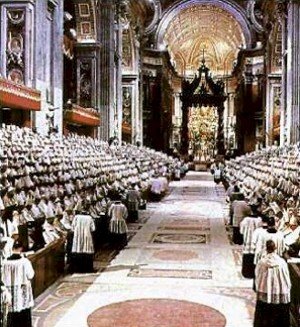
The Council he had called, with no very clear notion of what it might do, proved to be the most revolutionary Christian event since the Reformation. Despite the divided state of Christendom, it was, geographically at least, the most Catholic Council in the history of the Church: 2,800 bishops attended, fewer than half of them from Europe. Orthodox and Protestant observers attended the sessions, and substantially influenced the proceedings. The monolithic intransigence which had been the public face of the Catholic Church since 1870 proved astonishingly fragile, and over the four sessions of the Council, between 11 October 1962 and 8 December 1965, every aspect of the Church’s life was scrutinised and transformed. As at Vatican I, the Council rapidly polarised (with the help of sensational media coverage), but this time the intransigent group with curial backing were in a minority, and one by one, often with considerable bitterness, the curial draft documents were swept aside, and replaced with radically different texts, more open to the needs of the modem world, and more responsive to pastoral realities. By a supreme irony, the most influential theologians at the Council were men likeYves Congar and Karl Rahner who had been silenced or condemned under Pius XII, and their ideas shaped many of the crucial Conciliar decrees.
The central document of the Council was the Decree on the Church, Lumen Gentium. It moved far beyond the teaching of Mystici Corporis, abandoning the defensive juridical understanding of the Church which had dominated Catholic thought since the Conciliar movement, and placing at the centre of its teaching the notion of the People of God, embracing both clergy and laity. This concept moved understanding of the nature of the Church out of rigidly hierarchic categories, and enabled a radical and far more positive reassessment of the role of lay people in the life of the Church. The decree also moved beyond Mystici Corporis and all previous Roman Catholic teaching by refusing to identify the Roman Catholic Church with the Church of Christ, stating instead that the Church of Christ ‘subsisted in’ the Roman Catholic Church, and not that it simply ‘was’ the Roman Catholic Church. This apparently fine distinction opened the way to the recognition of the spiritual reality of other Churches and their sacraments and ministries. The decree’s use of the image of the ‘pilgrim people of God’ also opened the way to a new recognition of the imperfections and reformability of the Church and its structures. And in one of its most crucial and contested chapters, the decree sought to correct — or at any rate complete — the teaching ofVatican I on papal primacy and the episcopate, by emphasising the doctrine of collegiality, and placing the Pope’s primacy in the context of the shared responsibility of all the bishops for the Church.31
But Lumen Gentium was not the only revolutionary document produced by the Council. Gaudium et Spes, the ‘Pastoral Constitution on the Church in the Modern World’ (the Latin actually says ‘in this world of time’) represented a complete overturning of the Conciliar and papal denunciations of the ‘modern world’ which had been so regular a feature of the Ultramontane era. Setting out to ‘discern the signs of the times’, the Constitution embraced the journey of humanity in time as a place of encounter with the divine. It emphasised the need of the Church ‘in the events, needs and the longings it shares with other people of our time’ to discern in faith ‘what may be genuine signs of the presence or the purpose of God’. Faith is thereby presented as something which completes and seeks to understand our common humanity, not a matter of exclusive concern with a supernatural realm set over against a hostile world. The religious pilgrimage towards the ‘heavenly city’ is claimed to involve ‘a greater commitment to working with all men towards the establishment of a world that is more human’. In the wake of the Council, this emphasis would provide the charter for the development of theologies of social and political engagement, like Liberation Theology. It was one of the Council’s most profound acts of theological reorientation, and one which transcended the somewhat glib optimism of Gaudium et Spes itself, which, it must be admitted, in its concern to affirm the worth of human culture, shows little sense of the tragedy and brokenness of human history. 32
Its central emphasis, nevertheless, lay at the heart of the Council’s rethinking of Catholic theology, and was worlds away from the aggressive, hard certainties of the age ofVatican I. Then Catholics had felt that they, and they alone, knew exactly what both Church and[p.274] world were. By contrast, six months before his own election as Pope Paul VI, Cardinal Montini told the young priests of his diocese that in the Council:
the Church is looking for itself. It is trying, with great trust and with a great effort, to define itself more precisely and to understand what it is ... the Church is also looking for the world, and trying to come into contact with society ... by engaging in dialogue with the world, interpreting the needs of society in which it is working and observing the defects, the necessities, the sufferings and the hopes and aspirations that exist in human hearts. 33
Lumen Gentium and Gaudium et Spes were great acts of theological reorientation, reshaping the parameters of Catholic theology. The Council’s work on specific issues was hardly less revolutionary.The Decree on the Liturgy established a series of principles which would transform the worship of Roman Catholics, introducing the vernacular in place of Latin, encouraging greater simplicity and lay participation. The Decree on Revelation abandoned the sterile opposition between scripture and tradition which had dogged both Catholic and Protestant theology since the Reformation, and presented both as complementary expressions of the fundamental Word of God, which underlies them both. The Decree on Ecumenism broke decisively with the attitude of supercilious rejection of the ecumenical movement which Pius XI had established in Mortalium Annos, and placed the search for unity among Christians at the centre of the Church’s life. The Decree on Other Religions rejected once and for all the notion that the Jewish people could be held responsible for the death of Christ, the root of the age-old Christian tradition of anti-Semitism. Perhaps most revolutionary of all, the Decree on Religious Liberty declared unequivocally that ‘the human person has a right to religious liberty’, and that this religious freedom, a fundamental part of the dignity of human beings, must be enshrined in the constitution of society as a civil right.34
This was truly revolutionary teaching, for the persecution of heresy and enforcement of Catholicism had been a reality since the days of Constantine, and since the French Revolution pope after pope had repeatedly and explicitly denounced the notion that non-Catholics had a right to religious freedom. On the older view, error had no rights, and the Church was bound to proclaim the truth and, wherever it could, to see that society enforced the truth by secular sanctions. Heretics and unbelievers might in certain circumstances be granted toleration, but not liberty. The decree was opposed tooth and nail, especially by the Italian and Spanish bishops (the decree flew in the face of the Concordat which regulated the life of the Spanish church, and which discriminated against Protestants). Another opponent was Archbishop Marcel Lefebvre, who, after the Council, would eventually form his own breakaway movement committed not only to the pre-Conciliar liturgy but to the intransigent integralism and rejection of religious liberty which had flourished under Pius X and the last years of Pius XII.
The Decree on Religious Liberty was largely drafted by the American theologian John Courtney Murray, another of those under a cloud in the pontificate of Pius XII. It was strongly pressed by the American bishops, who felt that a failure to revise the Church’s teaching on this issue would discredit the Council in the eyes of the democratic nations. A lead had been given by the new Pope, Paul VI, during a flying visit to the United Nations in October 1963, when he spoke of ‘fundamental human rights and duties, human dignity and freedom — above all religious liberty’, a clear endorsement of the new teaching. Key support for the change also came from the Archbishop of Cracow, Karol Wojtyla, the future Pope John Paul II, who saw in the decree’s assertion of the fundamental human right to freedom of conscience a valuable weapon in the hands of the churches persecuted under communism.
On every front, then, the Council redrew the boundaries of what had seemed till 1959 a fixed and immutable system. For some Catholics, these changes were the long-awaited harvest of the New Theology, the reward of years of patient endurance during the winter of Pius XII. For others, they were apostasy, the capitulation of the Church to the corrupt and worldly values of the Enlightenment and the Revolution, which the popes from Pius [p.275] IX to Pius XII had rightly denounced. And for others, perhaps the majority, they were a bewildering stream of directives from above, to be obeyed as best they could. Many of the older clergy of the Catholic Church found themselves sleep-walking through the Conciliar and post-Conciliar years, loyal to an authority which called them to embrace attitudes which the same authority had once denounced as heresy. Pope John’s successor would have to deal with all this.
With a sort of inevitability, Giovanni Battista Montini, middle-class son of a Partito Popolare politician from Brescia, was elected to succeed John on 21 June 1963, taking the name Paul VI (1963-78). Everyone knew how crucial Montini’s insight and determination were to the shaping of the Council and the forcing through of its reforms. John had often felt outflanked by the Vatican bureaucracy, his peasant shrewdness no match for the complexities of curial filibuster and red tape. Montini, by contrast, who had worked in the Secretariat of State from 1922 to 1954, knew every inch of the Vatican and its ways, and could fight fire with fire.While still a young man he had toyed with the idea that the Pope of the future should break away from St Peter’s and the claustrophobia of the Vatican City, and go to live among his seminarians at the Cathedral Church of Rome, the Lateran, to take the papacy once more to the people. He never in fact had the daring to put this vision into practice, but it says much about his understanding of the tasks and challenges that confronted the Pope and the Council that he entertained it at all.
Yet he was emphatically no radical, and could hold the confidence of all but the most diehard reactionaries. It was up to him to steer the Council to the successful completion of its work, to oversee the implementation of its reforms, and to hold together conservatives and reformers while he did so. In the turbulent 1960s and early 1970s, when religious reform and social and moral revolution flowed together, the task was almost impossible. No pope since the time of Gregory the Great has had so daunting a task. The societies of the West were passing through a period of general questioning of structures and authority a crisis of confidence in old certainties and old institutions which was far wider than the Church. The reforms ofVatican II flowed into this general flux and challenging of values, and were often difficult to distinguish from it.
And a century and a half of rigidity had left the Church ill equipped for radical change. An institution which had wedded itself to what Manning had called ‘the beauty of inflexibility’ was now called upon to bend.The transformations of Catholicism which flowed from the Council were drastic and to many inexplicable. A liturgy once seen as timeless, beautiful and sacrosanct, its universality guaranteed by the exotic vestments and whispered or chanted Latin in which it was celebrated, was now reclothed in graceless modern vernaculars to the sound of guitars and drums. Before the Council Catholics had been forbidden even to recite the Lord’s Prayer in common with other Christians: they were now encouraged to hold joint services, prayer-groups, study-sessions.
The reform was experienced by many as the joyful clearing away of outmoded lumber, by others as the vandalising of a beautiful and precious inheritance. In addition to the signs of renewal and enthusiasm, there were signs of collapsing confidence. Thousands of priests left the priesthood to marry, nuns abandoned the religious habit, vocations to the religious life plummeted. In the exhilaration — or the horror — of seeing ancient taboos broken, prudence, a sense of proportion and the simple ability to tell baby from bathwater were rare commodities. Both the enthusiasts and the opponents of reform looked to the papacy for leadership and support. To hold this strife of voices in some sort of balance was a formidable task. Montini, who took the name Paul to signify a commitment to mission and reform, rose to the challenge, signalling both continuity and reform from the very moment of his election. He allowed himself to be crowned according to custom, but then sold the papal tiara which had been used for the ceremony, and gave the money to the poor.
Not everyone liked Paul’s methods. Determined that the Conciliar reforms should not be thrown off course, he was also determined that no one should feel steamrollered. There was to be, he declared, no one who felt conquered, only everyone convinced. To achieve this, he tried to neutralise conservative unease by matching every reform gesture with a conservative one. In a series of deeply unpopular interventions, he watered down Conciliar documents which had already been through most of the stages of Conciliar debate and approval, notably the decrees on the Church and on Ecumenism, to accommodate conservative worries (which he himself evidently shared). He gave to Mary the title Mother of the Church, which the Council had withheld because it seemed to separate her unhelpfully from the rest of redeemed humanity. He delayed the promulgation of the Decree on Religious Liberty.
This balancing act was not confined to his interventions at the Council. In 1967 he published his radical encyclical on social justice, Populorurn Progressio, which advanced beyond the generalities of Gaudium et Spes and denounced unrestrained economic liberalism as a ‘woeful system’, and called for the placing of the ‘superfluous wealth’ of the rich countries of the world for the benefit of the poor nations. This encyclical delighted the theologians and pastors of the Third World, and established Paul’s credentials as a ‘progressive’ on the side of the poor. In the same year, however, he reiterated the traditional teaching on priestly celibacy, alienating many of the same people who had acclaimed the encyclical. These contradictory gestures earned him, unjustly, the title ‘amletico’, a waverer like Hamlet.
Yet steadily he pushed the essential changes onwards: the reform of the Mass and its translation into the language of every day so as to involve ordinary people more deeply in worship; the establishment of the notion of episcopal collegiality along with the Pope, and the creation of the Synod of Bishops, which was to meet regularly to embody it. To increase efficiency and to break the stranglehold of Pius XII’s cardinals and bishops over the reform process, he introduced a compulsory retirement age of seventy-five for bishops (but not the Pope!) and decreed that cardinals after the age of eighty might not hold office in the Curia or take part in papal elections. This was a drastic measure. The average age of the heads of the Vatican dicasteries was seventy-nine: ten of the cardinals were over eighty, one was over ninety. Two of the leading curial conservatives, Cardinal Ottaviani and Cardinal Tisserant, made public their fury at their disfranchisement.
To make the central administration of the Church more representative, he hugely increased the membership of the College of Cardinals, including many Third World bishops, thereby decisively wiping out the Italian domination of papal elections. In the same spirit, he established a series of bodies to carry out the work of the Council. In particular he confirmed permanent secretariats for Christian Unity, for Non-Christian Religions and for Non-Believers as permanent parts of the Vatican administration. He was deeply committed to Christian unity, going to Jerusalem to meet the Greek Orthodox leader Patriarch Athenagoras in 1964. In the following year they lifted the age-old mutual excommunication of the Eastern and Western Churches. In 1966 he welcomed the Archbishop of Canterbury, Michael Ramsey, on a formal visit to Rome, to whom in a warmly personal but shrewdly dramatic gesture he gave his own episcopal ring. With calculated theological daring, he spoke of the Anglican and Roman Catholic Churches as ‘sister Churches’.
Paul began to travel, a new development for the modern papacy, addressing the United Nations in 1963 in a dramatic speech which greatly enhanced his standing as a moral leader — ‘no more war, war never again’ — and visiting the World Council of Churches in Geneva in 1969, the first Pope to set foot in Calvin’s city since the Reformation. In 1969 also he became the first Pope to visit Africa, ordaining bishops and encouraging the development of an indigenous church. In 1970 he visited the Philippines (where there was an assassination attempt) and Australia (where the Anglican Archbishop of Sydney boycotted the visit).
The character of Paul VI’s pontificate is perhaps most clearly revealed in the emergence under him of a new Vatican ‘Ostpolitik’, to ease the condition of the churches behind the [p.279 Iron Curtain. Despite his apprenticeship under Pope Pacelli, Paul believed that the Church’s confrontational attitude to communism was sterile and counter-productive, and he went far beyond Pope John’s personal warmth to a new policy of Realpolitik and accommodation to communist regimes. There were casualties. The symbol of the old confrontational attitude which had dominated the pontificate of Pius XII was the heroic and intransigent cold warrior Cardinal Jozsef Mindszenty, who had been living in the secular ‘sanctuary’ of the American Embassy in Budapest since the failure of the Hungarian Revolution in 1956, refusing every offer of rescue, a permanent witness against and thorn in the side of the Hungarian communist authorities. In 1971 the Americans told the Pope that Mindszenty was an embarrassment to them, preventing rapprochement with the Hungarians. The Pope ordered him to leave, and he settled in Vienna, writing his memoirs and denouncing the Hungarian regime. The Hungarian bishops told the Pope the denunciations were making life harder for the Church in Hungary. In 1973 the Pope asked Mindszenty to resign as bishop of Esztergom. He refused, on the ground that the new Vatican arrangements with the Hungarian government would give communists the final say in appointing his successor. Paul declared the see vacant, and in due course a replacement was appointed. The Cardinal never forgave this ‘betrayal’, and denounced Paul in his Memoirs. Mindszenty, like Archbishop Marcel Lefebvre, was the ghost of the pontificate of Pius XII, haunting the Church of the Second Vatican Council.
In all this, however, aspiration went further than achievement. Paul himself was often frightened by the runaway speed of change and was afraid of sacrificing essential papal prerogatives. However much he believed in the Church of the Second Vatican Council, however sincerely he fostered episcopal collegiality, he had been formed in the Church of Vatican I, and he never abandoned the lofty and lonely vision of papal authority which underlay the earlier Council’s teaching. Six weeks after becoming pope, Paul jotted down a private note on his new responsibilities. ‘The post’, he wrote;
is unique. It brings great solitude. I was solitary before, but now my solitariness becomes complete and awesome ... Jesus was alone on the cross ... My solitude will grow I need have no fears: I should not seek outside help to absolve me from my duty; my duty is to plan, decide, assume every responsibility for guiding others, even when it seems illogical and perhaps absurd. And to suffer alone ... me and God. The colloquy must be full and endless.35
This is a papacy conceived as service, not as power, but it is not a papacy conceived in terms of partnership with others. Given such a vision, and for all his good intentions, there were severe limits to the sharing Paul thought possible with his fellow bishops. Between him and them was the awesome gulf of that lonely vision, an absolute difference in responsibility and authority. The international synods of bishops would increasingly turn into talking shops, with little real power, where even the topics for discussion were carefully chosen by the Vatican. And in 1968, within three years of the end of the Council, his pontificate was profoundly damaged by the furore provoked by his encyclical on artificial birth-control, Humanae Vitae.
In the face of growing unhappiness with the Church’s total ban on all forms of artificial birth-control, even within marriage, Paul had taken the radical step of removing the question of contraception from the jurisdiction of the Council and remitting it to an advisory commission of theologians, scientists, doctors and married couples. The commission prepared a report recommending modification of the traditional teaching to allow birth control in certain circumstances, and it was widely expected that the Pope would accept this recommendation. In the event, he could not bring himself to do so, and the encyclical reaffirmed the traditional teaching, while setting it within a positive understanding of married sexuality. To his horror, instead of closing the question, Humanae Vitae provoked a storm of protest, and many priests resigned or were forced out of their posts for their opposition to the Pope’s teaching.
Paul never doubted that he had done what had to be done, but his confidence was shattered. He never wrote another encyclical, and the last ten years of his pontificate were marked by deepening gloom, as he agonised over the divisions within the Church and his own unpopularity, the mass exodus of priests and religious, and the growing violence of the secular world, signalled for him in 1978, the last year of his life, by the kidnap and murder of his close friend, the Christian Democratic politician Aldo Moro.
Paul was a complex man, affectionate, capable of deep and enduring friendship, yet reserved, prone to fits of depression, easily hurt. He was passionately committed to the Council and its pastoral renewal of the Church, yet he passionately believed also in the papal primacy, and was fearful of compromising it. Hugely intelligent and deeply intuitive, he saw and was daunted by difficulties which others could brush aside, a fact which sometimes made him appear indecisive, where another would have acted first and reflected later. He felt criticism deeply, and was acutely conscious of the loneliness and isolation of his position. His last years as pope were a sort of slow crucifixion for him, and he was often to identify himself with the suffering servant of the Prophet Isaiah, unloved, bearing the world’s woes. He did not despair. In 1975, a weary seventy-eight years old, he jotted down a series of notes on his isolation:
What is my state of mind? Am I Hamlet or Don Quixote? On the left? On the right? I don’t feel I have been properly understood. My feelings are “Superabundo Gaudio”, I am full of consolation, overcome with joy, throughout every tribulation.36 [p.282]
Tribulation had indeed become the element he moved in, yet he held the Church together during a period of unprecedented change, and there was no doubting his deeply felt Christian discipleship or his total dedication to the Petrine ministry as he understood it. More than anyone else, he was responsible for the consolidation of the achievements of the Second Vatican Council, and the renewal they brought to the Church. His funeral was conducted in the open air of St Peter’s Square, his simple wooden coffin bare of all regalia except the open pages of the Gospel book, blown about by the wind. It was a fitting symbol of the greatest but most troubled pontificate of modern times.
He was succeeded by another peasant pope, Albino Luciani, son of a migrant worker who had risen to become patriarch ofVenice. Lucian was a pope in the mould of Roncalli rather than Montini, a simple, good-humoured pastoral bishop chosen to lift the gloom that had descended during Paul’s last years. He signalled his commitment to the Council by taking the composite name John Paul, and established himself at once as a pastoral figure, opposed to all pomp, refusing, for example, to be crowned. There was universal enthusiasm for his appointment, despite his lack of experience, and the English Cardinal Hume was unwise enough in the euphoric aftermath of the Conclave to call him ‘God’s candidate’. There are in fact signs that the responsibilities of the papacy might have overwhelmed him, but there was no time to discover whether he had the stamina to cope with them or not, for just a month after his election he was found dead of a coronary embolism in the papal apartments. Sensational rumours, later shown to be groundless, suggested that he had been murdered to prevent him exposing and cleaning up financial corruption in the Vatican Bank
|
|
Pope John Paul II |
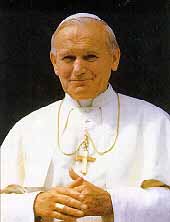
Once more the shocked cardinals assembled. They had elected a simple good man to be a pastoral pope, and the Lord had whisked him away. Was there a message in all this? General opinion called for another pastoral choice: but who? The choice of the cardinals, an overwhelming 103 votes out of 109, staggered every commentator. For the first time since 1522 they elected a non-Italian. He was a Pole, Karol Wojtyla, Archbishop of Cracow and at fifty-eight the youngest Pope since Pius IX. He took the name John Paul II. Though not widely known to the general public, he had established himself during the Vatican Council as a coming man, and had attracted some votes at the Conclave which had elected John Paul I.
A former university professor of philosophy and a published poet and playwright, a practised mountaineer and skier, a skilled linguist in French, German, English, Italian and Russian, Wojtyla was by any standards a star, with a remarkable career behind him. Son of a retired army officer widowed while Karol was still a child, he was a student at the outset of the Nazi occupation of Poland, and had served as a labourer in a quarry and a chemical factory. He was the first Pope for two centuries to have had anything approaching an ordinary upbringing — if such an upbringing counts as ordinary — and even a girlfriend. When he decided to become a priest he had to commence his studies in secret. His priestly and episcopal career had been under communist rule. He understood and was able to confront and handle the communist system. His philosophical interests were in the field of ethics and human responsibility, and he was deeply read in existentialist thinkers like the Jewish philosopher and theologian Martin Buber. Paul VI greatly admired him, and had drawn on his book Love and Responsibility in drafting Humanae Vitae.
In line with all these hopes and expectations, From the outset John Paul II pledged himself to continue the work of the Council and his immediate predecessors, whose names he took. But it was equally clear from the outset that his agenda was quite distinctive, and marked both by his philosophical concerns and by his Slav identity. Much preoccupied with the so-called ‘Church of silence’ suffering under communism, he set about strengthening it in its struggle with materialist regimes. He visited Poland in June 1979, addressing a rapturous third of the nation at meetings up and down the country. The visit helped focus national confidence in the face of a crumbling communist regime, and was a factor in the emergence of the independent union Solidarity in the following year. Papal support, both moral and, it is said, financial, played a crucial role in the success of the Solidarity movement, and Poland’s eventual transition to self-government and the end of communism there. Lech Walesa, the Solidarity leader, would pointedly sign the agreement with government which legalised Solidarity with a souvenir pen of the 1979 papal visit, sporting a portrait ofWojtyla.
But he was to be much more than a national redeemer for the Poles. Like Pius XII, Wojtyla saw the Pope as first and foremost a teacher, an oracle. In 1979 there appeared the first of a series of teaching encyclicals, Redemptor Hominis, setting out his vision of a Christian doctrine of human nature, in which Christ is seen not merely as revealing the nature of God, but as revealing also what it is to be truly human. From this first encyclical, which picked up themes from Gaudium et Spes, in the drafting of which Wojtyla had played an important part, the distinctive character of the new Pope’s Christian humanism was in evidence. He based his teaching about human dignity and responsibility not on natural law, but on the mystery of love revealed in Christ — as he wrote, ‘the name for [our] deep amazement at man’s worth and dignity is the Gospel’.37 The profundity of John Paul’s thought was quickly recognised, but so also was its markedly conservative character, and Redemptor Hominis contained a stern call to theologians to ‘close collaboration with the magisterium’ which foreshadowed tighter papal control over theological freedom within the Church.
This concern with orthodoxy showed itself especially in the field of sexual ethics. From the start of his pontificate,Wojtyla campaigned tirelessly against birth-control and abortion, [p.284] which he invariably linked, and there were recurrent rumours of a solemn statement which would endorse infallibly the teaching of Humanae Vitae. No such statement was in fact forthcoming, but his most formidable encyclical, Veritatis Splendor, published in October 1993, insisted on the objective reality of fundamental moral values, and asserted the existence of ‘intrinsically evil’ acts, which purity of intention could never make licit. Contraception was cited as one such act. Like Hurnani Generis, the encyclical was designed to reject, without naming names, a range of current theological approaches to morality. His concern with the evil of abortion expressed itself in 1995 in the encyclical Evangelium Vitae, in which he called for a ‘new culture’ of love and reverence for life, and attacked the ‘culture of death’ which he saw as characteristic of materialist societies, and of which abortion and euthanasia are the principle expression.
The uncompromising consistency of his opposition to every aspect of this ‘culture of death’, however, was to involve him and his Church in appalling moral dilemmas. The epidemic spread of HIV-Aids in Africa seemed to demand the use of condoms to prevent the transmission of the disease. But for Papa Wojtyla, the use of condoms was never justifiable, even in pursuit of an undoubted good like the halting of disease. The Church recommended chastity as the best and only protection against the disease, while highly placed Vatican spokesmen even harnessed dubious science to query the effectiveness of condoms as protection against the Aids virus. The world beyond the Church, and many within, found such intransigent teaching hard to comprehend – or to forgive.
Yet sex was by no means his main target. If Marxism dehumanized by collectivism, liberal capitalism, he believed, dehumanized by ruthless commodification, oppressing the world’s poor with un-payable debt, and turning moral agents into mere consumers. His visit to Poland in 1991 was embittered by agitation there for permissive abortion legislation, but also by the hectic growth of the trashier aspects of consumerism. Christian civilization, refined in the fire of suffering and fresh from its victory over Communism, seemed about to be sold for a mess of McDonald’s. Taking the Ten Commandments as the text for all his speeches, Papa Wojtyla shook his fist and wept at Polish crowds whom he feared were in danger of selling themselves into a new and worse kind of slavery.
John Paul’s attitude to Liberation Theology was to become one of the most controversial aspects of his theological stance. During the 1960s and 1970s theologians in Europe and the Americas increasingly gravitated towards an account of Christian salvation which emphasised the liberating effect of the Gospel not merely in the hereafter, but wherever human beings are enslaved by economic, social or political oppression: they were able to appeal for justification both to Gaudium et Spes and to Paul VI’s Populorum Progressio, The Exodus account of the deliverance of Israel from slavery, and the celebration in biblical texts like the Magnificat of a God who ‘puts down the mighty from their thrones’ and ‘lifts up the humble and meek’, were developed into a theological critique of the political and economic order which had particularly direct application in polarised societies like those of Latin America. Theologians like the Peruvian priest Gustavo Gutiérrez pressed into service Marxist notions such as ‘alienation’, and emphasised the evils of sinful economic and social structures as a form of institutionalised violence against the oppressed. In Ncaragua, Liberation Theology played a part in the Sandinista revolution, and five Catholic priests took their place in the Sandinista Cabinet, including the poet Father Ernesto Cardenal.
These emphases were taken up by many bishops and priests in Latin America during the pontificate of Paul VI, and became central to much rethinking of the nature of the Church’s mission, not least in the Society ofJesus.They alarmed Pope John Paul, however. Profoundly hostile to communism, he was deeply suspicious of the emphases of Liberation Theology, which he believed subordinated Christian concerns to a Marxist agenda. He was deeply opposed, also, to the direct participation of priests and bishops in politics, and he viewed the activities of bishops like Oscar Romero, Archbishop of San Salvador, or Evaristo Arns, Archbishop of Sao Paulo, who had thrown themselves into the defence of the poor against their governments, with a marked lack of warmth. When Romero was murdered by government assassins while saying Mass in 1980, he was acclaimed throughout Latin America as a martyr. The Pope, who had cautioned him not long before on the need for prudence, spoke of him only as ‘zealous’, and, addressing the Conference of Latin American Bishops in 1992, removed from the agreed text of the speech a reference to Romero’s martyrdom. Arns was undermined by having his huge diocese subdivided without his agreement, and the five new suffragan sees created filled with conservative bishops hostile to his social commitment.
Yet this reserve about Liberation Theology went alongside a profound suspicion of Western capitalism, signalled in a series of powerful and distinctive social encyclicals, like the denunciation in Dives in Misericordia (1980) of the ‘fundamental defect, or rather a series of defects, indeed a defective machinery ... at the root of contemporary economics and material civilisation’, defects which trap the ‘human family’ in ‘radically unjust situations’ in which children starve in a world of plenty.38 Even more explicitly, in his remarkable Sollicitudo Rei Socialis, published in 1988 to commemorate Paul VI’s Populorum Progressio, John Paul II excoriated both ‘liberal capitalism’ and ‘Marxist collectivism’ as systems embodying defective concepts of individual and social development, both of them in need of radical correction, and both contributing to the widening gap between North and South, rich and poor. He saw Catholic social teaching as something quite distinct from either, offering a critique of both, and even found space to praise the use of the concept of liberation in Latin American theology. The encyclical, which echoed the call for a ‘preferential love for the poor’, caused consternation among conservative American theologians and social theorists, used to seeing papal utterances as valuable underpinning for Western economic and social theory. 39
Nevertheless, for all these signs of ambivalence, under his pontificate conservative theological forces reasserted themselves in the Church, producing a series of confrontations between theologians and the authorities, especially the Congregation for the Doctrine of the Faith (the old Holy Office or Inquisition renamed), headed by the Bavarian Cardinal Joseph Ratzinger. Ratzinger had a distinguished record as an academic theologian, and in an earlier incarnation was one of the theological architects of the reforms ofVatican II. He had been profoundly shocked by student radicalism and the sexual revolution in Germany in the 1960s, however, as well as by what he regarded as the hijacking of genuine reform by essentially irreligious Enlightenment values.The flexibility and openness of his earlier writings gave way to a harshly pessimistic call for ‘restoration’ which suggested strong reservations about the legacy of the Council. Poacher turned gamekeeper, he presided over the silencing or disowning of a string of theologians, beginning with Hans Kung in 1979, and the reconstruction of a tight and increasingly assertive orthodoxy which has become the hallmark of the pontificate.The contrast with the pontificate of Paul VI, when even the traumatic aftermath of Humanae Vitae produced no papal denunciations or excommunications of theologians, was striking.
John Paul actively assisted in this process, most notably in his issuing of the apostolic letter Ordinatio Sacerdotalis in 1995, declaring that the debate about the ordination of women (hardly begun in the Catholic Church outside North America, and hardly an issue in most of the Third World, where the majority of Catholics live) was now closed. Christ had chosen only men as apostles, and so only men may be priests. In order that ‘all doubt may be removed’, therefore, ‘in virtue of my ministry of confirming the brethren,’ he declared that ‘the Church has no authority whatsoever to confer priestly ordination to women and that this judgement is to be definitively held by all the Church’s faithful’.The form in which this statement appeared, an ‘apostolic letter’, was several notches down in the hierarchy of authoritative papal utterances — below that, say, of an encyclical. Its phrasing, however, hinted at something more weighty — just what might be meant by ‘definitively held’, for example? In a subsequent gloss, Cardinal Ratzinger actually attempted to claim infallibility for the Pope’s statement, evoking howls of protest at a blatant attempt to stifle discussion of an issue [p.286] which many consider not yet ripe for resolution.
Pope John Paul’s suspicion of Western liberalism was in part an aspect of his Slav inheritance. From the start of his pontificate he looked East more consistently than any pope of modern times. His strong sense of Slav identity expressed itself in the conviction that the religious schism between East and West has left the Church breathing ‘through only one lung’, desperately in need of the spiritual depth and wisdom born of suffering which the Churches of the East could bring. The 1995 encyclical Ut Unum Sint on Christian unity contained an extended and hopeful discussion of the fundamental unity of the ‘Sister Churches’ of East and West (unlike Paul VI, John Paul has been careful never to apply this phrase to any Church of the Reformation). The encyclical left no doubt about the Pope’s ardent commitment to reconciliation with the Orthodox Churches. Paradoxically, however, his own exalted understanding of papal authority, combined with the reintroduction or strengthening of Catholic hierarchies of both the Latin and Byzantine rites into the countries of the former Soviet Union, has done a good deal to set back relationships with the Orthodox world. Ut Unum Sint recognised the barrier presented by the Petrine ministry, but asserted its permanent and God-given role as a special ‘service of unity’.The Pope, in a remarkable gesture, invited the leaders and theologians of other Churches to enter into a ‘patient and fraternal dialogue’ with him to discover how the Petrine ministry might be exercised in a way which ‘may accomplish a service of love recognised by all concerned’. Rueful Catholic hierarchies and theologians wondered if he wanted a similar dialogue with them.40
For Wojtyla, it was clear from the start, believed passionately in a hands-on papacy. As soon as he was elected, the flood of permissions for priests to leave the priesthood and marry dried up. Priests might leave the ministry, but with difficulty, and the Pope would not release them from their vows of celibacy: there was no mistaking in this change of policy Wojtyla’s own stern convictions. More broadly, the role of the Pope and his nuncios became absolutely central once again in Catholic thinking, and in the running and staffing of the local churches. John Paul II saw himself as the universal Bishop, and within months of his appointment he launched an extraordinary series of pastoral visits to every corner of the world, carrying his message of old-fashioned moral values and fidelity to the teaching authority of the hierarchical Church, yet with a personal energy and charisma which brought the faithful out in their millions like football fans or zealots at a rally. Asked by a reporter why he intended to visit Britain in 1982 he explained, ‘I must go: it is my Church.’ Critics deplored these paternalist visitations as disabling and absolutist, upstaging the local bishops and placing the isolated figure of the pope in the limelight. Wojtyla saw them as a distinctive and necessary feature of the modern Petrine ministry, while the actor and populist in him unfolded in the sun of popular enthusiasm. He appeared on balconies and platforms wearing Mexican sombreros, or Native American headdress. As infirmity descended on him he harnessed that too, twirling his walking cane like Charlie Chaplin’s tramp, while the crowd roared its approval. For the crowds adored him, especially the young, who rallied in their millions, responding to his demanding exhortations to generosity for Christ and chastity in an age of licence, with the chant ‘John Paul Two, we love you.’ There were an estimated five million at the World Youth Day held in Manila in 1995. By the end of his pontificate he had conducted more than a hundred such international trips, and had addressed, and been seen by, more people than anyone else in history.
His interventions extended to every aspect of the Church’s life, not least that of the religious orders. He became alarmed by the spread of radical theological opinions among the Jesuits under Paul VI’s friend, the saintly and charismatic General Pedro Aruppe. In 1981, Aruppe had a stroke, and Pope John Paul suspended the constitution of the Society ofJesus, thereby preventing the election by the Jesuits of a successor. Instead, the Pope, in an unprecedented intervention, imposed his own candidate, the seventy-nine-year-old Father Paolo Dezza, a Vatican ‘trusty’, theologically conservative and almost blind. The move was seen as an attempt to impose a papal puppet on the Society, and strained Jesuit loyalty to the limit, evoking a letter of protest from the venerable Jesuit theologian Karl Rahner. The Pope subsequently allowed the order to proceed to a free election, and publicly expressed his confidence in their work, but the intervention was recognised as a shot across the bows of an order which he felt was in danger of politicising the Gospel by over-commitment to the Theology of Liberation.
In his later years, John Paul II seemed at times more like the successor of Pius IX, Pius X or Pius XII than of John XXIII or Paul VI. An Ultramontane, filled with a profound sense of the immensity of his own office and of his centrality in the providence of God, he was convinced, for example, that the shot with which the deranged Turkish communist Mehmet Ali Agca almost killed him in St Peter’s Square in 1981 was miraculously deflected by Our Lady of Fatima. There were resonances behind this conviction that went beyond mere piety. Fatima is a Portuguese shrine where the Virgin was believed to have appeared in 1917. The apparitions and the Fatima cult rapidly became drawn into the apocalyptic hopes and fears associated with the Bolshevik Revolution and the communist attack on Christianity. During the Cold War years Fatima become a devotional focus for anti-communist feeling, and the ageing Pius XII was rumoured to have received visions of the Virgin of Fatima. Agca’s bullet was later presented to the shrine at Fatima, where it was set in the Virgin’s jewelled crown. The assassination attempt was not the only event interpreted by John Paul as a manifestation of his mystical vocation. In 1994, when, like many another old man, he fell in the shower and broke his thigh, he saw the accident as a deeper entry into his prophetic calling: the Pope, he declared, must suffer.
Suffering, indeed, offers the key to his character: the death of his mother when he was nine, of his beloved elder brother when he was thirteen, the harshness of his wartime experience as a labourer in a quarry and a chemical factory, the years of concealment, resistance and confrontation as seminarian, priest and bishop under Nazi and then communist rule. All these combined to shape an outlook half grieved by and half contemptuous of the self-indulgence of the West, dismissive of the moral and social values of the Enlightenment which, he believes, have led humanity into a spiritual cul-de-sac and have more than half seduced the Churches.
He was a hard man to measure. Sternly authoritarian, he abandoned the use of the royal plural in his encyclicals and allocutions: he is the first Pope to write not as ‘we’ but in his own persona, as Karol Wojtyla. He was also a passionate believer in religious liberty, and at Vatican II played a key role in the transformation of Catholic teaching in that area. Often seen as dismissive of other faiths, he has an intense interest in Judaism, born out of a lifelong friendship with a Jewish boy from Kracow: he was the first Pope to visit the Roman Synagogue, and in 1993 he established formal diplomatic relations with the State of Israel. His openness to other religions extends to the non-Abrahamic traditions. In October 1986 at Assisi he initiated acts of worship involving not only Muslims, but Hindus, the Dali Lama and assorted Shamans. When praying by the Ganges at the scene of Ghandi’s cremation he became so absorbed that his entourage lost patience and literally shook him back into his schedule.The uncompromising defender of profoundly unpopular teaching on matters such as birth-control, he is nevertheless the most populist Pope in history, the veteran of nearly seventy international tours, an unstoppable tarmac-kisser, hand-shaker, granny-blesser, baby-hugger. Convinced of his own immediate authority over and responsibility for every Catholic in the world, he has gone to the people, showing himself, asserting his authority, coaxing, scolding, joking, weeping, and trailing exhausted local hierarchies in his wake.
Wojtyla had a special preoccupation with the making of saints. Believing that the creation of indigenous models of holiness was a fundamental part of embedding the Gospel in the world’s cultures, he beatified and canonized local saints wherever he went, creating in all nearly five hundred saints and fourteen hundred beati or ‘blesseds’, more than had been made by all previous popes put together. This prodigal multiplication of saints alarmed many even in the Vatican, and in 1989 even Joseph Ratzinger wondered whether too many saints were being declared ‘who don’t really have much to say to the great multitude of believers’. 41 As Cardinal Ratzinger pointed out, every canonization represented a choice of priorities. The priorities in practice were often those of others, since pressure for the choice of saints often originated in the local churches rather than at Rome. Nevertheless, the lists of new saints were eagerly scrutinized for whatever signals the pope might be thought to be sending. On 3 September 2000 Wojtyla beatified Pope John XXIII, the much-loved pope of the Council. This was an immensely popular move. John’s tomb in the Vatican crypt had been constantly surrounded by kneeling pilgrims since the day of his burial, and his raising to the altars of the Church was seen by many as an overdue endorsement of Papa Roncalli’s Council and the changes it had brought. But in the same ceremony Wojtyla also beatified Pio Nono, the pope of the Syllabus of Errors and the First Vatican Council, and the symbol of an infallible papacy intransigently at odds with modernity and with secular Italy. It had originally been planned to beatify Roncalli alongside his very different predecessor, Eugenio Pacelli, Pius XII. Controversy over Papa Pacelli’s alleged silence about the treatment of the Jews during the Nazi era made this pairing impossible. Pio Nono’s cause had in fact been in process long before Roncalli’s, but canonizations are public statements, and inevitably there were many who saw the linking of these incongruously contrasting popes as an attempt to offset any advantage pro-Conciliar forces in the Church of the Third Millennium might have derived from the raising of Pope John to the altars. In all likelihood there was more than a whiff of paranoia in such fears; that they were aired at all is a sign of the tensions of the last years of the Polish pope.
For the titanic energy of Wojtyla’s pontificate had momentous consequences for the Church, not all of them good. The endless journeys, designed to unite the Church around the pope, sometimes seemed in fact to highlight divisions. The rhetoric of shared responsibility with other bishops was often belied by increasing Vatican intervention in the local churches, not least in some disastrous, and disastrously unpopular, episcopal appointments, like that of Mgr. Wolfgang Haas to the Swiss diocese of Chur. Haas, deeply conservative and very confrontational, was widely believed to have been introduced by the Vatican to promote reactionary theological views and pastoral policies. He rapidly alienated clergy and laity alike, priests applied in large numbers for transfers to other dioceses, and there were public demonstrations against him. The Canton of Zurich voted to cut off all payments to the diocese. Haas attributed all this to the fact that he was a defender of orthodoxy: ‘If one fully accepts the magisterium of the Church, an essential condition for Catholics, then one comes under fire.’ In 1990 the other Swiss bishops went to see the pope to secure Haas’ removal. He was not removed. Instead, in 1997 the Vatican adopted the extraordinary face-saving device of creating a new Archdiocese for the tiny principality of Lichtenstein (formerly part of the diocese of Chur), and transferred Haas into it.
Under John Paul, the autonomy of local hierarchies was systematically eroded. Vatican departments tightened their grip on matters formerly in the remit of regional hierarchies, including even the details of the translation of the liturgy into local vernaculars. Vatican scholars challenged the theological and canonical status of the National Conferences of Bishops, arguing that episcopal ‘collegiality’ is only exercised by the bishops gathered round the pope, never acting independently. Joint decisions of Conferences of Bishops – like those of Latin America, or the North American bishops, represent merely ‘collective’ decisions, introducing inappropriate ‘democratic’ structures into the hierarchy of the Church which have no theological standing. In all this, many saw the reversal of the devolution of authority to local churches in the wake of Vatican II.
Despite his patent commitment to the implementation of the Second Vatican Council, John Paul II threw his weight behind movements and energies which seemed to some to sit uneasily with the spirit of the Council. He gave strong personal endorsement to lay movements like Communione e Liberazione, a renewal of Catholic Action in the style of Pius XI. In particular, he gave his protection and the unique canonical status of a ‘personal prelature’, and hence exemption from local episcopal authority, to the semi-secret organization Opus Dei, founded in pre-Franco Spain by Josemaría Escrivá. Wojtyla went to pray at Escrivá’s tomb in Rome just before the Conclave which elected him pope in 1978. Escrivá’s rapid beatification (1992) and canonization (2002), against strong and vocal opposition, was a political act which made clear the pope’s identification with the spirit and objectives of the Opus Dei Movement, whose conservative theological and pastoral influence and growing backroom control over many official Church events and institutions, including even episcopal meetings and synods, caused considerable unease to some local hierarchies. More disturbing was the slowness of the Vatican under Wojtyla to grasp the scale and devastating implications of the multiple cases of sexual abuse within the Church which emerged in America, Australasia and Europe in the last ten years of the pontificate, triggering a massive withdrawal of trust and a tidal wave of legal actions.
John Paul’s last years were dogged by inexorably advancing illness which reduced the former athlete to a painfully stooped and frail figure. Parkinson’s disease froze his charismatic face into an immobile mask incapable of smiling: his left hand trembled uncontrollably. He refused to be defeated. Despite increasingly explicit speculation in the media about the possibility of a papal resignation, he soldiered on, permitting no letup in the gruelling regime of roving evangelist he had evolved for himself. The international trips went on, 104 by the time of his death, to 130 countries, covering more than a million miles, every trip a punishing round of receptions, mass-meetings and liturgies. Some, like that to Castro’s Cuba in January 1998, were of major international significance: a deal which helped Cuba in its efforts to lift the American-led blockade against it, and which, from the pope’s point of view, gave him an opportunity to secure new freedoms for the Cuban church and to carry his unswerving campaign for religious and human liberties into the last outpost of Soviet-style Communism in the West (Wojtyla secured from Castro the release of 200 political prisoners). Kept on his feet by injections administered in the sacristy before long ceremonies, the ageing pope was often visibly exhausted, stunned or dozing as his illness overcame him, yet capable of summoning his strength in astonishing returns of the old magic. The Bimillennial Holy-Year 2000 was a series of such surprises: Wojtyla drew a flood of pilgrims to Rome, and packed the year with farreaching initiatives, like the Day of Pardon he presided over, brushing aside more cautious counsels in the Vatican, at the start of Lent in March 2000. In the course of this ceremony in St Peter’s, designed to initiate a ‘Purification of Memory’ for the Church in the Third Millennium, he solemnly acknowledged and apologized for the Catholic Church’s past sins against human and religious freedoms, against the dignity of women, against the Jews. He reiterated this public act of repentance during an historic visit to the Holy Land later the same month, in an eloquent address at the Yad Vashem memorial for the dead of the Shoah, and, even more touchingly, when the stooped and trembling old man inserted into a crevice in the Wailing Wail a prayer of penitence for Christian sins against the Jews. The Holy Year had begun too, with spectacular gestures, notably the ceremony for the opening of the Holy Doors at St Paul’s outside the walls in January when Wojtyla was assisted in swinging back the door by the Protestant evangelical Archbishop of Canterbury, George Carey, an ecumenical gesture unimaginable in any previous pontificate, and a testimony to Wojtyla’s continuing ability to draw imaginative and generous responses from other Christian leaders.
He was to continue such gestures after the Holy Year had ended, for example in his remarkable visit to Greece in May 2001, which initially evoked a storm of protest from Orthodox ecclesiastics, but in the course of which the pope simply and humbly apologized before the Archbishop of Athens for Roman Catholic sins against the Orthodox churches, especially the Sack of Constantinople during the Fourth Crusade, an episode which for many Orthodox epitomized the evils of Latin Christendom. Wojtyla’s trip in June that year to the Ukraine, where historic tensions between the Orthodox Church and the five million Byzantinerite Catholics had worsened since the collapse of Communism, heartened the Catholic faithful there, but was less successful ecumenically.
In these last journeyings the pope’s frailty itself became an instrument of his mission, almost a weapon, a reproach to his opponents and an eloquent sign of the total dedication and abandonment to the will of God which he saw as the core of the Christian and above all the priestly life. But it was also a source of anxiety to many in the Church, who admired Wojtyla’s courage and fidelity, but who feared that his growing weakness left control of the central administration of the Church in the hands of the Vatican bureaucracy. Always on the move, he had never given much attention to administrative detail or Church structures, leaving such things largely to his staff. The lack of concern for detail was evident in the new procedures he authorized in 1996 for future papal conclaves, which made provision for the abandonment of the traditional two-thirds majority in the event of deadlock, and permitted election by a simple majority. Many viewed such a change as placing a weapon in the hands of any well-organized faction determined to impose a particular candidate rather than work for consensus, and thus a recipe for disaster. A more experienced papal administrator would never have agreed to it. In his old age, the authority of the Vatican Congregations grew, above all that of Cardinal Ratzinger’s Congregation for the Doctrine of the Faith, always the single most influential Vatican department and now, rightly or wrongly, widely perceived as empire-building. A case in point was the publication by the Congregation for the Doctrine of the Faith in September 2000 of a declaration on the unity and universality of Christianity, Dominus Iesus. Markedly different in tone and rhetorical impact from Ut Unum Sint, the pope’s own encyclical on this subject, Dominus Iesus was an emphatic assertion not merely of the centrality of Christ for salvation, but of the imperfection and incompleteness of all other religions. Within Christianity, it insisted on the centrality of the Roman Catholic Church. A ‘note’ on the usage ‘sister churches’ seemed to many to be designed to reverse a trend inaugurated by Paul VI, by forbidding the application of the phrase to the Church of England and other churches of the Reformation.
This document was widely understood as a restorationist attempt to halt creeping relativism in the Catholic Church’s relations with other churches and other faiths. It was issued, however, without prior consultation with the two Vatican bodies charged with direct responsibility for Ecumenism and inter-faith dialogue, and was accordingly resented. Cardinal Walter Kasper, head of the Pontifical Council for Promoting Christian Unity considered the document ecumenically disastrous, and issued a statement explaining and correcting its emphases: he described it as ‘perhaps too densely written’, a phrase which in Vatican-speak was as near to a howl of protest as protocol allowed. Kasper later let it be known that when he went to the pope with a file full of protests about Dominus Jesus from spokesmen and leaders of the other Christian churches, Papa Wojtyla seemed uncertain of the exact content of the document. The implication was clear: the pope was no longer in charge of major statements and policy decisions issued under his authority.
John Paul II’s pontificate, the longest since Pius IX and the second longest in history, will also be judged one of the most momentous, in which a pope not only once more reasserted papal control of the Church, and thereby sought to call a halt to the decentralizing initiated as a result of the Second Vatican Council, but in which the pope, long since a marginal figure in the world of realpolitik, once more played a major role in world history, and the downfall of Soviet Communism. John Paul’s own contradictions defied easy categorizations. Passionately committed to the freedom and integrity of the human person, he was the twentieth century’s most effective ambassador for such freedoms, setting his own country on a path to liberation and thereby helping trigger the collapse of the Soviet empire. Two of his major encyclicals, Veritatis Splendor and Fides et Ratio, celebrate the ability of the free human mind to grasp fundamental truth and to discern the will of God which is also the fulfilment of human nature. Yet under his rule, the last quarter of the twentieth century saw a revived authoritarianism in the Catholic Church, in which, in the judgement of many, theological exploration was needlessly outlawed or prematurely constrained. Passionately committed to reconciliation with the Orthodox, his pontificate saw an expansion of Catholi cism within the former Soviet Union which outraged Orthodox leaders and hardened the ancient suspicions he so painfully and sincerely laboured to dispel. This Polish pope did more than any single individual in the whole history of Christianity to reconcile Jews and Christians and to remove the ancient stain of anti-Semitism from the Christian imagination: his visits to the Roman synagogue and above all to the Holy Land in 2000, and his repeated expressions of penitence for Christian anti-Semitism, were imaginative gestures whose full implications and consequences have yet to appear. Yet he canonized Maximillian Kolbe, the Polish Franciscan who voluntarily took the place of a married man in a Nazi concentration camp death cell, but who had edited an anti-Semitic paper between the Wars. Wojtyla also canonized Edith Stein, the Jewish convert to Catholicism who became a Carmelite nun and died because she was a Jew in Auschwitz in 1942. The pope saw Stein as a reconciling figure. Jews saw her as an emblem of proselytization and, as in the case of Kolbe, an attempt to annex the Shoah for Catholicism. Wojtyla was not deflected from his purpose, and despite protests both canonizations went ahead.
Wojtyla’s dying was as magnificent as anything in his life. In the summer of 2004 he visited the international shrine of Lourdes. Visits to the national shrines of the Virgin were a routine feature of his apostolic journeys, but now he came to the greatest of all the shrines of Catholicism, as he himself declared, less as pope than as a sick and ailing pilgrim. His increasing immobility was both moving, and painful to watch: praying at the grotto of the apparition, he slumped forward and could not raise himself, manifestly a dying man. Over the next six months speculation about resignation or what emergency measures might be put in place if the pope were to become mentally incapable, were rampant. In February 2005 he was rushed to the Gemelli hospital in Rome with a respiratory infection which made a tracheotomy necessary: the world’s most impassioned talker was now struck dumb. Still the crowds gathered, and still he struggled to greet them. Back in the Vatican, he was unable to carry out the demanding ceremonies of Holy Week: for the first time in the twenty-seven year whirlwind of his pontificate, someone else (Cardinal Ratzinger) led the meditations on the stations of the Cross in the Coliseum on Good Friday. On Easter Sunday, the pope appeared at his Vatican window to bless the crowds and lead the midday prayer of the Angelus. A microphone was placed before him, but he struggled in vain to speak: the colossus was in chains. In the following week his condition suddenly worsened. Papa Wojtyla, the second longest-serving pope in history, died at 9.37 pm on Saturday 2 April.
His last spectacular crowd-pulling appearance now began. In the twelve hours after his death, 500,000 people flocked to St Peter’s square, and over the next week four million pilgrims, a million and a half of them from Poland, flooded into the city, queuing for up to sixteen hours at a time to file past his body. On the day of his funeral, more than a million mourners assembled in St Peter’s square and the other great squares of the city, where enormous TV screens had been placed. The funeral mass, presided over by Cardinal Ratzinger and attended by representatives of most of the world’s churches and by 140 leaders of non-Christian religions, as well as by 200 heads of state and diplomatic representatives including three Presidents of the USA, was relayed to an estimated two billion viewers round the world, making it the most watched event in history. The Prince of Wales postponed his wedding to Camilla Parker Bowles, scheduled for the same day, and attended the funeral. There was non-stop media coverage: the death of the pope, even more than his life, had become the greatest show on earth. Banners round the crowded Piazza San Pietro demanded peremptorily ‘Santo subito’ – ‘Canonize him at once.’ (It was said that the banners had been organized by the Focolare Movement.)
Wojtyla preached a craggy and at times uncomfortable Christianity, but he was neither a prude nor a pessimist. He was the first pope in history to write extensively about sex as a mirror of the life of the Godhead, even advocating that married lovers should seek orgasm together. His inaugural sermon had been a resounding affirmation of a Christian humanism, calling for a renewed world order in the light of the gospel: ‘open wide the doors for Christ. To his saving power open the boundaries of states, economic and political systems, the vast fields of culture, civilisation and development. Do not be afraid. Christ knows what is in man. He alone knows it.’ There was nothing escapistly otherworldly about his message. Believing that the Christian Gospel illuminates politics and economics as well as individual morality, he translated theory into practice by his role in the liberation of Poland. He rejected Marxism not only for its practical consequences, but for its collectivist metaphysic, which he believed ‘degraded and pulverized the fundamental uniqueness of each human person.’ His own philosophy emphasized the supreme value of free and loving moral action, in which each person realizes their own individuality. But for him such action was never the freedom to invent oneself from scratch. True liberty and happiness came from grasping the divine reality which underlies the world – ‘the splendor of truth’ – and acting in harmony with it. Truth is the hard thing, a terrible joy, obedience to which runs counter to our own desire for security. But it joins us to Christ on the Cross, that figure in which true humanity, suffering humanity, is raised for all to see, a source of resurrection, but also of more authentic existence now.
He will be remembered for many things, not least for the way in which his charismatic and authoritarian personality halted and reversed the relativization of papal power, which had been one of the most marked and most apparently irreversible transformations effected by the Second Vatican Council. Virtually single-handedly, he placed the Papacy back at the centre of Catholicism. His long pontificate meant that he left behind him a hierarchy most of whose members he had appointed: he had elevated to the Cardinalate, for example, all but two of the 115 electors who were to choose his successor. But his uncomfortable vision of the costly freedom of the Gospel is perhaps his most distinctive legacy. For all his openness to people of other faiths, he had utter confidence in the ancient teachings of Catholicism, certain that lives lived in accordance with them are the most richly human. His own excruciating perseverance in the face of crippling illness was a deliberate clinging to the cross, a witness to the nobility of suffering and the value of the weak whom society prefers to sideline. In his last years he endured publicly all the indignities and diminishments of the sick and aged, which he had once ministered to in others in a thousand encounters with the oppressed, the poor and the sick on those endless journeyings. Someone in his entourage, daunted by the sight of such sufferings, had once asked him if it made him weep. ‘Not on the outside,’ said Wojtyla.
29 Hebblethwaite, Paul VI, p. 284.
30 Hebblethwaite, John XXIII, Pope of the Council, London 1984, pp. 430– 3.
31 A. Flannery (ed.), Vatican Council II: the Conciliar and Post-Conciliar Documents, Leominster 1981, pp. 350– 432.
32 Flannery, Vatican Council II, pp. 903– 1001.
33 Cited in A. Stacpoole (ed.), Vatican II by those who were there, London 1986, pp. 142– 3.
34 Flannery, Vatican Council II, pp. 1– 56 (Liturgy), pp. 452 –70 (Ecumenism): pp. 738– 42 (Other Religions), pp. 799– 812 (Religious Liberty).
35 Hebblethwaite, Paul VI, p. 339.
36 Cited in A. Hastings (ed.), Modern Catholicism, London 1991, p. 48.
37 J. M. Miller (ed.), The Encyclicals of John Paul II, Huntington, Indiana 1996, p. 59.
38 Ibid., p. 137.
39 Ibid., pp. 442, 472.
40 Ibid., pp. 914– 77.
41 John L. Allen, The Rise of Benedict XVI, New York and London 2005, p. 200.
42 Cardinal Joseph Ratzinger, Salt of the Earth: Christianity and the Catholic Church at the end of the Millennium: an interview with Peter Seewald, San Francisco 1996, p. 73.
43 John L. Allen, Cardinal Ratzinger: the Vatican’s Enforcer of the Faith, New York and London 2000, pp. 62, 67– 9.
44 Aidan Nichols, The Theology of Joseph Ratzinger, Edinburgh 1988, pp. 100, 151.
45 Salt of the Earth, pp. 73– 8.
46 Joseph Ratzinger, Milestones: Memoirs 1927– 1977, San Francisco 1998, pp. 128, 140– 4.
47 Salt of the Earth, pp. 176– 7.
48 Salt of the Earth, p. 105.
49 Adrian Pabst (ed.), The Crisis of Global Capitalism: Pope Benedict’s Social Encyclical and the future of Political Economy, Eugene, Oregon 2011.
50 For intelligent but contrasting perspectives on this debate, Matthew Lamb and Matthew Levering (eds), Vatican II, Renewal within Tradition, Oxford 2008; John O’Malley, What Happened at Vatican II? Cambridge, Mass. 2008.
51 In October 2012 Mgr Scicluna was appointed auxiliary bishop in the Archdiocese of Malta, a ‘promotion’ widely perceived as the kicking upstairs of a man who had made Curial enemies by his efficiency and outspoken condemnation of the ‘deadly culture of silence’ which surrounded clerical sexual abuse. Scicluna himself vigorously denied that his move was a victory for his opponents, declaring that ‘If you want to silence someone, you don’t make him a bishop’.
52 Pastoral letter of Benedict XVI to the Catholics of Ireland, http:// www.vatican.va/ holy_father/ benedict_xvi/ letters/ 2010/ documents/ hf_ben-xvi_let_20100319_church-ireland_en.html para 4.
53 Peter Seewald, Light of the World: the Pope, the Church, and the Signs of the Times, London 2010.
54 Official Latin text, http:// www.vatican.va/ holy_father/ benedict_xvi/ speeches/ 2013/ february/ documents/ hf_ben-xvi_spe_20130211_declaratio_lt.html English translation, http:// www.vatican.va/ holy_father/ benedict_xvi/ speeches/ 2013/ february/ documents/ hf_ben-xvi_spe_20130211_declaratio_en.html
55 Francesca Ambrogetti and Sergio Rubin, Pope Francis: Conversations with Jorge Bergoglio, New York 2013, p. 36.
56 Paul Vallely, Pope Francis, Untying the Knots, London 2013, p. 37.
57 Jorge Mario Bergoglio and Abraham Skorka, On Heaven and Earth, Pope Francis on Faith, Family and the Church in the 21st Century, London 2013, ch. 25
58 Conversations, p. 46.
59 Vallely, Pope Francis, p. 96.
60 Full text of interview available at http:// www.americamagazine.org/ pope-interview
61 For his own sense of having ‘played Tarzan’, see Conversations pp. 71– 2.
62 On Heaven and Earth ch. 9.
63 Conversations, pp. 71– 3.
64 Text available at http:// en.radiovaticana.va/ news/ 2013/ 03/ 27/ bergoglios_intervention:_a_diagnosis_of_the_problems_in_the_church/ en1– 677269
65 Full text available at http:// www.vatican.va/ holy_father/ francesco/ encyclicals/ documents/ papa-francesco_20130629_enciclica-lumen-fidei_en.html
66 Full text available at http:// www.catholicherald.co.uk/ news/ 2013/ 07/ 27/ wyd-2013-full-text-of-papal-address-to-brazilian-bishops/
67 Conversations pp. 85– 6.
68 Text of Evangelii Gaudium available at http:// www.vatican.va/ holy_father/ francesco/ apost_exhortations/
CHAPTER THREE – SET ABOVE NATIONS
This Webpage was created for a workshop held at Saint Andrew's Abbey, Valyermo, California in 2002