|
|
Farnborough
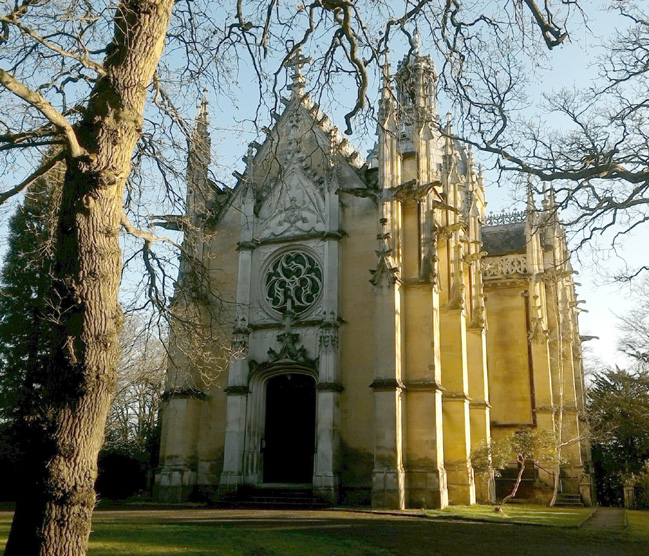
Abbey Church |
|
|
Farnborough
Abbey Church |
A. The Second Republic: 1848
(1) REVOLUTIONS OF 1848
Orléanist collapse. By February, 1848, the Orléans monarchy had for one reason or another alienated the majority of Frenchmen. Liberal reformers organized “banquets” to promote a movement for extension of the suffrage. When Premier Guizot banned these political rallies, the agitation got out of hand and the Socialists mounted the barricades. Riots ensued during which royal troops fired on the mob. A cry arose: “Louis Philippe massacres us as did Charles X; let him go join Charles X.” The “King of the French” could take a hint; as “Mr. Smith” he followed his royal predecessor into English exile, February 24, 1848.
Provisional government. The successful rebels proclaimed a Second Republic, but the provisional government reflected the heterogeneous nature of the new regime. The Revolution had not been directed against the Church, and “Catholic liberals” were popular for a time. Lamennais was elected along with Lacordaire to the legislature, and the poet Alphonse Lamartine became premier. He was, however, checked by the Republican leader Ledru-Rollin, and Louis Blanc, pre-Marxian Socialist. The latter devised a system of “national workshops,” a sort of badly managed W.P.A. for the Parisian workers, and induced the provisional government to guarantee “the right to work”: public insurance of work relief.
Bourgeois reaction. But Blanc’s attacks on private property alarmed the middle class and the peasantry. The April elections based on manhood suffrage gave these groups a majority in the new assembly. But when they decreed abolition of the “national workshops,” the proletariat rebelled in June. Sanguinary street fighting followed, during which Archbishop Denis Affre of Paris lost his life in attempting to mediate. At length General Louis Cavaignac was given temporary dictatorial powers and suppressed the insurrection firmly.
(2) COMING OF THE “PRINCE-PRESIDENT”
Presidential elections next occupied the center of the stage. Since the Socialists were discredited, and the “Catholic Liberals” too few, the contest lay between General Cavaignac and Louis Napoleon Bonaparte (1808-73), nephew of the famous Napoleon. Cavaignac was a resolute and honest soldier, but had incurred unpopularity by his stern repression of the June riots. Bonaparte, an adventurer, had the advantage of not being implicated in any of the party contests of the foregoing administration. He was profuse in references to “my great uncle,” whom he [p. 544] resembled chiefly in his campaign promises: patriots would learn the glories of a new militarism; industrialists might be certain that private property would be safe; the commoners need not fear the loss of universal suffrage won by the Second Republic. Bonaparte courted Catholics in particular, by assuring them of revision of the prevailing secularized education and support for Pius IX in his troubles with the Roman Republic. Elected deputy in September, Bonaparte successfully continued his campaign in the Chamber until the elections of December, 1848. When the votes were counted, he had 5,500,000 to Cavaignac’s 1,500,000, Ledru-Rollin’s 370,000, and Lamartine’s 17,000.
B. Bonapartist Conservatism (1848-59)
(1) THE PRESIDENCY (1848-52)
The “Prince-President” took the oath of office December 20, 1848. Though he pledged himself to maintain the Republic, his whole previous career had been devoted to restoration of his dynasty, and he continued to exploit the Napoleonic legend. Shrewdly he worked to conciliate as many groups as possible, paying at least one dividend on each of his campaign promises. Clericals were pleased by the papal relief expedition and religious instruction in the schools. Laborers heard of an old age pension. Citizens were assured that the president would defend universal manhood suffrage against any bourgeois attempts to restrict it. It was in fact on the pretext of protecting democracy against a reaction to privilege that Bonaparte assumed dictatorial powers on December 2, 1851—though not without bloodshed. Thereafter his campaign for a crown was obvious: his term of office was lengthened; military reviews in uniform were frequent; “spontaneous” outbursts of “vive l’empereur” were condoned. At length a managed plebiscite, November 21, 1852, restored the Bonapartist empire, and the following December 2, anniversary of his “great uncle’s” coronation, Louis Bonaparte proclaimed himself Napoleon III, though without explicit papal sanction.
(2) CONSERVATIVE IMPERIALISM (1852-59)
Domestic policies. Guedalla has caustically termed Bonaparte’s reign as the “tragedy of an arriviste who arrived.” 7 Once in power, Napoleon III displayed few basic policies. At first he strove to give the real benefits to the Conservatives while beguiling Liberals with promises. Liberty for education and freedom of communication with the Holy See conciliated believers. The Liberal bourgeoisie were assured that the Socialist threat to property would not return, and that the government would take full cognizance of the Industrial Revolution and of laissez-faire economic [p. 545] theory. Republicans were cajoled by lip service to universal suffrage and frequent plebiscites—as free as any Nazi election. Workingmen were encouraged by subsidies and democratic fraternization from the sovereign, while the socially talented Empress Eugénie (1826-1920) fascinated the old aristocracy. Behind this façade, Bonaparte ruled by muzzling the legislature and censoring the press.
‘Philip Guedala, The Second Empire (New York: G. P. Putnam’s Sons, 1923), p. 242.
Foreign affairs. The Napoleonic legend demanded glory and conquest, even if Napoleon III had promised, “the empire means peace.” In his efforts to fill his uncle’s far larger military boots, Napoleon III made most of his worst mistakes. At first, it is true, he seemed successful. African colonial expansion harmed no European power, and the Crimean War (1854-56) was a crusade against barbarism, autocracy, or schism—whatever each party at home might choose to call it. But the Italian question proved a two-edged sword. Napoleon wished to dominate Italy and yet please Liberals by assisting in Italian liberation; he would unite Italians without destroying the Papal State. He made halfhearted efforts to realize now one, now the other of such incompatible objectives. Though he was eventually induced to intervene, an “inspired” writer Dela Gueronniere suggested in Napoleon III et l’Italie and Le Pape et le Congrès a temporal power restricted to Rome. All these shifty maneuvers raised a storm of criticism from the right. To conciliate criticism itself, Napoleon III embarked on a “Liberal” course.
(3) CHURCH-STATE RELATIONS
Clerical influence in the state was comparatively strong during this conservative period. Napoleon III allowed his uncle’s “Organic Articles” to lie dormant; provincial councils and episcopal communication with Rome were unhampered. Cardinals were given seats in the French senate; certain clerical stipends were increased; and chaplains were named for the armed forces. Religious orders were unrestricted, Sunday observance was enforced and sacrilege suppressed, and the police confiscated antireligious books. Empress Eugénie, a practicing Catholic, contributed to the foundation of many new churches. Clericalism, then, was influential, but was also accused of being officious and avaricious. If the aristocracy and bourgeoisie gave an impression of piety, these circles were satirized as “more clerical than believing.”
Religious instruction. Bonaparte rewarded Catholics for their support in the presidential election by naming Frederic, vicomte de Falloux (1811-85) , minister of education. This ardent Catholic sponsored a bill which permitted erection of primary and secondary schools under direction of duly qualified religious or lay teachers. “Study certificates” and state examinations for diplomas were abolished, and the baccalaureate opened to pupils in seminaries and religious schools. Though Falloux [p. 546] went out of office in 1849, his successor Pariou put through what was to be known as the “Falloux Law,” March 15, 1850. This measure was deemed acceptable, if not perfect, by Bishop Dupanloup of Orléans and the comte de Montalembert, though denounced by Veuillot for what it withheld. The monopoly on education hitherto possessed by the Rationalist university was broken, some hierarchical influence on higher education was conceded, and private religious schools were authorized. Though the university still conferred degrees, Napoleon III prevented it from using this prerogative to the serious detriment of Catholics during the conservative period. It would seem by Catholic standards that the Falloux Law did much good. Within two years 257 Catholic schools had been set up, and 52 secular institutions closed for want of attendance. Councils of instruction, composed of both clerics and laymen, supervised these schools.
(4) CLERICAL CONTROVERSIES
Parties unfortunately existed within the ranks of the practicing Catholics, who were divided on issues of papal and secular government. In the Ultramontane camp, Louis Veuillot (1813-83), lay editor of the Univers, was as uncompromising and extreme in his zeal as W. G. Ward of the Dublin Review, and he sometimes confused papal infallibility with inspiration. Unlike the legitimism of Louis Pie (1815-80) , bishop of Poitiers, Veuillot, however, declared that there were no more truly Catholic princes and urged the Church to throw in its lot with the people and a democratic form of secular government. The leader of the moderates, Bishop Dupanloup, was not a Gallican, though an opportunist. Staunchly loyal to the Holy See, he endeavored yet to explain and soften intransigent papal pronouncements, and to persuade the government to cease sponsoring Italian unification.
Controversies were all too numerous. In 1850 the Gallican Archbishop Sibour of Paris promulgated conciliar decrees against meddling lay editors, with special animus against Veuillot. The latter, however, appealed to Rome and was defended by the nuncio, Monsignor Fornari, a provocative Ultramontane who placed all progressive works on the Index. Disputes resumed in 1851 when Abbé Gaume denounced the pagan classics as a menace to Catholic education, with Veuillot’s support. This time Bishop Dupanloup and others took the opposite view and gained many episcopal signatures on behalf of the indicted works. Meanwhile Archbishop Sibour and fifteen bishops issued a manifesto defending “legitimate Gallican customs,” and the archbishop condemned the Univers in 1853. Under pressure from Rome and other members of the hierarchy, Sibour withdrew his ban. In 1853 the pope approved the use of the pagan classics and gently and indirectly, but firmly, rejected all [p. 547] Gallicanism, including that of the episcopal manifesto. Assassination of Archbishop Sibour in 1857 by a disgruntled cleric and the attack on the Papal State (1859) served to unite clerical factions.
C. Bonapartist Liberalism (1859-70)
(1) LIBERAL POLITICS
Domestic Policies. About 1860, therefore, Napoleon III proclaimed that he was “liberalizing” his government and permitting criticism of his ministers by the legislature. Limited freedom of debate and of the press was conceded. At the same time Napoleon assured Catholics that he would never desert Pius IX—and did maintain a garrison at Rome until July, 1870. But some of the spirit of the Organic Articles now returned. Despite this show of Liberalism, Napoleon III was still able to have his own way in domestic affairs until 1869 when the government won its re-election by less than a million votes. Then Napoleon went the whole way toward Liberalism by conceding ministerial responsibility. With the Liberal O1ivier as his Mirabeau, he seemed to have found the right formula again, for in May, 1870, a plebiscite returned him 7,000,000 ayes to 1,500,000 nays.
Foreign affairs once again proved Napoleon’s undoing. He tried to distract French attention abroad, but now he was trying to create situations in which he might recoup his waning prestige. The Polish Revolt of 1863 afforded him a good chance to appease both Catholics and Liberals, but he hesitated too long and confined himself to protest. In Mexico he proposed collecting capitalists’ debts while installing a Catholic monarch—a double-headed venture such as always tempted him. When the anticlerical President Juarez imperiled the project, French troops had to be used to occupy Mexico. But after the Civil War the United States bluntly reminded Napoleon of the Monroe Doctrine, and the French ruler beat an ignominious retreat, leaving Maximilian to his fate. Thereafter the ailing monarch was clearly fumbling at the diplomatic controls. He turned attention to Germany where Bismarck’s Prussia loomed too large after defeating Austria in 1866. Would not Bismarck in compensation permit France to annex Belgium, or Luxemburg, or a south German state in exchange for giving Prussia a free hand in reorganizing Germany? The wily Iron Chancellor played his imperial fish until Prussia was secure, and then refused.
Imperial collapse. Against his better judgment Napoleon III took the last plunge. Yielding to 011ivier’s assurance that a firm stand was needed against Hohenzollern candidacy for the Spanish throne, he furnished provocation for Bismarck’s garbled “Ems Despatch” in such wise as to inflame public opinion in Germany and France. Urged on by Eugénie to save the dynasty, Napoleon sought to rally all Frenchmen to a war [p. 548] against Prussia. But they marched out on Bastile Day, 1870, only to surrender at Sedan in September. This was a signal for proclamation of the Third Republic, and a third French monarch sought asylum in England. Few Catholics regretted his departure, but the demagogue, Léon Gambetta, who led Paris in overthrowing Neo-Bonapartism, would presently give the new regime its war cry: “Clericalism: there is the enemy.”
(2) THE CHURCH AND LIBERAL IMPERIALISM
The temporal power. When Napoleon III in Le Pape et Le Congrès, December, 1859, had suggested that papal sovereignty might conveniently be confined to Rome, Pius IX rejected this advice in Nullis Certe, January, 1860. Publication of this encyclical by the Univers resulted in suppression of that review until 1867. Bonaparte tried to apologize, but Bishop Pie retorted scornfully: “Wash thy hands, O Pilate; posterity spurns thy justification.”
Local restrictions multiplied. In 1863 the secularist Duruy was made minister of education and began to attenuate the Falloux Law’s enforcement, while Persigny as minister of the interior imposed regulations on the St. Vincent de Paul Society and dissolved it. While the government’s favor to the Church wore thin, and religious were often criticized, Ernest Renan (1828-92) produced in 1863 a rationalist Life of Jesus which shocked France.
The Syllabus of Errors, therefore, exploded in 1864 within a tense atmosphere. Napoleon forbade its publication within France, and the Gallican Rouland indicted Ultramontanism in the French senate. To this Cardinal Bonnechose replied by deploring the placing of Gallican interests before those of the Roman pontiff, and Bishop Pie and Veuillot upheld the most extreme interpretations of the papal document. Bishop Dupanloup made a prudent distinction between “thesis and hypothesis”: the Syllabus set forth an ideal Catholic society, but adaptation to existing conditions was left to the prudent conscience of the faithful. Archbishop Darboy of Paris urged “wisdom and conciliation.” The controversy gradually died down in the public prints, though it still smoldered under the surface. Thus the last decade of the Bonapartist regime proved a transition to the open anticlericalism of the Third Republic.
Catholic life. The prelates and curés seemed by now to lack close contact with their people. Though generally zealous, they were prone to combat past errors and to resist change. Religious orders indeed increased in personnel. Yet despite many charitable works and many contemporary saints,—St. Jean Vianney and St. Sophie Barat among them —the breakdown of the Christian tradition in France seems to date from the middle of the nineteenth century. The country people tended to lose their pious traditions with their provincial dress, and parochial [p. 549] missions did not entirely halt this process. Though baptism, First Communion, ecclesiastical marriage and burial, remained conventional, Sunday observance and even Easter Duties began to be neglected by many. The anticlerical press weakened the Church’s influence among the people, and at Paris and Lyons bitter anti-anticlericalism was in evolution.
|
|
Bismarck |
A. Nationalism and
the State (1848-71)
(1) LIBERAL NATIONALISM (1848-62)
Liberal uprisings (1848-49) finally ended the surface tranquility of the Metternich System. Since 1845 there had been petitions for national autonomy in the Austrian monarchy, and demands for a constitution forced Metternich into exile. The Hungarian masonic leader, Louis Kossuth (1802-91), seized this opportunity to proclaim a Hungarian Republic, while a Pan-Slavic conference met at Prague in Bohemia. In Germany, princes were forced by other revolts either to abdicate or concede liberal constitutions. By May, 1848, Liberals and nationalists were meeting at Frankfurt to design a new German federal government. Before the end of the year this body had drawn up the “Fundamental Rights of the German Nation,” a variation of the French Revolution’s “Rights of Man and the Citizen.” During April, 1849, the Frankfurt assembly produced a constitution for a federated parliamentary monarchy, and offered the crown to Frederick William IV of Prussia, who had been one of the first rulers to concede a constitution.
Conservative reaction (1848-50), however, had set in by this time. Revolt began to lose ground where it had begun—Vienna. Here the Liberals proved to be divided among themselves regarding details of a constitution, and various subject nationalities of the Habsburg monarchy were contending for primacy. When radical leaders came to the fore, the conservative military class used the consequent disorder as a reason for counterrevolution. In June, 1848, General Windischgrätz subjugated Bohemia, dispersing the Pan-Slav Congress. In October the military aristocrat Schwarzenberg seized Vienna and made himself chancellor. After securing Ferdinand’s abdication, Schwarzenberg installed the monarch’s nephew, Francis III Joseph (1848-1916) . Claiming that Ferdinand’s concessions had been voided by the change of regime, the chancellor proceeded to restore much of the old system of government. Kossuth’s Hungarian Republic was suppressed with Russian military assistance in August, 1849, and Austrian power was restored in northern Italy. Meanwhile in Prussia the Junker, Count Brandenburg, had become chancellor and had induced the king to spurn the Frankfurt offer as a “crown from the gutter.” Frankfurt Liberals then made desperate [p. 550] efforts to set up a German Republic, but were speedily suppressed. Schwarzenberg by 1850 felt strong enough to demand restoration of the old Germanic Confederation under Austrian presidency, and the vacillating Frederick William IV feared to assert Prussian claims to leadership at the expense of civil war in Germany. Thus, Metternich’s system was in large measure restored under Schwarzenberg’s new management. Though a number of paper constitutions survived, the only real gain was the abolition of serfdom. German Liberalism had failed, and would not have another opportunity until 1918. For about a decade after these mid-century revolts, Germany remained comparatively peaceful. German princes excluded known Liberals from political life, and, indeed, nationalistic patriots were now inclined to regard Liberal aims and means as visionary. Vowed to achieve unification of Germans at all costs, they were particularly susceptible to the successful methods of Otto von Bismarck (1815-98), who became Prussian premier in 1862, proposing to act “not by parliamentary speeches but by blood and iron.”
(2) AUTOCRATIC NATIONALISM (1862-71)
Austro-Prussian duel. Bismarck was determined to unite Germany under Prussian hegemony to the exclusion of the multinational Austrian Monarchy. He approached his objective by devious ways. In 1863 King Christian IX of Denmark promulgated a common constitution for Denmark and the German state of Schleswig-Holstein which he ruled as duke. Bismarck branded this as alien aggression and summoned German patriots to repel it. Francis Joseph of Austria, the majority of whose subjects were non-German, perceived that the charge might be used against himself as well. Hence he sought to prove his German nationalism by joining Prussia in a war against Denmark. The Teutonic giants easily overwhelmed their tiny Danish neighbor and appropriated the disputed duchies of Schleswig and Holstein. Bismarck proposed joint Austro-Prussian occupation of the area, apparently in the expectation that friction would develop between the leading German powers and give an excuse for war. He proceeded to isolate Austria diplomatically: Russia was pleased at Bismarck’s offer of assistance in suppressing the Polish Revolt of 1863; Italy was promised Venice still in Austrian possession; Napoleon III was given vague hints of “compensations” in exchange for neutrality; Queen Victoria of Great Britain was reminded of her German ancestry and sympathies. When ready, June, 1866, Bismarck engineered intrigues against Austrian occupation of Schleswig-Holstein. When Austria complained to the Germanic Confederation Diet, Bismarck declared that Prussia seceded from the Confederation, and accused the Diet of virtual attack upon Prussia by sustaining Austria in a resolution. Prussian forces then launched their first modern [p. 551] blitzkrieg against Austria, and within six weeks had routed the incompetent Austrian generals. Francis Joseph hastened to conclude the Treaty of Prague, August 23, 1866, whereby he ceded Schleswig-Holstein to Prussia, Venetia to Italy, and withdrew from the Germanic Confederation, which thereupon virtually came to an end. It was the termination of four centuries of Habsburg primacy in Germany; for the first time in her history Germany was to have a non-Catholic sovereign.
Prussian leadership within the remainder of the German states was a natural corollary of its population, size and power. In punishment for supporting Austria during the recent war, Hanover—since 1837 separated from the British crown—was annexed to Prussia, and Hesse-Cassel, Nassau, and Frankfurt were also appropriated. The remaining states north of the river Main were dragooned into the new North German Federation with Prussia at its head. In the new federation the Prussian monarch as president managed foreign and military affairs, and Prussian deputies in the Reichstag could outvote the other states combined. This left outside the new Prussian-dominated federation only the southern states of Baden, Bavaria, Hesse-Darmstadt, and Wurtemberg. These Bismarck preferred to persuade than conquer. He bided his time until Napoleon III claimed his “compensations.” When the latter secretly suggested that he be allowed to annex a part of southern Germany, Bismarck had only to inform the South German states of French designs in order to induce them to conclude hasty defensive alliances with the North German Federation. After carefully prepared diplomatic isôlation of his intended French victim, Bismarck utilized the Spanish offer of a crown to a Hohenzollern prince to provoke war. He published a truncated version of diplomatic correspondence which made it appear that mutual royal insults had been exchanged between William I of Prussia and Napoleon III. The French were stampeded into declaring war on Bastile Day, 1870, but North and South Germans easily and quickly defeated the French armies, captured Napoleon and encircled Paris. During these common military successes, Bismarck had little difficulty in securing the adherence of the South German states to an enlarged Federation. On January 18, 1871, in the occupied Versailles palace, German leaders transformed the North German Federation into the “German Empire”: the second or Hohenzollern Reich (1871-1918) . King William of Prussia (1861-88) became Kaiser William, and Bismarck was his prophet.
B. Nationalism and the Church
(1) CHURCH-STATE RELATIONS
Ecclesiastical unity in Germany had already been demonstrated during the Prussian Mixed Marriage Controversy which had crossed state [p. 552] lines, and progress toward German political unification reacted upon the Church as well. Although limited state autonomy continued even under the Second Reich, so that the status of the Church varied somewhat with different constitutions and concordats with Rome, henceforth Catholic questions became chiefly national in scope. As before, no more than a survey of the developments in the leading Catholic and Protestant states can be attempted.
Austrian Concordat. With the Liberals discredited by the failure of the 1848 uprising, Francis Joseph was able to assert his personal wishes. The Revolution had swept away some Josephinist barnacles and these were not replaced. In 1850 Francis Joseph also renounced the placet by royal edict, and recognized episcopal right to inflict censures and to license theology professors in the University of Vienna. During 1851 Bishop Joseph Rauscher (1797-1875) of Seckau was instrumental in securing governmental recognition of canonical matrimonial regulations. Promoted to the archdiocese of Vienna in 1852, Rauscher was named plenipotentiary to arrange a concordat with the Holy See. This pact was concluded on August 18, 1855, and earned for Rauscher a cardinal’s hat. In general, the Concordat guaranteed the Catholic Church all of her canonical rights and privileges as the state religion. Bishops were to be nominated by the monarch after consultation with the hierarchy, and subject to papal confirmation. Possession of and free administration of church property were assured. Seminaries were placed under exclusive episcopal supervision, while the teaching of the Catholic religion became obligatory in all state schools. Religious orders were granted their freedom, the Church remained free to regulate marriage, and all contrary civil laws were declared null. Until threatened by the Austro-Hungarian Ausgleich of 1867 this Concordat regulated Church-state relations. There was a resurgence of Catholic life. The hierarchy, if learned and conscientious, tended to be quite conservative, and not overly critical of the secular regime.
Prussian toleration. Catholic freedom was the rule during the greater part of the reign of Frederick William IV (1840-61) . The 1848 constitution conceded Catholics liberty of worship, of discipline, of religious instruction, and of communication with Rome. This benign state of affairs continued for a decade. In 1858 when Prince William became regent for the ailing king, the new prime minister Anton von Hohenzollern (1858-62) was anti-Catholic in spirit and prone to denounce Catholics as unpatriotic. But when Bismarck succeeded as premier (1862-90), he at first refrained from such hostile expressions. He had been previously and was yet again to prove anti-Catholic, but for the moment the Iron Chancellor wished Catholic support for his schemes of German unification. Hence he blocked anti-Catholic legislation and even [p. 553] restrained liberals from sectarian conflict. In 1869 Bismarck ignored a petition from German journalists, demanding suppression of the monasteries. Some Catholics were probably lulled into sleep by this toleration, but events soon demonstrated that Bismarck was but delaying his Kulturkampf until all the southern German states, largely Catholic, were safely in the Second Reich.
Bavarian Febronianism revived after the deposition of Prince Louis in 1848. Prime Minister Chlodwig Hohenlohe (1866-70), whose brother the cardinal was almost disloyal to the Vatican, gave the Church much to suffer. But when he threatened religious instruction in the primary schools, the laity formed the Bavarian People’s Party which overthrew the Hohenlohe ministry in 1870.
(2) THEOLOGICAL SCHOOLS AND CONTROVERSIES
Philosophical trends. In Germany, use of modern philosophy as a basis for theological speculation had not been extinguished with Hermes, condemned by Gregory XVI in 1835 for Rationalism. In place of a rejected Scholasticism, there appeared tendencies toward Kantian subjectivism or Hegelian historicism which would eventually lead to Modernism. The Tübingen School founded by Johann Möhler maintained high standards of historical scholarship and patristic theology. Its chief representatives during the century were Johann Kuhn (1806-87) and Karl von Hefele (1809-93) . The former, a dogmatic theologian, was professor from 1839 to 1882, and the latter was historian of the Church councils and later bishop of Rothenburg. Though the school remained orthodox during the nineteenth century, there were already some tendencies in the direction of Modernism. At Munich, the great historian was Ignaz Doellinger (1799-1890), an outstanding luminary from 1826. But despite his immense learning, he was an egotistical and opinionated controversialist. If his trenchant criticism demolished many legends, it often degenerated into invective and hyper-criticism—all of which but enhanced his reputation in certain circles. One pattern is clear in his “thesis writing”: he is nearly always anti-Jesuit, anticurial, against the papal temporal power. His sarcastic and utterly one-sided exposé of Luther infuriated Protestants. Doellinger was piqued by the staunch and sometimes excessive Ultramontanism of the German Mainz School. Yet the school had intelligent moderates in the theologian Matthew Scheeben (1835-88), the historians Joseph Hergenroether (1824-90) and Johannes Janssen (1829-91), whose disciple was Ludwig von Pastor (1854-1928).
Würzburg Discussions. For the first time since the Ems Congress of 1786, the German hierarchy met at Würzburg in 1848. Even in southern Germany, Febronianism had begun to pass out of fashion, and Bishop [p. 554] Richarz of Augsburg was deemed reactionary in airing Febronian views. On the other hand, the bishops paid scant attention to Doellinger, who pleaded for a national church in his opposition to secularism. Archbishop Geissel of Cologne provided moderate and intelligent leadership in opposing the placet and the patronage system. He led the bishops in a circular to the governments which complained of secular interference in clerical training, lay education, clerical administration and bestowal of benefices. This was the first indication of a united hierarchy, capable of joining in firm and moderate demands.
Social movements. While Father Wilhelm Ketteler’s pioneer indictment of Marxism—treated separately—attracted attention at Frankfurt in 1848, at the same time Canon Adam Lenning of Mainz organized the Pius-Verein in defense of Catholic interests. During October, 1848, delegates from all over Germany held the first of periodical general meetings. In 1849 the Bonifatius-Verein was founded on Doellinger’s initiative to assist scattered Catholics in the Protestant districts of Germany; from 1850 to 1875 it received the active direction of Bishop Martin of Paderborn. The Munich Catholic Congress of 1863, however, witnessed Doellinger’s daring and ill-advised plea for the “rights of theology” and complete “liberty of movement.” Theologians from Mainz and Würzburg protested, and the meeting closed, amiably enough, but with an ambiguous compromise formula which revealed profound differences between the so-called “German” and “Roman” theological schools, i.e., Doellinger’s group and the Ultramontanes.
(3) GERMAN CATHOLIC SOCIAL ACTION
Bishop Wilhelm von Ketteler (1811-77) proved to be the outstanding Catholic social leader of the period. At first a dueling Prussian bureaucrat, he had resigned from the civil service in 1837 in protest over the arrest of Archbishop Droste-Vischering. This was his first step toward a more fervent Catholic life. In 1843 he was ordained to the priesthood and devoted himself to the poor in country parishes. Elected to the Frankfurt Assembly in 1848, he won national attention by his defense of ecclesiastical liberty. He was perhaps the first critic of Marx’s Communist Manifesto in the very year of its publication (1848) . He resigned from the parliament in January, 1849, and became provost of St. Hedwig’s in Berlin where he organized the first Corpus Christi procession since the Lutheran Revolt. In March, 1850, he was named bishop of Mainz and continued to occupy St. Boniface’s see until his death. He now flayed princely absolutism and anticlerical Liberalism alike. He excoriated the Freemasons for their secrecy and Naturalism. Socialism was rejected, but he had a positive program of social reform to put in its place—as will be analyzed later. To this end he introduced [p. 555] the Daughters of Charity and the St. Vincent de Paul Society, championed co-operatives, state relief, higher wages, shorter workingmen’s hours, abolition of child labor, and mitigation of the hardships of women workers. These ideas which he disseminated in sermons and pamphlets were to be given wider application by Pope Leo XIII in Rerum No-varum (1891) .
Adolf Kolping (1813-65), like St. John Bosco, was a workman before his ordination to the priesthood. As a priest he devoted much of his time to helping laborers. One part of his program included the provision of community dwellings—”Kolping Houses”—for young journeyman artisans. Here the workers could receive religious, vocational, and recreational helps under the supervision of a chaplain. Founded in Elberfeld in 1845, the organization opened national headquarters in Cologne by 1851, and presently followed German emigrants to the United States.
Ludwig Windhorst (1812-91) was an outstanding Catholic lay leader. He began his career of social service as chairman of the Catholic school board in Hanover, and from 1848 to 1865 he was almost continuously in office as minister or legislator. After the Prussian annexation of Hanover in 1866, Windhorst entered the Federal Reichstag. Here in 1868 he formed a coalition of minority groups wronged by Prussia and entered into alliance with the Bavarian People’s Party. Minor successes proved the utility of the venture, and in 1870 all these groups, largely but not exclusively Catholic, fused into the German Center Party with the professed aims of the defense of religion, democracy, and social justice. The Kulturkampf was to prove its strength and bring its membership up to one hundred deputies. With this strong minority bloc the Centrists safeguarded Catholic interests and cooperated in many beneficial national projects until their dissolution by Hitler in 1933.
|
|
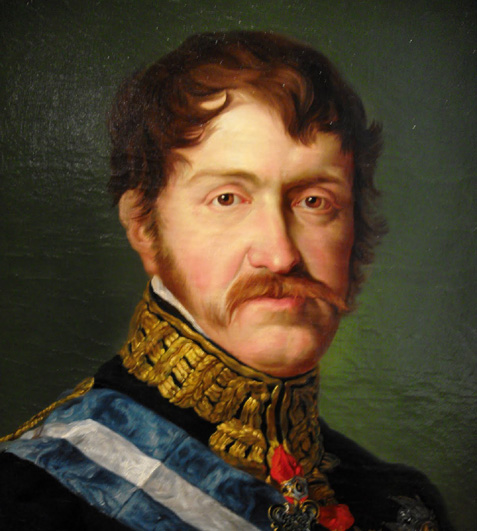
Don Carlos |
A.
Spain: 1808-74
(1) REVOLUTION AND REACTION (1808-19)
Bonapartist Revolution. After interning the Spanish Bourbon royal house at Bayonne in France during 1808, Napoleon Bonaparte had commissioned his brother Joseph to remodel the Spanish monarchy on the French state. Social and administrative changes in keeping with the ideas of the French Revolution were announced, and King Joseph suppressed the Inquisition and decreed confiscation of religious houses. While these changes were welcomed by a few Spanish Jacobins, foreign rule was something which no Spaniard would tolerate, so that Joseph had scarcely a peaceful day during his nominal reign (1808-13) . [p. 556]
Liberal resistance. From the Dos de Mayo uprising in 1808, Spanish guerillas conducted a war of liberation against the French. With British assistance they wore down and cut off French armies, and by 1813 expelled them from Spanish territory. Meanwhile a provisional junta had been set up. A Cortes met near Cadiz during September, 1810. Though opened by Mass, this assembly was dominated by Liberals from the Catalonian provinces in the absence of delegates from French-occupied Castile. Using the French Constitution of 1791 as a model, the Liberals in 1812 issued a similar document. Though Catholicity was recognized as the sole legal religion, clerical privileges were curtailed and smaller religious houses suppressed. When protests were made by the hierarchy, the papal nuncio was expelled and some bishops exiled. Subsequent electoral success by Conservatives restrained the Liberals from further measures.
Legitimist reaction. Liberal excesses had alienated many Spaniards, and former Crown Prince Ferdinand was able to regain his throne (1813-33). Though he temporized with facile promises, he was unalterably opposed to any deviation from absolutism. By 1814 he utilized a conservative reaction to abolish the constitution and arrest Liberal chiefs. Prerevolutionary conditions returned: confiscated church property was restored, the Jesuits recalled, and the Inquisition re-established. But the king displayed little prudence in government and even Conservatives dared not defend his personal morality. He set himself against any recognition of the Industrial Revolution, or any departure from mercantilist policy toward the American colonies. These colonies, left to themselves during the French occupation of Spain, were ill-disposed toward subjection, much less to absolutism.
(2) LIBERAL REPRESSION (1819-33)
Liberal triennium (1820-23) . Late in 1819 the king concentrated troops at Cadiz for the suppression of revolutions in Latin America. Liberal agitators demoralized the soldiers and in January, 1820, Colonel Riego led a successful insurrection which held the king virtually a prisoner until 1823. During the next three years Spanish history paralleled that of France between 1789 and 1792: the monarch was a figurehead, secretly intriguing for foreign intervention, while a bourgeois assembly effected a revolution. The order to proclaim the Constitution of 1812 provoked violence, and the bishop of Vich and other clerics were murdered. Liberal ministries confiscated church goods to allay financial stress, abolished the clerical tithes and banished the Jesuits. Feudal rights and distinctions were done away with. As in the French Revolution, the Radicals rapidly forged ahead and it was the latter group who ruled by 1822 through assassination and violence. [p. 557]
Autocratic reversal. Such excesses strengthened Metternich’s hand and he deputized the duc d’Angoulême, nephew of Louis XVIII of France, to lead an expedition into Spain in the name of the Quadruple Alliance. The antagonism of the Spanish nobility to the Liberal program and the loyalty of the peasants to the clergy made the invasion a comparatively easy task. After the Battle of Trocadero, August 31, 1823, had routed the Liberals, the king restored the Old Regime once more—though this time the Inquisition stayed abolished. Ferdinand VII spent the rest of his reign in taking a terrible vengeance on Liberal partisans. But the uprising enabled most of the Latin American colonies to establish their independence. Yet the king would not recognize their loss nor permit invasion of the real patronado over the sees of the revolted lands. When the Holy See reorganized the Latin American hierarchy notwithstanding, the king refused to receive the papal nuncio. Pope Leo XII warned the monarch: “Because we place bishops where you have not exercised authority for twelve years, should you threaten your loyal estates of Spain with a controversy with the Holy See? Our duties are from above.” Eventually the king acquiesced.
(3) LIBERAL ASCENDANCY (1833-43)
Disputed succession to Ferdinand’s throne undid the Conservative victory. The Bourbons had introduced the Salic Law into Spain, which had previously permitted rule by women. According to the Bourbon custom, Ferdinand’s heir was his brother Don Carlos, like the French Charles d’Artois a reactionary champion of union of “Throne and Altar.” But masonic propaganda and the scheming of Ferdinand’s fourth wife, Christina of Naples, induced the doting monarch to alter the succession in favor of his daughter Isabella (1830-1904). Accordingly when Ferdinand VII died in September, 1833, Christina assumed the regency for Queen Isabella II who nominally held the throne until her deposition in 1868.
The Carlist War (1833-40) followed when Don Carlos challenged this arrangement. To his standard rallied Conservatives, together with most of the clergy. This forced Dona Christina to turn to the Liberals, whose support she consolidated by conceding a constitution in 1837. The Liberals responded eagerly under the leadership of General Baldomero Espartero (1792-1879) . Anticlerical riots broke out in Madrid and other cities in 1834-35. Some nine hundred religious houses were suppressed by Premier Mendizabal in an “emergency measure.” The 1837 Constitution confirmed “nationalization” of clerical property and the abolition of the tithes and annates. All religious orders save the Escolapians and Hospitalers were dissolved. Bishops who protested were expelled until, by 1843, half of the Spanish sees were vacant. [p. 558]
Though Don Carlos enjoyed the support of Metternich, the advent of the Orléans monarchy in France prevented any repetition of 1823. Don Carlos tried to win the provinces by promising provincial autonomy against the Liberals’ centralizing trend. The Basques did declare for him, but in the long run sectionalist rivalry became a plague for Spain. The Liberals, on the other hand, enjoyed the powerful support of Louis Philippe of France and the British minister Palmerston. Nevertheless the struggle proved severe. No quarter was given at times and well-nigh indelible hatreds engendered. The Carlist forces broke up in dissension in 1839. Don Carlos fled to pretend abroad, and in 1840 General Cabrera surrendered the last armed forces. Don Carlos’s descendants kept up pretensions to the Spanish throne until the extinction of their line in 1936; diehard legitimists still find pretenders.
Radical Liberalism became the rule when General Espartero deposed Queen Christina and assumed the regency for himself (1840-43) . Wholesale arrest and exile of bishops and priests followed to make way for pastors enjoying the government’s confidence. By 1841 only six sees had canonical incumbents. Pope Gregory XVI denounced the government’s tactics in March, 1841, and during 1842 asked public prayers for a change in Spain.
(4) PREDOMINANTLY CONSERVATIVE ERA (1843-68)
Conservative reaction. Spaniards themselves heeded the papal request in the summer of 1843 when a coalition of Conservatives and Moderate Liberals overthrew Espartero and proclaimed Isabella II of age. Clerical exiles were permitted to return, and relations resumed with the Holy See in 1845. Protracted negotiations culminated in 1851 in a concordat with the Holy See. By its terms the Church renounced confiscated properties—estimated at nearly $200,000,000 at 1938 rates—in exchange for government subsidies for public worship and payment of clerical salaries. Canonical institution was now conceded to governmental nominations to bishoprics, and special provision was made for seminaries. Officially the 1851 Concordat remained in force until 1931, but there were numerous suspensions during Liberal relapses, and subsidies were meager and often in arrears, stationary amid rising prices.
Liberal relapse (1854-56) . When the Conservatives announced their intention of revising the Liberal constitution, the coalition dissolved. A “progressive” biennium followed, again directed by Espartero. The latter at once passed some anticlerical legislation, but when he proposed sale of all church property and discontinuance of governmental subsidies entirely, the Moderates disagreed and dismissed him.
Moderate regimes (1856-68). Succeeding governments were dominated either by the Moderate Liberal leader, General O’Donnell (1809-67) [p. 559] or the Conservative, Ramon Narvâez (1800-1868). The former, premier in 1856 and from 1857 to 1863, proposed less drastic appropriation of church property and sponsored Liberalism at home and abroad. But he had repealed Espartero’s legislation and in 1860 reached a supplementary agreement with the Holy See regarding some violations of the Concordat. Premier Narvâez arrested Liberals and sponsored political reaction. But his death and that of O’Donnell deprived Spain of experienced administrators, and the incompetent ministry of Bravo permitted another Radical revolt that overthrew the monarchy. Queen Isabella fled to France, involving in her merited discredit her long-suffering and dragooned spiritual advisor, St. Antonio Claret.
(5) LIBERAL CRISES (1868-74)
Anticlerical monarchy. After Isabella’s deposition, a regency was installed while Spain advertised for a Liberal constitutional monarch. The Cortes of 1869 proclaimed a neutral regime based on popular sovereignty, with freedom of cult, education, and press. Civil marriage was authorized, but “freedom of association” did not apply to religious orders, which were restricted. Indeed, debates on the new constitution revealed some fanatical atheism such as the plea of Suner y Capdevila: “Would that Spaniards had no religion. I intend to devote myself to the dissemination of this great teaching: War on God!” Riots, churchburnings and confiscations occurred in Madrid and elsewhere. In 1870 the vacant throne was accepted by Amadeo, younger son of Victor Emmanuel II of Italy, destroyer of the Papal States. Though endeared to Liberals by such an environment, King Amadeo (1870-73) spent himself in vain trying to reconcile Carlists, Alfonsists, Liberals, Republicans, Radicals, Clericals. Spanish patriotism had been outraged by choice of a foreign king, and in February, 1873, Amadeo abdicated in disgust and returned to Italy.
The First Republic (1873-74) was immediately proclaimed by the Radical majority in the Cortes. The Republicans, however, were divided on the degree of centralization to give the administration, and four presidents passed in rapid succession. All of the leaders of the Republic united in opposition to the Church, however, and riots and arson resumed. One of the presidents, Pi y Margall, asserted that Catholicity was outmoded both for humanity and the Spanish people. This Spaniards recognized as nonsense and Carlists took the field along with partisans of Don Alfonso, son of the deposed Queen Isabella II. For about a year a three-cornered civil war went on until the leading generals, disgusted with the anarchy, overthrew the Republic late in December, 1874.
Alfonsist restoration followed upon the handsome young prince’s magic phrase that he would be a “Good Spaniard, good Catholic, and [p. 560] good Liberal.” Proclaimed Alfonso XII (1874-85), the new king restored the 1851 Concordat with slight modifications, paid the arrears of clerical stipends, and inaugurated a moderate regime which for the most part kept on outwardly polite terms with the Church until overthrown by the Second Republic in 1931. The 1876 Constitution, in operation until 1923, proclaimed religious liberty and parliamentary government, though the latter proved more nominal than real. Liberals and Conservatives, more or less anticlerical, would rotate in power until the next major Spanish explosion in the twentieth century.
B. Portugal: 1809-1910
(1) PORTUGUESE ANALOGIES TO SPAIN (1809-34)
Revolutionary conditions. Portuguese history during the early part of the nineteenth century presented many resemblances to that of Spain. Like Spain, Portugal felt the force of French invasion, though her royal family escaped to the American colony of Brazil. During the royal absence (1807-22), Portugal became a battlefield. Bishop de Castro of Porto formed a junta to resist the French and invoked English aid. An expeditionary force was sent under Lord Beresford who exercised martial law from 1809 to 1820. British occupation authorities did not seriously interfere with the Catholic Church, but Liberals were naturally in favor.
Royal restoration. Continuance of martial law after the war incensed Portuguese patriots who expelled the English during Beresford’s absence. In 1820 a Portuguese assembly adopted a constitution similar to the Spanish charter of 1812: feudal privileges were abolished; clerical prerogatives curtailed; church property “nationalized”; and some religious orders disbanded. After freedom of the press and popular sovereignty had been proclaimed, the king was invited to return to enjoy a merely suspensive veto over a unicameral Cortes. John VI, regent since 1792 and king since 1816, returned to Portugal in 1822 after appointing Crown Prince Pedro regent of Brazil. John perforce accepted the Liberal Constitution, but his younger son, Dom Miguel, denounced the document and built up a reactionary party. Miguel succeeded in dissolving the constituent Cortes, but the king was preparing a compromise when he died.
Dynastic dispute. John’s middle-of-the-road policies had pleased neither his Liberal son Pedro nor his reactionary son Miguel. Dom Pedro had been proclaimed “Emperor of Brazil” in 1822 to avert complete separation of that colony from the Braganza dynasty, and Brazilians objected to reunion of the royal authority in one person. Dom Pedro accordingly returned to Portugal merely to abdicate the Portuguese crown in favor of his infant daughter, Maria da Gloria. After [p. 561] betrothing her to her uncle, Dom Miguel, Pedro left the regency in the latter’s hands, but exacted a promise to support the Liberal Constitution. Then Pedro returned to Brazil.
Miguelist Civil War. In 1828, however, Dom Miguel abolished the constitution and proclaimed himself “autocratic king.” Liberals were repressed and clerical support courted. There followed a protracted civil contest during which Dom Pedro was assisted by the British navy to return to Portugal from Brazil where he had left his infant son Pedro II in nominal possession of the throne. By May, 1834, the prevailing sentiment for Miguel had been overcome by force of arms, largely supplied from without. Dom Miguel went into exile on a pension, though his partisans, like those of Don Carlos in Spain, long kept up pretensions to the throne. Dom Pedro then restored the Liberal regime. Prelates favorable to Miguel were replaced by his own nominees. Clerical tithes were abolished without compensation, and religious orders declared suppressed and their properties confiscated. All secular benefices were subjected to governmental appointment. Relations were broken off with the Vatican, but Pedro’s death in September, 1834, put a halt to further attacks on the Church, a month after Gregory XVI had denounced the regime.
(2) LIBERAL ALIENATION (1834-83)
Queen Maria II (1826-53) , though personally well disposed to the Church, had great difficulty in modifying the Liberal regime bequeathed to her by her father. By 1840, however, she succeeded in replacing some of Pedro’s fanatical accomplices with more moderate Liberals, so that negotiations could be reopened with the Vatican. Even then a concordat proved impossible, and the best that could be achieved in 1841 was a limited understanding which permitted reopening of some seminaries under governmental supervision. Confiscated property was renounced by the Holy See, and canonical institution given to governmental nominees to bishoprics. But the government continued to dispose of lesser benefices, and even the administration of the sacraments failed to escape its meddling. The Church was deprived of nearly all voice in education, except that the catechism might be taught in the state primary schools. Private schools were allowed, but did not attain the success achieved in contemporary France. Finally, the whole educational system continued to be dominated by the rationalistic University of Coimbra.
Clerical conformity to Liberalism was the worst feature of the Portuguese scene during the nineteenth century. Many clerics who had been educated in government-controlled seminaries or colleges were passive or even favorable to the most flagrant manifestations of Liberalism. [p. 562]
Some prelates even co-operated in masonic functions, while ecclesiastical sodalities sometimes became virtual subsidiaries of the masonic lodges. During 1862 Pope Pius IX saw fit to protest to the patriarch of Lisbon regarding the entire Portuguese hierarchy: “No public testimony has come to prove that you have displayed in the fulfillment of your episcopal charge the vigilance and energy which are necessary. . . . Difficulties could doubtless hinder you from coming to us, but it is not less evident that nothing could hinder you from sending letters.” Yet despite this rebuke, only two bishops from Portugal were present at the Vatican Council in 1870.
Maria’s sons, Pedro (1853-61) and Luis (1861-89), effected no substantial change in this situation. They were children of Maria and Ferdinand of Saxe-Coburg-Gotha, and thus the male line of the Braganza dynasty ceased to rule in Portugal, though continuing in Brazil until the revolution of 1889. The advocates of Dom Miguel and his descendants accordingly renewed their agitation, and like the Spanish Carlists struck a discordant note in politics. Religious apathy continued. Introduction of the Daughters of Charity was followed by a masonic campaign of abuse until the king was obliged to demand their recall. When Luis in 1872 attempted to give legal recognition to some religious orders, Liberals, and Masons—who often displayed their lodge insignia openly in parliament—forced him to desist. Some religious continued to work in Portugal and her colonies without legal sanction, but the Goa schism in Portuguese India revealed considerable insubordination to the Holy See even among the missionaries, while the crown refused to surrender its patronage claims.
(3) PARTIAL AMELIORATION (1878-1903)
Pope Leo XIII (1878-1903), however, witnessed some improvement in the condition of the Church in Portugal. During 1883 a new modus vivendi was reached regarding seminaries, henceforth subjected to episcopal supervision. Dioceses were rearranged, some of them combined, and revenues of prelates reduced, thus removing a temptation to worldly noblemen. In 1886 the crown ceded some of its excessive patronage claims, and permitted the Holy See to reorganize the missionary hierarchy. As in France and Spain, Pope Leo urged Catholics to avoid mixing religion with politics, and to unite in defense of ecclesiastical interests. During 1895 a Catholic congress at Lisbon explored projects for social reform, though it must be admitted with slight results. In 1901 there was some renewed persecution of religious, eliciting a papal rebuke in 1902. Portuguese Catholics would have done well to heed the pope’s renewed exhortation to unity, for the anticlerical Republic was at hand. [p. 563]
This Webpage was created for a workshop held at Saint Andrew's Abbey, Valyermo, California in 2002